Cellular Respiration overview
Glycolysis
Pyruvate
Citric Acid/Kreb's Cycle
Electron Transport Chain
ETC protein depth
ATP Synthase
100
What is Cellular Respiration and what are the 4 components of it?
Cellular respiration is the oxidation of glucose(and other fuel molecules) to generate useful energy. The four components of Cellular Respiration in order are: Glycolysis, pyruvate oxidation, Citric Acid/Kreb's Cylce, and Oxidative Phosphorylation.
100
What os the definition of Glycolysis(what is happening)?
The splitting of 1 six carbon glucose molecule into two 3 carbon pyruvate molecules.
100
What is Pyruvate?
What is pyruvate's formula?
Pyruvate is the end product of glycolysis and feeds into both fermentation and cellular respiration(if oxygen is present).
Molecular formula: C3H3O3-
Structural Formula: CH3COCOO-
100
Is the Citric Acid Cycle an exergonic or Endergonic Reaction?
What Reactions are being Coupled?
Which compounds are being reduced and which oxidized?
1. Exergonic
2. Malate---> oxaloacetate
NAD+ ---> NADH
3. Malate is oxidized to oxaloacetate, NAD+ is reduced to NADH.
Look on slide 28, how can we tell? 5pt. bonus
100
What is the Electron Transport Chain? What does it do?
15 pt. bonus: What type of phosphorylation is the ETC?
The Electron Transport Chain(ETC) is a series of redox reactions that allow the stepwise transfer of electrons to capture energy at multiple points. The ETC harvests energy of reduced NADH and FADH2.
The ETC is oxidative phosphorylation.
100
What is happening in Complex I of the ETC?
NADH & FADH2 donates their electrons. Transport of electrons through this complex is coupled to proton pumping. When Complex I accepts the high free energy electrons from NADH, the proteins in the complex increase in free energy. Then when complex I becomes oxidized by donating these e- down the chain, the complex uses this drop in free energy to power the movement of H+ up its concentration gradient.
100
What is Chemiosmosis?
Chemiosmosis is the diffusion if H+ ions through the coupling of electron transport and ATP production.
200
How much ATP can a Glucose Molecule produce?
32 ATP
200
What is the full equation for glycolysis. Which are the starting compounds, which are the prodcuts?
5 pt. bonus if can name the NET ATP/NADH per glucose molecule
Full: C6H12O6(glucose) + 2ATP + 4ADP + 4Pi + 2NAD+--> 2NADH + 4ATP + 2 Pyruvate + 2ADP + 2Pi
Net: 2ATP, 2NADH
200
What is the full equation for Pyruvate Processing?
What are the starting material? What are the Products?
5pt. bonus if can name the NET products per glucose.
Full: (2)Pyruvate + 2CoA(Coenzyme A) + 2NAD+ --> (2) Acetyl-CoA + 2CO2 + 2 NADH
Starting material: (2)Pyruvate + 2CoA(Coenzyme A) + 2NAD+
Products: (2) Acetyl-CoA + 2CO2 + 2 NADH
Net: 2NADH
200
What is the full equation for the Citric Acid Cycle?
What are the starting material? What are the Products?
5pt. bonus if can name the NET products per glucose.
Full: (2)Acetyl-CoA + 6NAD+ + 2ADP + 2FAD--> 4CO2 + 6NADH + 2ATP + 2FADH2
Starting material: (2)Acetyl-CoA + 6NAD+ + 2ADP + 2FAD
Products: 4CO2 + 6NADH + 2ATP + 2FADH2
Net: 6NADH + 2ATP + 2FADH2
200
What is the full equation for the Electron Transport Chain?
What are the starting material? What are the Products?
5pt. bonus if can name the NET products per glucose.
Full: 10NADH + 28ADP + 2FADH2 + oxygen----> 10NAD+ + 28ATP + 2FAD
Starting material: 10NADH + 28ADP + 2FADH2 + oxygen
Products: 10NAD+ + 28ATP + 2FAD
NET: 28ATP per glucose molecule
200
What is happening in Complex II of the ETC?
Why doesn't the donor electron carrier Complex II has not donate to complex I?
Complex II allows FADH2 to donate electrons to the ETC. FADH2 does not donate to complex I because the electrons it has do not have sufficient free energy to pump protons compared to NADH. Thus, fewer H+ protons are pumped compared to NADH as well.
200
What is ATP synthase?
ATP synthase is when energy falls from the electrons down the ETC and is used to pump H+ into the intermembrane space, creating a proton gradient across the membrane.
ATP synthase uses chemiosmosis to generate ATP.
300
Define Anaerobic and Aerobic? Which processes of cellular respiration are which?
Anaerobic processes are processes that do NOT require oxygen, while Aerobic processes require oxygen. Glycolysis is the only cellular respiration process that is Anaerobic, while the others: pyruvate processing, citric acid cycle, and Electron transport & Oxidative Phosphorylation are all Aerobic.
300
How many reactions occur in glycolysis? What are the three phases of Glycolysis(in order).
Glycolysis includes 10 reactions in three phases: Energy Investment Phase, Energy Payoff/Cleavage Phase, and Net phase(extracting usable energy).
300
1.Where does the carbon dioxide come from?
2.How many of the original carbons in one glucose are in the form of acetyl CoA after this reaction?
1.The carboxyl group on pyruvate(must break it off).
2. 4(2x2)
300
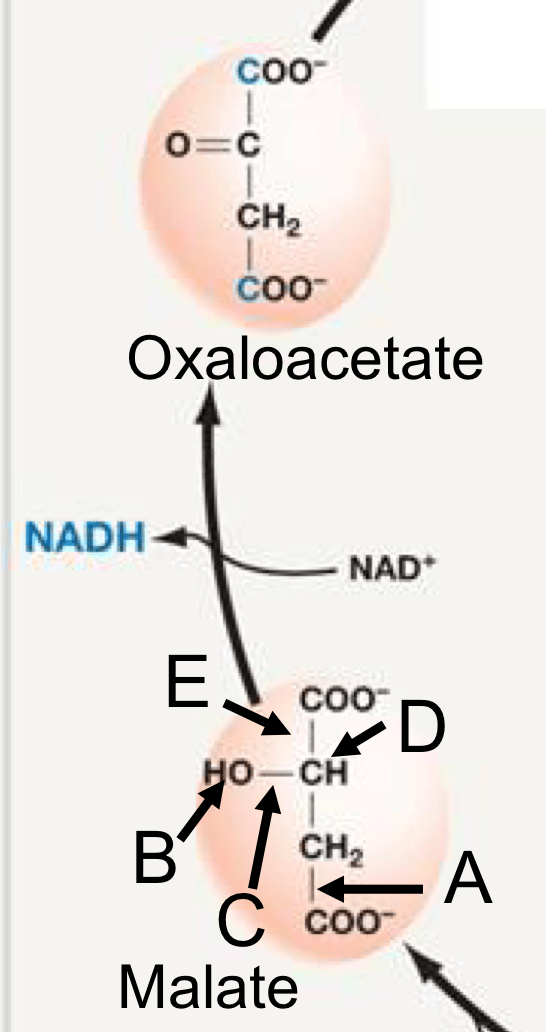 Which bond are the high free energy electrons donated to NAD+ coming from?
Breaking of a np covalent bond; specifically the CH bond(D).
300
What is the ETC comprised of? Where is the ETC located again?
The ETC is located in the inner membrane of the mitochondrian(alt. name membranes of cristae).
The ETC is comprised of 4 large protein complexes : Complex I, II, III, and IV.
300
What is happening in Complex III?
Complex III and IV accept the high free energy electrons from Coenzyme Q(ubiquinone) and Cytochrome c (Cyt c), in which the proteins in the complex increase in free energy. Once the complex becomes oxidized by donating these e- further down the chain, dropping in free energy to power the movement of H+ up its concentration gradient from the matrix to the intermembrane space.
300
What is Pi?
Inorganic Phosphate(i.e. just phosphate).
400
Where do the steps of cellular respiration occur in prokaryotes?
All steps(Glycolysis, pyruvate processing, Citric Acid Cycle, and Electron transport and Chemiosmosis) occur in the Cytoplasm and plasma membrane for prokaryotes.
400
What is Substrate Level Phosphorylation?
Using a chemical substrate to add a phosphate to ADP to make ATP- this takes energy OUT of G3P.
400
Where did the high free energy electrons donated to NAD+ come from?
The top most C-C bond. *must be specific*
Discussion 8, slide 2
400
How much ATP is produced by substrate level phosphorylation?
How much NADH is produced when NAD+ is reduced, how much FADH2 is produced when FAD is reduced(these amounts are per acetyl CoA).
How much CO2 is released per turn?
1 ATP produced by substrate level phosphorylation.
3 NADH produced and 1 FADH produced.
2 CO2 produced per turn( 4 in total)
400
Does free energy decrease or increase during the ETC? What is the final electron acceptor?
Free energy progressively decreases through the ETC.
Oxygen is the final electron acceptor.
400
What is happening in complex IV?
Electrons originally stripped from carbohydrates and carried by NADH or FADH2 are donated to the ETC and travels down it to finally be accepted by O2 which is the reduced form of H2O.
400
What is the total ATP yield per glucose?
Where are the 4 ATP generated?
32 total ATP yield
2 ATP generated from Glycolysis other 2 generated from the Citric Acid Cycle.
500
Where does Glycolysis, Pyruvate processing, the citric acid cycle, and Oxidative phosphorylation & Electron transport & Chemiosmosis take place?
Glycolysis occurs in the cytosol. Pyruvate Processing and the citric acid cycle occur in the mitochondrial matrix. Electron Transport and Chemiosmosis occurs across the inner mitochondrial membrane.
500
What is happening during each stage of glycolysis?
800 pts.
Phase 1: Glucose consumes ATP to turn to Glucose 6-phosphate and gets 2 ADP as a byproduct; then glucose 6-phosphate turns into Fructose 6-Phosphate and uses ATP again to turn it Fructose 1,6-biphosphate with 2ADP as a byproduct again.
Phase 2: Cleavage of the 6-carbon glucose derivative into two 3 carbon sugars. The two(G3-P) molecules will be oxidized to pyruvate in the third phase.
Phase 3: The bulk of the reactions happen in this phase, overall ATP is synthesized by substrate-level phosphorylation and NAD+ is reduced to NADH.
More info on slides 11,12,13, and 17.
500
Overall what is happening during Pyruvate Processing/Oxidation?
Pyruvate is converted to Acetyl-CoA producing reduced electron carriers(NADH + H+) and CO2 along the way.
Slide 23
500
What is the Citric Acid(Krebs) Cycle?
How many times does it run/turn?
The Citric Acid(Krebs) cycle extracts energy from Acetyl-CoA, and is a serious of redox reactions with multiple intermediates transferring the chemical energy in acetyl-CoA to coenzymes.
The CAC turns/runs twice per every Glucose molecule, from which each turn uses one Acetyl-CoA
500
The multiple steps of ETC allow energy to be collected at multiple points, how?
By generating ATP and high energy electron carriers: NADH and FADH2
500
1.When Complex I is reduced, what happens to its free energy.
2.What happens when a complex accepts electrons?
3. What happens when a complex donates electrons?
4. What is complex oxidation?
1. Increase in its free energy occurs(slide 36)
2. It becomes reduced(RIG) and increases in free energy
3. it becomes oxidized(OIL)
4. Complex oxidation is an exergonic reaction that can power H+ pumping(an endergonic reaction).
500
What is the energy Hierarchy if Molecules?
1. Glucose 2. G3P(Glyceraldehyde 3-phosphate)
3. Pyruvate 4. Acetyl-CoA
5. NADH 6. FADH2
7.ATP 8. O2