Plant development
Floral organ specification
ABC model
Flower Genotyping
100
Why is the mustard weed the best studied model for plant development?
It is a simple flowering plant, it has a small genome size, it is small in size, and has a six week generation time.
100
What is it called when mutants of one organ type is replaced by another?
What are the organs of flowers called?
Homeotic
Whorls
100
Define the ABC model.
What do all the ABC genes code for?
The combination of A, B, and C activities in each whorl determining which floral organs develop from that whorl.
All ABC genes code for regulatory transcription factors.
100
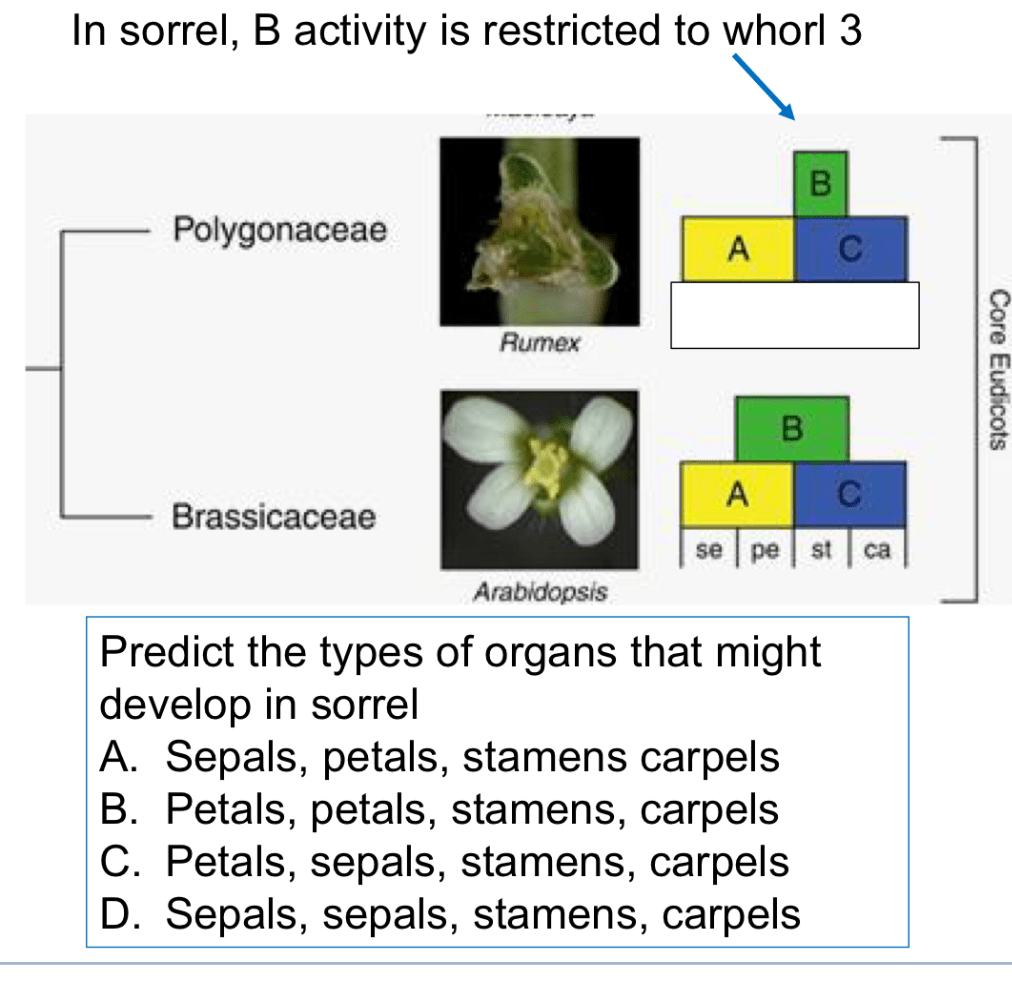
The correct answer is D(Sepals, sepals, stamens, carpels).
200
Which parts of the plant are Stem cells, which are embryonic tissues?
Shoot apical meristem(SAM) and Root apical meristem(RAM) are stem cells. Epidermis, Ground tissue, and vascular tissue are embryonic tissues.
200
What wild- type gene is required for sepal and petal specification?
What wild- type gene is required for Stamen and petal specification?
What wild- type gene is required for Stamen and carpel specification?
Wild-type A. Wild-type B. Wild-type C
200
Which genes(or combination of genes) code for each organ?
Which two genes are transcribed in every whorl?
A codes for sepals, Genes A&B code for Petals, Genes B & C code for Stamens, and gene C codes for carpel.
A & C are the two genes transcribed in every whorl, but the phenotype they give off is not apparent in every whorl unless a mutation has occurred.
200
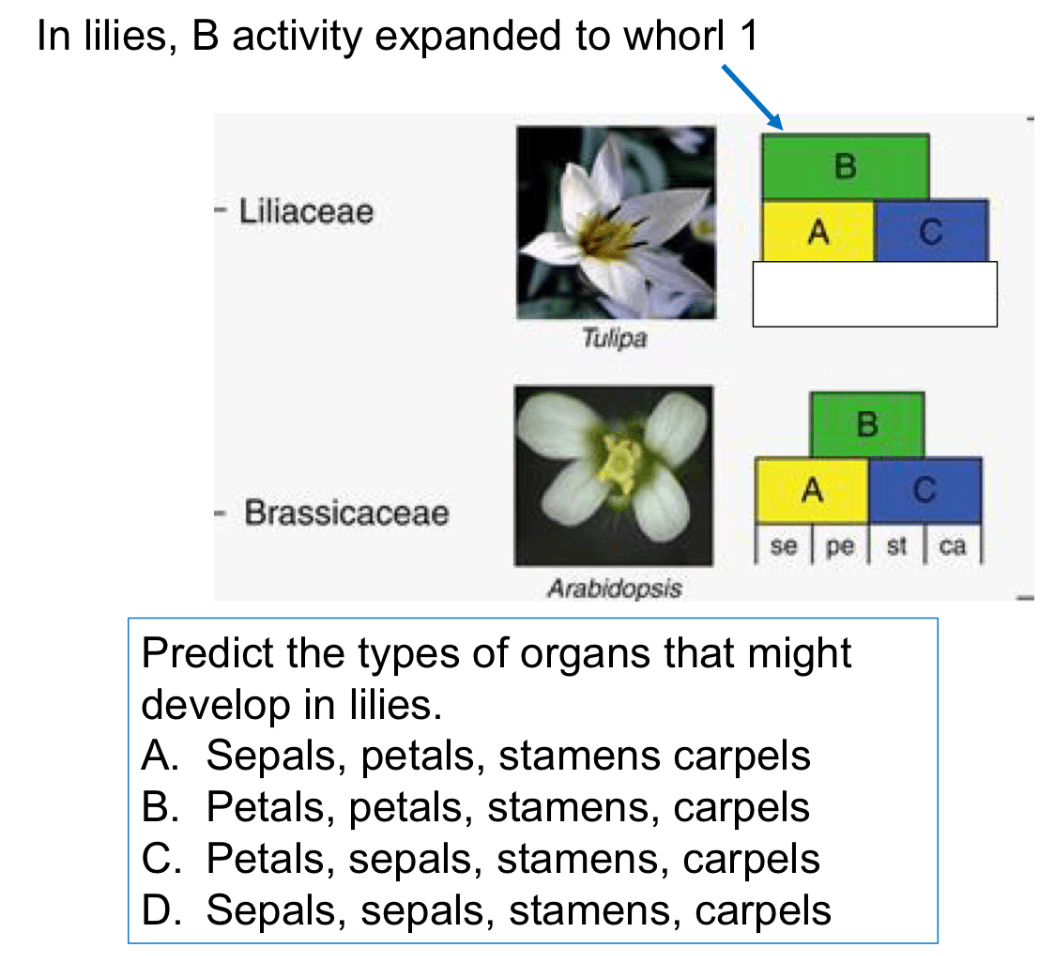
Correct answer is B(Petals, petals, stamens,carpels)
300
What do meristems do?
Meristems provide continuous growth and development. Once embryonic development is complete, further development of the plant body is driven by the meristems that contain endlessly dividing stem cells.
At the meristems, stem cells continually produce new organs and tissues.
300
Define inference.
Inference: the wild type version of the gene is necessary for the proper development of the missing or disrupted organ.
300
What two genes are antagonist against each other? How do they block each other?
Both A & C have antagonism against each other. Both A & C experience this because they are both capable of being transcribed in all 4 whorls because of a "flower enhancer".
A protein DIRECTLY inhibits C gene transcription by binding to a SILENCER on the C gene.
C protein INDIRECTLY inhibits A activity by binding to an ENHANCER on a miRNA that inhibits A mRNA translation.
300
1. What phenotypes would develop if there is Loss of function mutation in Gene C?
2. What phenotypes would develop if there is Loss of function mutation in Gene A?
3. What phenotypes would develop if there is Loss of function mutation in both Gene B and Gene C ?
1. Sepal, Petal, petal, sepal
2. Carpel, Stamen, stamen, carpel
3., Sepal, Sepal, Sepal Sepal
400
What are some differences between plant and animal development?
*Plant growth and development takes places without cell migration which is typically seen in animals.
*Plant embryonic structures take shape because cell divisions occur in precise orientations and the resulting cells exhibit differential growth.
* Nearly all plant organs are formed post-embryonically.
400
How many whorls of organs are there in flowers? What are they and what do they do?
There are 4 whorls of organs in flowers: Whorl 1-Sepals, Whorl 2-petal, Whorl 3-Stamen, and Whorl 4 Carpel.
Sepals enclose and protect the flower. Petals attract pollinators. Stamens are the male gametes. Carpels are the female gametes.
400
Define Positive feedback. Why is it important?
Positive feedback is a regulatory process where a change in a system triggers responses that amplify that same change, pushing the system farther in the same direction rather than stabilizing it.
Positive feedback is important in developmental settings to create very distinct differentiated cells even though they are in proximity to one another.
400
Describe the genotype where all 4 whorls of the flowers develop into stamens.
Loss-of-function mutation in gene A. Expression of gene B & C in every whorl
500
Describe Reproductive development in plants.
Unlike animals, plants don't have germ cells that are set aside early in development. Instead, flowering and gametogenesis occurs when a shoot meristem converts from vegetative development(leaves) to reproductive development.
Most plants are hermaphrodites, but some have separate males and females. To prevent inbreeding, most plants have evolved mechanisms to limit self-fertilization.
500
The floral meristem of plants, consist of four concentric whorls of tissue, and the development of these whorls is dictated by the genes A, B, and C. Which of the following would you expect to be the same in all four whorls of tissue?
a) Regulatory transcription factors
b) DNA methylation patterns
c) mRNA transcripts
d) genes expressed
e) enhancers
e) enhancers. DNA will be the same.
500
How do we visualize mRNAs by RNA in situ hybridization?
1. Start w/ single stranded DNA or RNA probe, complementary in sequence to the target mRNA. 2. add label to the probe so you can see where the probe goes. 3. Preserve the specimen. 4. Treat preserved cells or tissues to make them permeable to probe. Add many copies of probe. 5. Probe binds to target mRNA. Labeled probe that does not bind to target mRNA is excess and washed away. 6. target mRNAs are concentrated in the anterior end of the embryo- label shows up.
500
Where is Morgan from?
Detroit!