Neural Tissue
Spinal Cord, Nerves, Reflexes
Brain
Sensory Pathways and the
Somatic Nervous System/
Neural Integration
Somatic Nervous System/
Neural Integration
100
Draw the branches of the nervous system starting with the overall nervous system as the most basic and the parasympathetic/sympathetic as the most specific
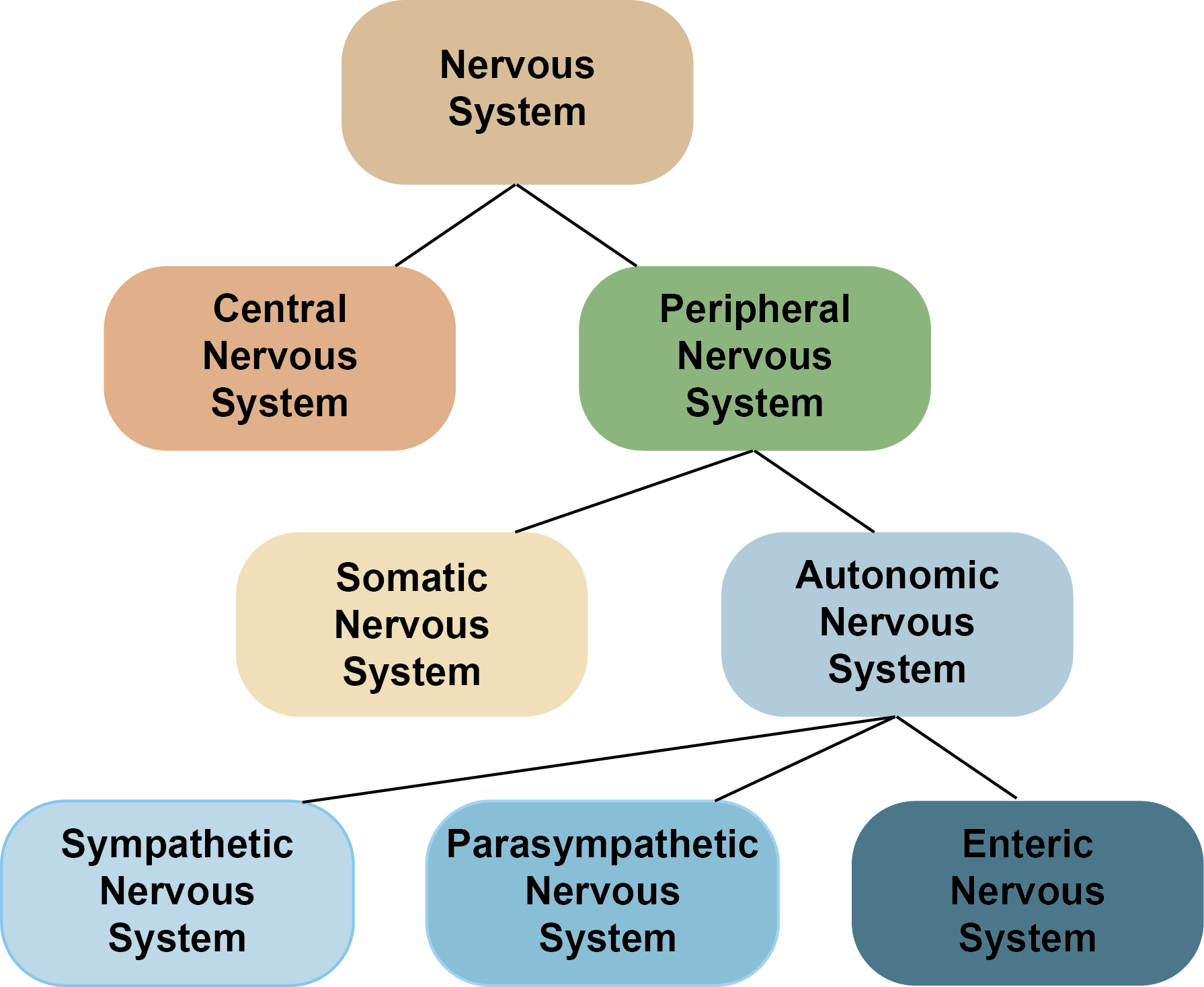
100
These neurons carry sensory information to the brain. (Alternate name for sensory neurons)
Afferent neurons
100
What are the four lobes of the brain?
frontal, occipital, parietal, and temporal
100
Which type of receptors are crucial in regulation of autonomic function? (2 answers)
baroreceptors and chemoreceptors
200
Oligodendrocytes are to the central nervous system as _______ are to the peripheral nervous system.
Schwann cells
200
Name the layers of meninges from outermost to innermost. Be specific.
dura mater -> arachnoid mater -> pia mater
200
What is the labeled structure g and its function?

medulla oblangata; Relays sensory information to thalamus and to other portions of the brainstem; Autonomic centers for regulation of visceral function (cardiovascular, respiratory, and digestive system activities)
200
Define what the receptive field of a neuron is. The ability of the brain to distinguish two points as different stimuli is known as ______________.
area in body that detects stimuli for a specific sensory neuron. two-point discrimination
300
Give one example of an excitatory neurotransmitter and an inhibitory neurotransmitter (must be different).
E: Acetylcholine (Ach), dopamine, glutamate,
serotonin
I: GABA, dopamine, serotonin.
300
Which of the 4 nerve plexi supplies the sciatic nerve?
sacral plexus
300
What type of waves are found in an EEG during intense concentration?
beta waves
300
The _______ spinothalamic tract carry pain and temperature sensations. They decussate through the ____________ (structure).
lateral; anterior white commisure
400
These 2 types of ion channels and active transporter are involved in action potential propogation. Name all 3 of these proteins. Be specific
voltage-gated sodium and potassium channels
Na-K ATPase
400
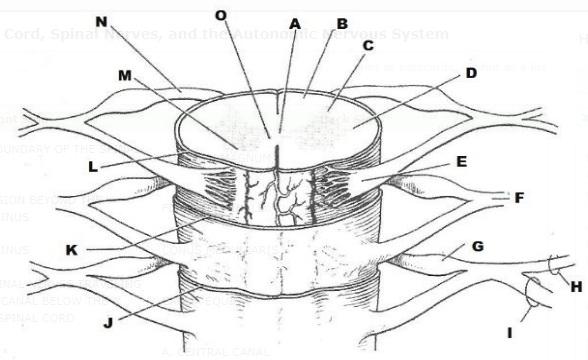 What is the name of the structure marked by G, and what kind of information does it carry?
dorsal root ganglion; sensory information
400
which part of the hypothalamus regulates circadian rhythms?
suprachiasmatic nucleus
400
Which one sensory pathway does not experience decussation at all?
posterior spinocerebellar tract
(only part of the anterior corticospinal tract does not decussate)
500
Describe the events in synaptic transmission of a cholinergic synapse. Start with the arrival of depolarizing stimulus at axon terminal and end with breakdown of Ach in the synapse at the end.
An arriving action potential depolarizes the axon terminal membrane of a presynaptic neuron.
Depolarization of the axon terminal membrane opens voltage-gated calcium ion channels, and calcium ions (Ca2+) enter the cytosol of the axon terminal. This results in ACh release from the synaptic vesicles by exocytosis.
ACh diffuses across the synaptic cleft and binds to receptors on the postynaptic membrane. Cation (Na+, K+) channels open, producing a graded depolarization due to Na+ inflow.
Depolarization ends as ACh is broken down into acetate and choline by AChE. The axon terminal reabsorbs choline from the synaptic cleft and uses it to resynthesize ACh.
500
What are the events in a reflex arc from beginning to end? Begin with stimulus and end with response.
Arrival of stimulus and activation of specific sensory receptor. Activation of sensory neuron. Information processing in CNS integration center or interneuron. Activation of motor neuron. Response by peripheral effector.
500
Name at least 1 function of the limbic system and at least 3 components of it.
Establishes emotional states; Links conscious functions of cerebral cortex with autonomic functions of brainstem; Facilitates memory storage and retrieval
thalamus, hypothalamus, cingulate gyrus, dentate gyrus, parahippocampal gyrus, fornix, amygdaloid body, hippocampus
500
List 3 tactile receptors found in skin and what they detect.
free nerve endings: pain, touch, pressure , temp
root hair plexus: hair movement
tactile discs: fine touch and pressure
Ruffini corpuscles: pressure of deep dermis
Pacinian corpuscle: deep pressure and high-freq vibration
Meissner corpuscle: fine touch, pressure, and low-frequency vibration