Rhythms & Road Maps
Intervals & Accidentals
Minor & Other Scales
Music History Eras
Orchestras & Instrument Families
1
In a simple meter like 2/4 time, what is one standard counting syllable pattern we used to feel the duration of two standard eighth notes?
Ti-Ti
1
Which accidental symbol is used to raise a note by one half-step (if it is starting as a natural note)?
Sharp (#)
1
The Natural Minor scale is structurally equivalent to which mode, formed by starting and ending a major scale on its sixth degree ("La")?
Aeolian mode
1
Which historical period of Western music is characterized by the earliest surviving written monophonic chants, the growth of sacred vocal polyphony, and church-driven notation development (c. 900–1400)?
Medieval Period
1
How do woodwind and brass instruments fundamentally differ in how they physically produce sound in an ensemble?
Woodwinds vibrate air using edge-blown mouthpieces or reeds (single/double), while brass produce sound through the performer's buzzing lips in a tube.
2
When a rhythm consists of a dotted quarter note followed by an eighth note in 2/4 time, what is the standard counting syllable pattern we learned?
Ta-(i)-Ti
2
When counting staff steps to determine an interval number (such as a third), what rule must you always follow regarding the starting note (in other words, what number do you start your count on)?
1
2
Where must the two half-step (m2) intervals always fall within a Natural Minor (Aeolian) scale for it to maintain its characteristic sound?
Between the second and third notes, and between the fifth and sixth notes.
2
Which technological invention around 1450 revolutionized the Renaissance musical landscape by enabling mass production of affordable sheet music and instruction books for the middle class?
The printing press
2
Which historical development in 1814 permanently transformed brass instruments by enabling them to easily access a full chromatic range of notes?
Valves
3
What is the specific duration breakdown of a dotted quarter note in 2/4 time relative to eighth notes ("Ti"s) -- in other words, how many eighths notes are equal to a dotted quarter note?
3
3
Which 4 intervals are classified as a Perfect interval according to the standard interval rules we've looked at so far?
1, 4, 5, 8
3
When a major scale and a minor scale contain the exact same set of key signature notes and differ only in which note serves as the tonic, what is their relationship called?
Relative
3
Which landmark 1607 theatrical work by Claudio Monteverdi is recognized as the first "real" opera, specifying exact instrumental timbres and serving as a precursor to the modern orchestra?
L'Orfeo
3
Within a standard symphony orchestra seating layout, which instrument family traditionally occupies the largest physical space closest to the conductor?
Strings
4
When encountering the musical symbol known as a fermata over a note in a score (such as in the sea shanty "John Kanaka"), what does it instruct the performer to do?
Hold this note as long as you want
4
What is the quality of this third?
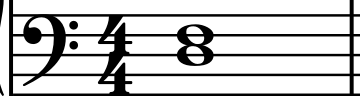
Minor
4
What modification correctly describes how a Harmonic Minor scale is constructed starting from a Natural Minor scale base?
Raising the seventh note of the scale by one half-step, which creates a m3 jump between the sixth and seventh notes.
4
Which defining musical and artistic traits were central to the Baroque Period (1600–1750)?
Functional major/minor harmony, continuous "spinning" melodies, and "terraced dynamics"
4
Despite being chordophones (producing sound via strings), where are instruments like the piano and harp typically seated and classified within the operational structure of a symphony orchestra?
Percussion family.
5
When a performer encounters the navigation instruction D.S. al Coda in a piece of sheet music, what is the correct sequence they must follow?
Go back to the Sign, play forward until reaching the Coda symbol, and then skip ahead directly to the Coda Section to finish.
5
Say you have the following Minor 2nd:
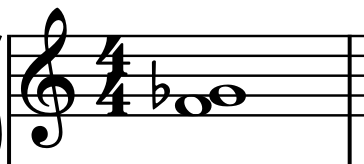 What must you do to the TOP note in order to make it a Major 2nd?
Make it a G natural.
5
How does the Melodic Minor scale behave differently when played ascending versus descending?
It raises both the sixth and seventh notes on the way up, but lowers them back down on the way down (returning to Natural Minor descending)
5
The Classical Period (1750–1820) was heavily influenced by the "Age of Enlightenment." Which stylistic goal dominated its music?
Light, balanced, symmetrical "gallant styles" emphasizing formal clarity, noble simplicity, and calm grandeur
5
What is the primary artistic and technical role of the conductor standing in front of a modern orchestra or large ensemble?
To act as ensemble leader/decision-maker, translate printed sheet music into a living performance during rehearsals, keep time, indicate meter/tempo, and give visual emotional cues.
6
What is the precise structural difference between navigating a D.C. al Fine versus a D.S. al Coda?
D.C. al Fine goes back to the absolute beginning (Da Capo) and stops at "Fine", whereas D.S. al Coda goes back to the Sign (Dal Segno) and jumps to a Coda section.
6
Say you have the following Major 3rd:
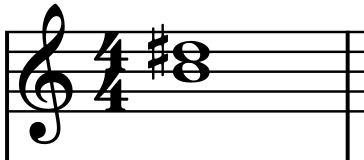 What must you do to the BOTTOM note in order to make it a Minor 3rd?
Make it a B#
6
How many total pitches are contained within a single octave of a whole-tone scale?
7
6
Which sweeping cultural and technological shifts defined the 20th Century in Western art music (1900–1945 and post-WWII)?
Rapid artistic revolutions, rejection of traditional tonality, incorporation of global world music influences, and the advent of magnetic tape and electronic synthesizers
6
What distinguishes a chamber ensemble from a large symphony orchestra?
Chamber ensembles feature smaller groups where all parts have equal individual importance.