Unit 1: Marathon Runner -Homeostasis & Feedback Mechanisms
Unit 2: Humans vs Bacteria - Natural Selection and Interdependence
Unit 3: Evolution of Sick Humans - Genetics and Protein Synthesis
Unit 4: Saving the Mountain Lion - reproduction and genetic variation
??? Random ???
100
Feedback Mechanisms are the mechanisms(things that do things) that help us maintain homeostasis because they let us ___________ and ____________ to environmental stimuli. This feedback helps us adjust our body to combat changes that disrupt homeostasis.
Sense/recognise/notice/become aware of, Respond/react/take action
100
In Unit 2: Humans Vs Bacteria we learned about the evolution of populations of bacteria. What did you learned from a model organism's population to help you better understand bacterial populations?
Hint:mice
Responses may include: +5
- Mice are a familiar species to us, whose populations we can easily see and study.
- We learned that when the environment changes, populations must adapt.
- we learned that certain traits allow for better chances of survival than others and get passed on to offspring during reproduction.
- This topic applies to all organisms. Bacteria are organisms.
100
Where is a model of DNA located in the classroom, what does it look like/what is the shape called, and what are the 4 bases?
3D DNA models hang in the room and are seen on posters hanging in the room.
A double helix (twisted ladder)
ATCG
100
Why did the mountain lion from the Unit 4 story travel 1,000+ miles to find a mate?
All of the female lions in his area were related to him and he wanted to mate with a lion who is not similar to him, to increase genetic diversity and avoid inbreeding.
100
What is our Room number?
241
200
The things in the body (usually found in the hypothalamus) that are responsible for getting all sorts of signals or messages from environmental stimuli are called ____________?
Receptors !!! are receptive to the signals they recieve
200
How does LactAse work? What is it and what does it do?
Lactase is an enzyme (protein) made by the body, lactose is a disaccharide (2-part) sugar molecule that the enzyme binds to and breaks into 2 separate sugars (glucose and galactose) +5
200
These two steps have to happen in order for DNA to be used as a template for building proteins outside of the nucleus (at the ribosomes)
Hint: T&T
Transcription
Translation
200
Why would introducing a mountain lion from a place far away help reduce inbreeding in the area where the lion from the story lives?
Hint:Does heterozygosity increase or does homozygosity increase. WHY? HOW do you know?
Bringing in a new mate brings in new genes to combine with the male during reproduction and heterozygosity increases in the offspring. We calculated the frequency of heterozygosity and saw it went up. We calculated the inbreeding coefficient and saw it went down.
200
How many minutes long is one class period?
44 minutes I'm pretty sure
300
Humans aren't the only organisms capable of sensing and responding to the environment. This is something all living things do and is actually a requirement for something to being classified as "living."
As a group or "one-man-act", act out 1 way plants react to changes their environment. Someone MUST narrate. Actors ARE silent!!! no props obtained from farther away than reaching distance, sorry, sit down.
Hint a: Gas Exchange
Hint b: Circadian Rhythms
It has to make sense
300
Explain: populations of organisms survive, reproduce, and over long periods of time/many generations, eVoLuTion CAN occur. Explain how/why bacteria might evolve over time.
Hint: what is the selective pressure in their environment? What does it cause to happen?
populations of organisms can only evolve over time if these occur…
(1) there is potential for the population to increase in number
(2) there is heritable (able to be passed on in DNA) genetic variation (variety of traits) between individuals (due to sexual reproduction and/or random mutations)
(3) There is competition for limited resources (ex. not enough food where the population lives)
(4) the proliferation(rapid increase) of those organisms that are better able to survive and reproduce in the environment.
Responses may vary +5
- antibiotics drive evolution through natural selection
- bacteriophages drive evolution through natural selection
300
List the following terms from biggest to smallest:
Person organ base organelle
organ system cell chromosome
DNA gene base pair
Person, organ system, organ, cell, organelle, DNA, chromosome, gene, base pair, base
300
What type of cells pass on genetic material to offspring?
sex cells/ egg&sperm/ the gametes
300
What do 12AM and 12PM look like on an analog clock? (the little and big hands point where)
Hint: a broken clock is still right 2 times a day
both hands point to 12. AM/PM is not told to you. AM starts when you should be asleep. PM starts at lunch time/noon. Look out a window.
400
Describe how 3 body systems work together
Reminder: body systems include Digestive System, Circulatory System, Integumentary System, Reproductive System, Excretory System, Immune System, Musculoskeletal System, Respiratory System, Endocrine System, Cardiovascular System.
Responses may vary +5
400
Fill in the blanks: Kanna tried milk and got sick. This is because she didn't inherit the helpful hereditary trait called ___________ ______________. Unlike her friend Alissa, her body does not continue producing the enzyme she needs to breakdown (AKA _ _ _ _ _ _ ) the disaccharide sugar in her milk. Instead her gut bacteria get to "eat" it and make gas in her digestive tract :(
Kanna's hereditary material (fancy word for the _ _ _ she got from her parents) contains sections of unique combinations of the chemicals A,C,T,G. Sections that code for specific traits are called coding _ _ _ _ s. There are also sections called non-coding - - - -s (parts that don't direct the production factory in your cells AKA the ribosomes, instead they do mysterious things like keep - - - - s "switched" _ _ . )
LactAse Persistence +10
Digest
DNA
Genes gENES gENES
ON
CONGRATULATIONS: you have unlocked "That was hard. DANCE BREAK." If YOUR team gets this whole thing right and YOU read this out loud so I can hear YOU reading it, you get to pick ONE 3 minute or less SCHOOL APPROPRIATE song for us to listen to on the YouTube (yes you have to say the Youtube.)
400
Protein synthesis is important because it builds things in the body. Enzymes like lactase are made of proteins. If a person has the gene for making lactase and the mutation to keep the gene on, they continue making lactase as an adult.
Explain this in detail using the following vocab words: DNA, Gene, code, transcription/translation, amino acids, proteins.
HINT: 
Your DNA might have a gene for lactase and that code can be used during transcription and translation to make amino acids, which fold into proteins. 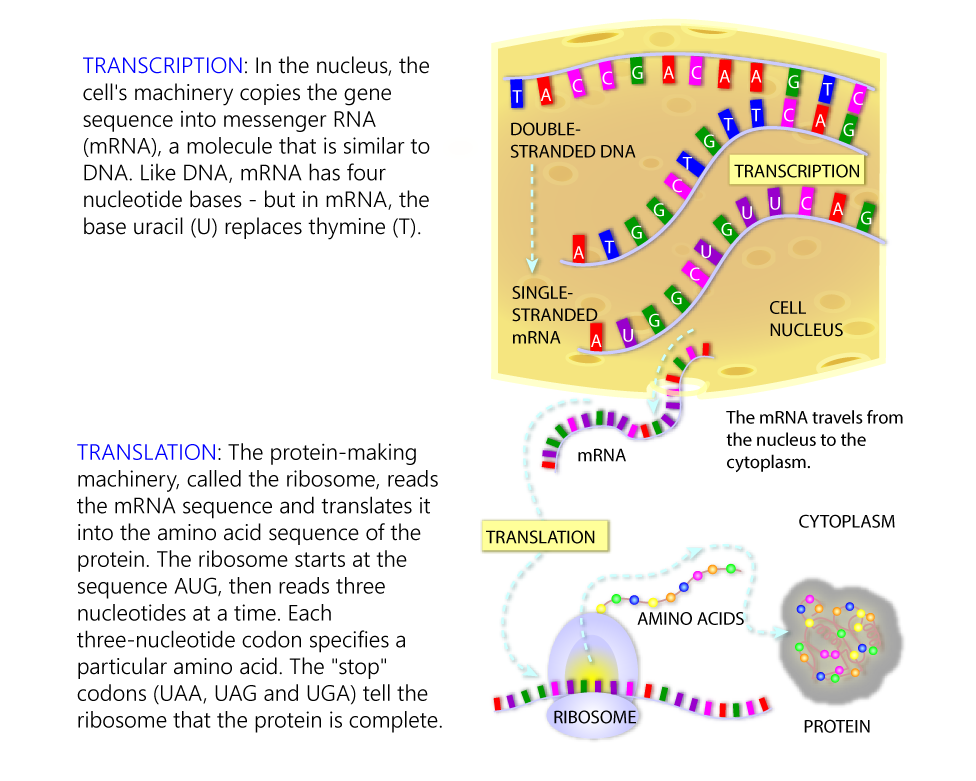
400
Teach the class about Osmosis. If you mess up as the teacher you skip your turn. The class hasn't been taught unless you can provide sufficient evidence that they learned something. Without enough evidence to support your claims of amazing success, I will tell you you're just lucky (your teaching skills are correlated to but not causing good grades). To do this you will need to quiz everyone on what you taught them between when I say GO and when I say STOP. You have 1 minute to meet with me for help. Everyone else, please behave as you normally would on a Monday after a 2 week break. (:
Pass/Fail no arguing or you are disqualified from these points
500
M: Cellular Respiration involves inputs and outputs. Photosynthesis also involves inputs and outputs. How are these chemicals/molecules cycled between humans and plants? Explain using at least one complete sentence.
+5
- they both involve the same exact set of chemicals/types of molecules and...
- they are opposites. in for one = out for the other, out for one = in for the other. Meaning...
- etc
500
Humans and bacteria coexist. Humans rely on bacteria to help with things like digestion, bacteria rely on humans for a place to live. This is a symbiotic relationship (both benefit). How did bacteria drive the evolution of humans AND how did humans drive the evolution of bacteria during The Black Death story?
Bacteria kill off the less fit humans (people with weak immune systems) leaving the more fit individuals to survive and produce offspring who are also immune. Human’s immune systems fight off and kill the less fit bacteria and leave the resistant to survive and reproduce more resistant offspring.
+10
500
How do mutations affect protein synthesis and the body's ability to function?
Mutations change the DNA sequence so codons are not read properly and proteins are not made or are made incorrectly, which causes them not to function, which causes the body not to function properly.
600
Thermoregulation helps your body to maintain a "normal" or set range of internal conditions. Draw a simple line graph (X/Y axis labeled, set point labeled, 1 data line drawn) to show Thermoregulation taking place in your body throughout one day (24 hours).
Hint: draw the "Set Point" as a dashed or dotted line across your graph and label it "set point", then add a solid line to show hypothetical body temp. data. The Homeostatic temperature range of humans = ~98.6* +/- 2ish degrees
X and Y axis are drawn (no labels ok), single solid line fluctuates a tiny bit up/down about the labeled set point (98.6*).
*extreme fluctuations, ie. going from 0* to 200* is not acceptable. You would die. I will accept logical temp changes only.
600
Humans and bacteria are just two examples of organisms that can be affected by natural selection. What is another example of natural selection affecting an organism? Name the organism, the selective pressure in the environment, and what happens over time to the population due to selective pressure.
Results may vary
600
Mutations are one way new traits can come about in a population. Another way is through genetic recombination during sexual reproduction, as seen below using pea plants as an example. What percent of pea plants are likely to be Green after the two parent plants are bred, according to statistical probability. How do you know?
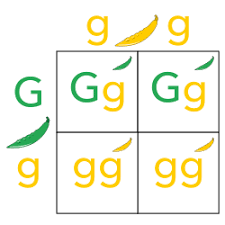
50% because green is a dominant trait that covers up the recessive yellow trait
EX. If 100 plants are produced, about 50 would be green and 50 would be yellow.
700
When your brain senses that you are becoming dehydrated, hormones tell your __________s (lima bean shaped organs that you have 2 of) to reabsorb ________ back into the bloodstream instead of peeing it out. This means your pee looks more ___________(color). This helps us maintain osmotic(water) balance.
kidneys, water, dark/yellow +5
700
Which statement BEST describes traits of a fit organism being passed down from one organism to the next during survival and reproduction?
a) if an organism survives to it’s reproductive age, then it is likely that advantageous traits will be passed down during reproduction via genetic recombination. Half of the chromosomes (that are found in sex cells/gametes) from the parents combine randomly: 23+23=46 new chromosomes.
b) disadvantageous traits are passed down to offspring because organisms do not want them. Organisms choose which traits they inherit.
c) if an organism survives to reproductive age, advantageous traits are passed down through proteins which tell cells to make DNA and traits. Traits come from codes in the DNA because different cells hold only certain codes.
d) disadvantageous traits are are passed down through body cells while advantageous traits are passed down through sex cells. 50% are advantageous and 50% are disadvantageous to the offspring.
a) +5
700
 What codon(s) code for the amino acid Leucine (L) as seen on the codon chart above?
CU- U,C,A,G
UU- A,G
x6 codons
800
Fully and accurately explain, going one image at a time, all of the pieces of information that this model is trying to communicate with us. Base your response on what you see below and what you know already. 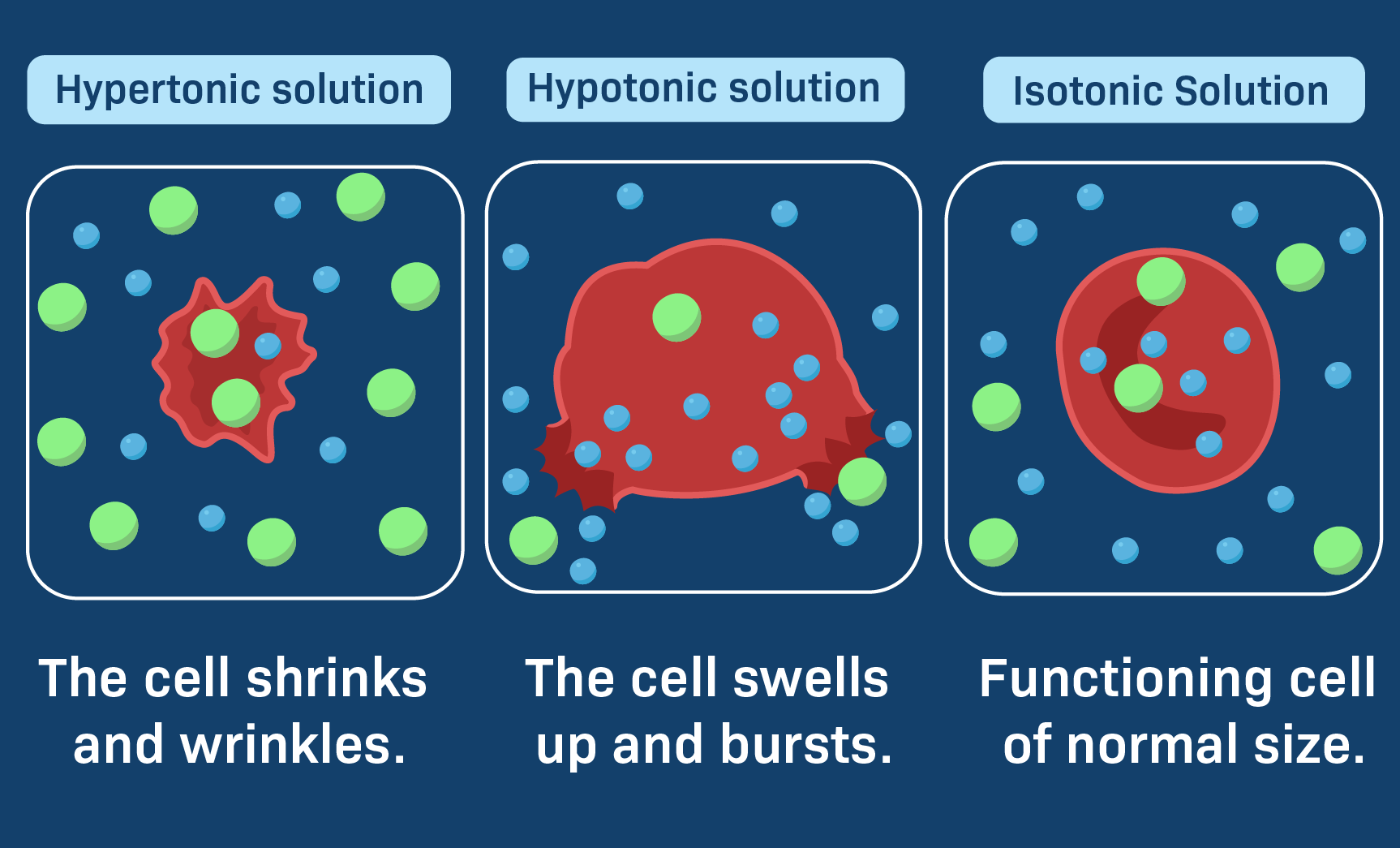
1. Solution outside is superrrrrrr hyperrrrr-salty/sugary/tonic-y so water moves out to try to balance this and the cell shrinks
2. Solution is looooow hypoooo-salty/sugary/tonic-y which means it must have water taking up room. The cell doesn't have as much water in it. Water flows in and the cell might burst from getting too full.
3. balanced= no net movement
800
Which of the following situations will lead to natural selection?
A. The seeds of two plants land near each other and one grows larger than the other.
B. Two types of fish eat the same kind of food, and one is better able to gather food than the other.
C. Male lions compete for the right to mate with females, with only one possible winner.
D. all of the above
D
800
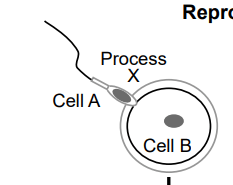
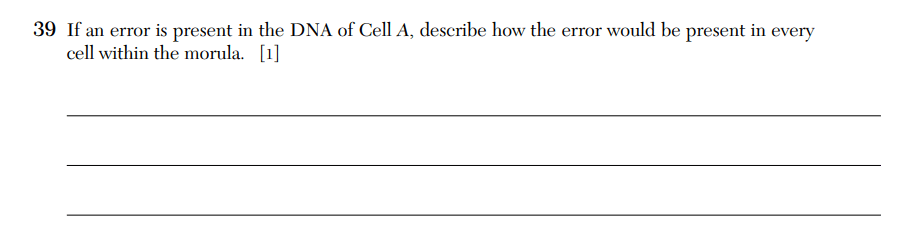
If the error is present in the part of the sperm's chromosome (gene) that get passed on (when chromosomes are recombined during sexual reproduction), it will get passed on to the embryo and then to all of the body cells that divide to make a baby after that
900
What happens to the rate of cellular respiration when someone goes from standing around the football field to running 120 yards to the other side. Accurately include all inputs and outputs of this process, and how the rate changes.
a) It is likely that nothing will happen to the inputs (Oxygen and glucose) or the outputs (Carbon Dioxide, water vapor, and ATP) because the body will maintain homeostasis.
b) It is likely that the inputs (Oxygen and glucose) and the outputs (Carbon Dioxide, water vapor, and ATP) will all increase if the body properly maintains homeostasis.
c) It is likely that the inputs (Oxygen and water) and the outputs (Carbon Dioxide, ATP, and glucose) will all increase if the body properly maintains homeostasis.
b - correct +5
c - tricky -2
d - trickier -3
900
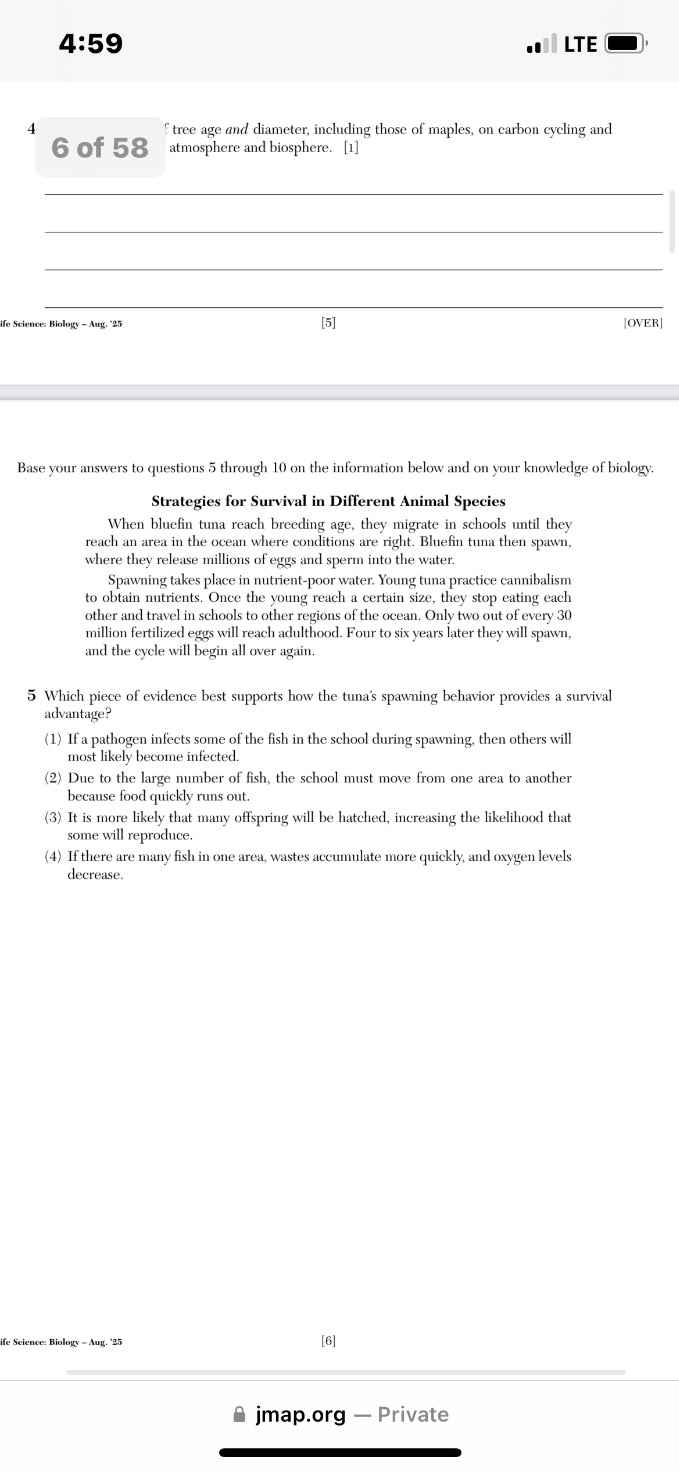
3)
900
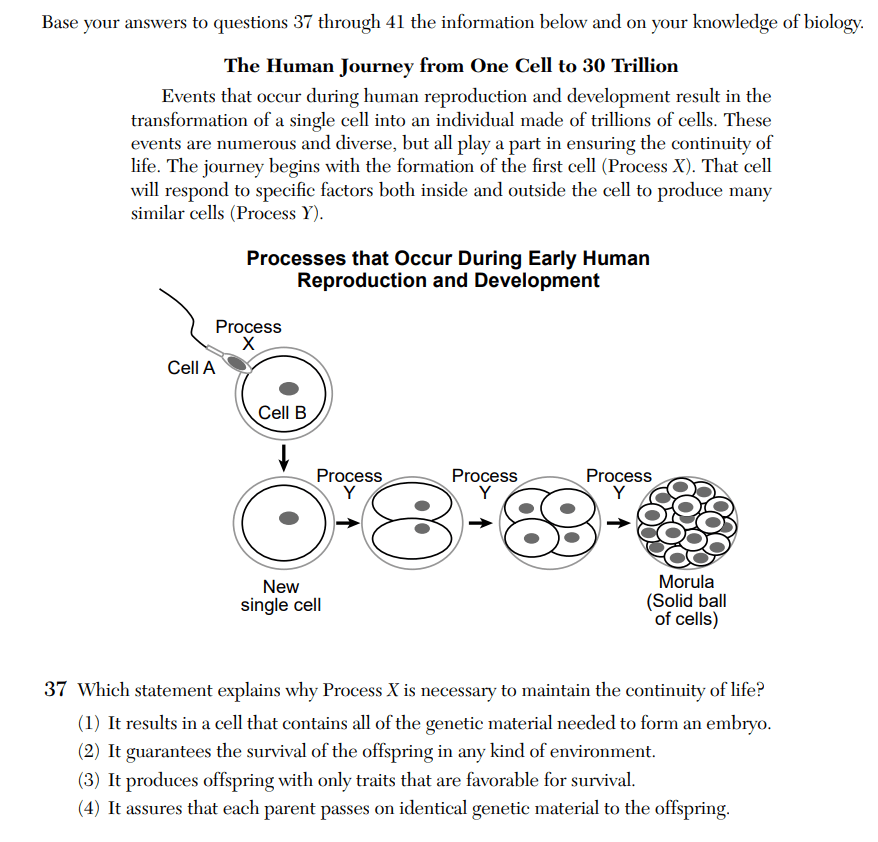
1
1000
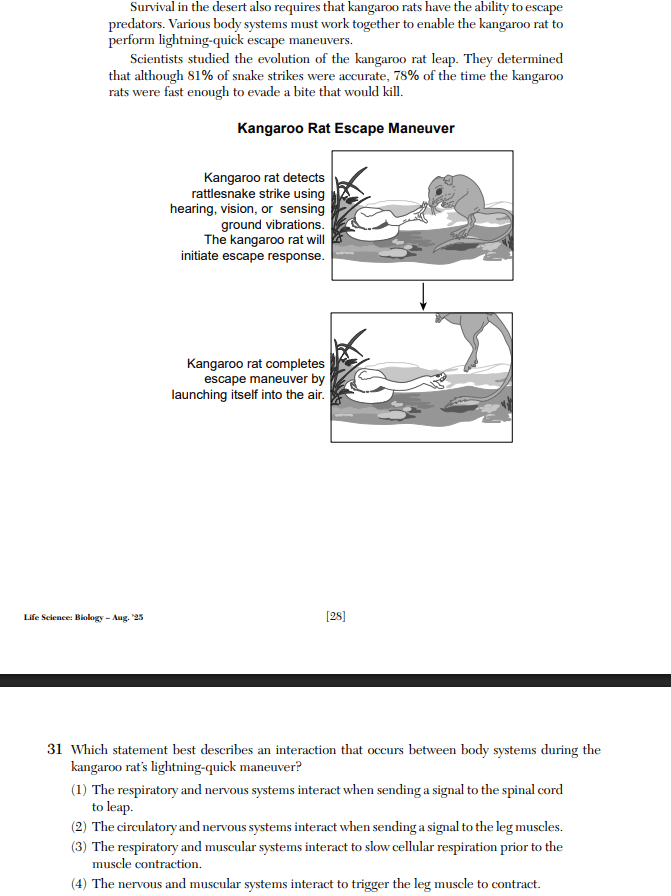
4) +10
1000
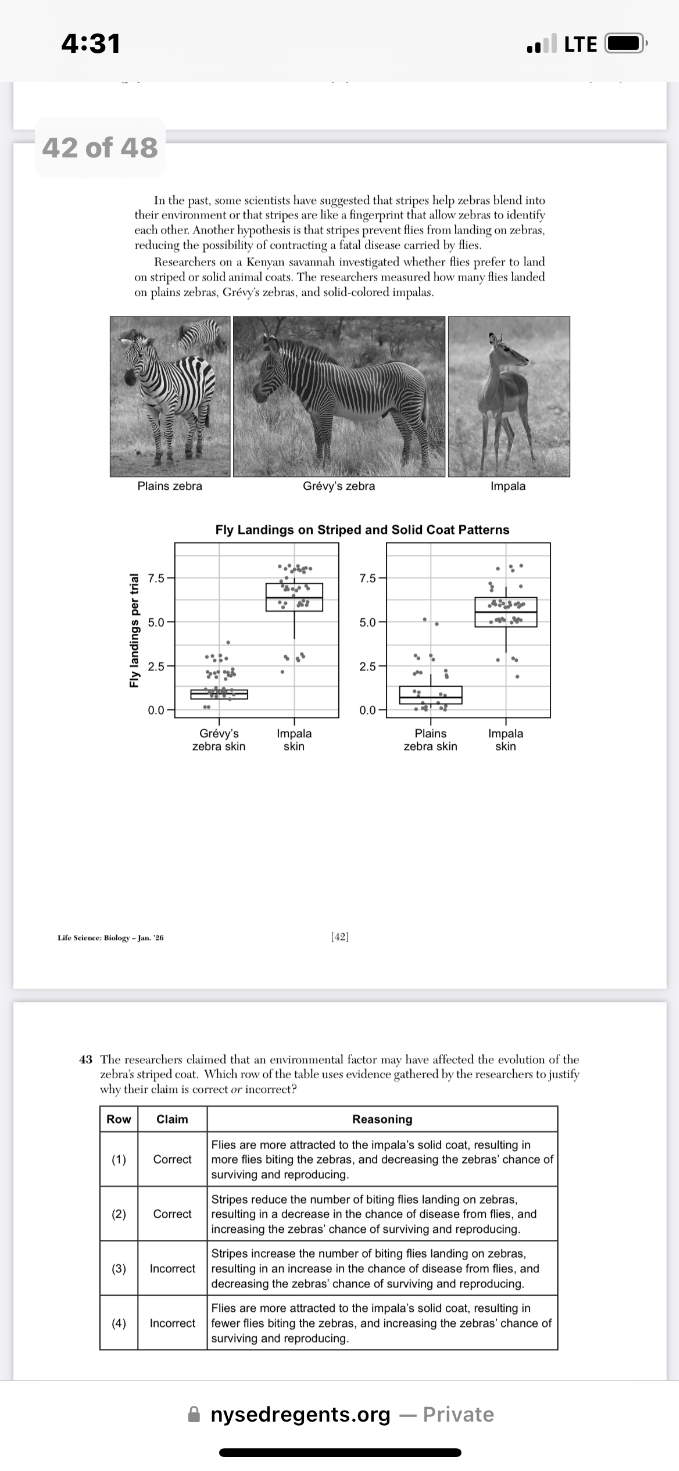
2) +10
4) -2
3) -4
1) -4
1000
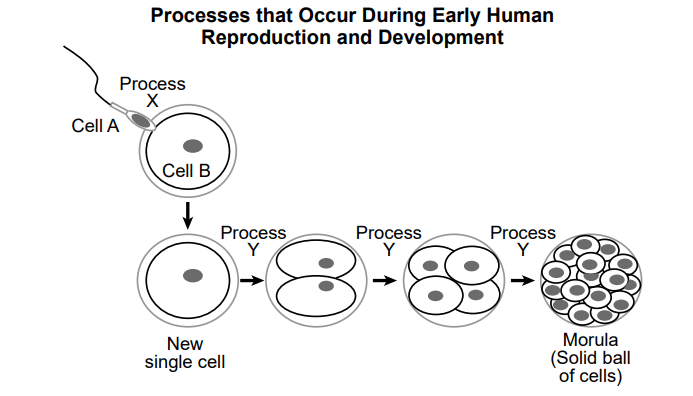
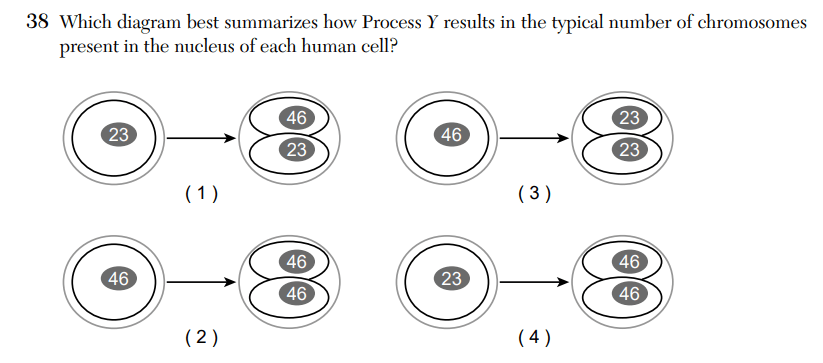
2