Wave Behaviour of Light
Wave-Particle Duality
Structure of the Atom
Standard Model
Random
100
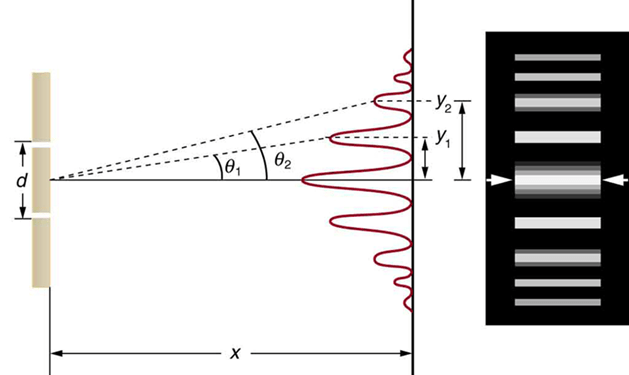
Draw the intensity distribution for two slit interference.
100
A massless particle, very well known.
What is the photon?
100
How is this image created and what is it evidence for?

low density gas emit discrete wavelengths when energised by light.
Discrete wavelengths (spectral line) match energy of the transition of an electron between energy levels.
100
Quarks required for a proton
What is two up, one down?
100
What is the frequency of yellow light with a wavelength of 600 nm?
5 x 10¹⁴ HZ
200
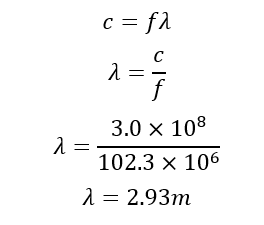
A popular radio station in Adelaide broadcasts radio waves with a frequency of 102.3MHz.
Calculate the wavelength of the transmitted radio waves.
200
What experiment led to believing light behaves a wave?
Double Slit Experiment (Young's)
200
What is the difference between baryons and mesons?
Baryons have 3 quarks, but mesons have one quark and one anti-quark
200
The work function of a silver surface is 4.73 eV. Two photons of 2.5 eV each hit the silver.
Why are no electrons ejected?
1:1 interaction.
Does not meet work function to get electron to surface etc.
300
Describe how transmitting and receiving antennas work.
EM waves produced by oscillating charges (AC current in conductor) with freq equal to AC current.
E field of radio wave exerts force on electrons in conductor causing them to oscillate at freq of incoming wave.
300
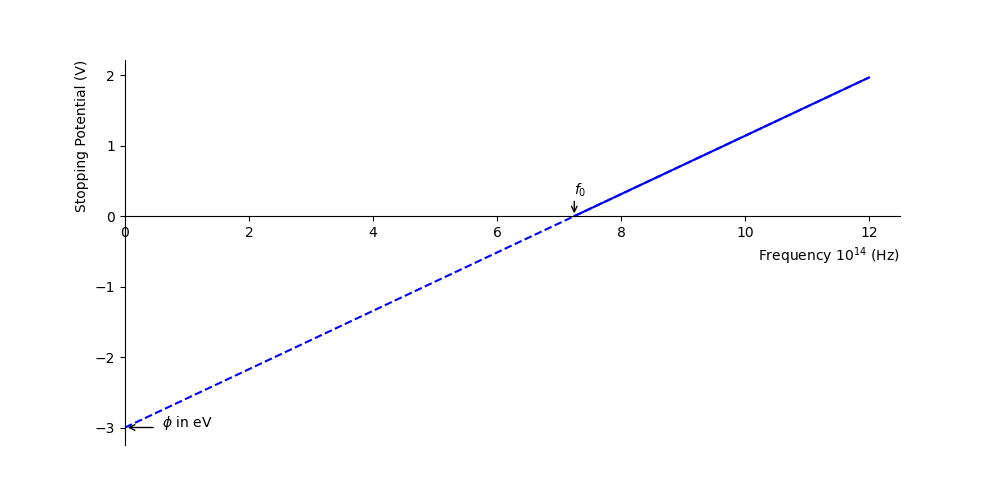 Describe three features of this graph.
Slope = h
X intercept = threshold freq
y-intercept = work function
300
Carried by two bosons.
What is the weak nuclear force?
300
What is meant by superposition?
When two waves meet
resultant displacement is the sum of the individual displacement
400
Explain why the double-slit experiment produces alternating bright and dark bands.
- waves diffracted as they passed through the two slits.
- they interfered with each other resulting in constructive and destructive interference
- Where the waves add together → Bright bands
Where the waves cancel each other → Dark bands
500
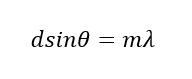
Derive:
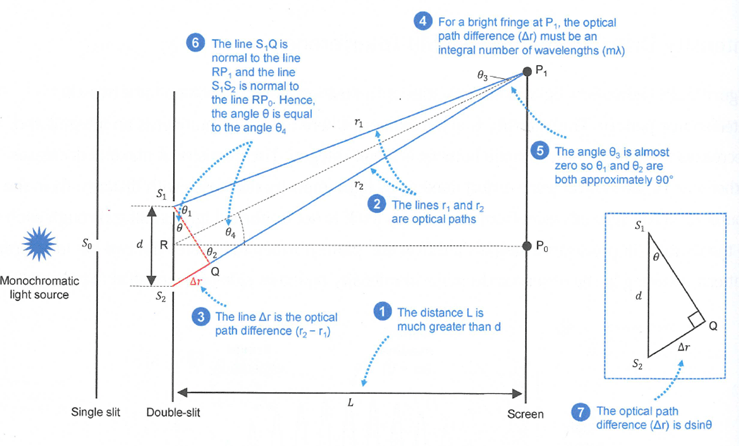
500
Davisson-Germer experiment
Electron diffraction by a crystal, supports de Broglie’s hypothesis of the wave nature of matter?