Characteristics of Life
The Human Body
Ecology
Cells
Biomolecules
100
The combination of all chemical reactions that occur in an organism is called:
Metabolism
100
Which is the correct order from least complex to most complex from the following: tissue, organelle, organ, cell, organ system
Organelle-->cell-->tissue-->organ-->organ system
100
This organism makes its own food using sunlight and forms the base of most food chains.
Producer / Autotroph
100
Which organelle captures energy from the Sun and uses it to help produce organic molecules?
Chloroplasts
100
What do proteins break down into?
Amino acids
200
Growth and repair in organisms depend on this process, in which cells divide to produce new cells.
Mitosis
200
These specialized proteins on a cell's membrane receive chemical messages from other cells.
Receptors
200
Define carrying capacity
The maximum population size of a species that an environment can sustain indefinitely without degrading the ecosystem
200
The genetic material of an organism is found in which organelle?
Nucleus
200
Starches are macromolecules used for energy. Which monomer do starches break down into?
Glucose
300
When the human body is responding to stress, the hormone adrenaline is released. A short time later, the body returns to normal. This is an example of how a human
Maintains dynamic equilibrium (Homeostasis)
300
Which two organ systems provide materials required for the human body to produce ATP?
Digestive and respiratory
300
Decomposers are necessary in a food chain because they
Return nutrients to the ecosystem
300
Muscle cells contain many more mitochondria than skin cells because muscle cells require more of this.
Energy (ATP)
300
A mutation changes the sequence of bases in a DNA molecule. The biomolecule directly affected is this.
Nucleic Acid
400
Single celled organisms are able to maintain internal stability because they
contain organelles
contain structures that perform life functions
400
What two systems are directly involved in providing molecules needed for the synthesis of fats in human cells
digestive and circulatory
400
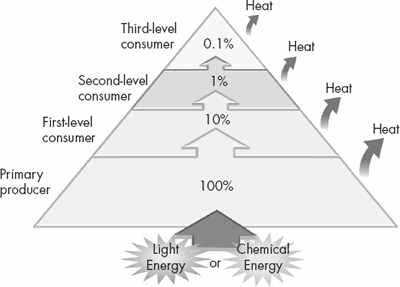 Explain why energy is lost traveling up the pyramid.
energy is lost as heat is released through metabolic processes
Producers are organisms that make their own food (e.g. plants).
400
When you put a cell in a salt solution, it shrinks because
Water leaves the cell
400
Cell membranes are selectively permeable because they are primarily composed of a double layer of these molecules.
Phospholipid Bilayer (lipids)
500
Provide 3 examples of the 7 characteristics of life
Growth: all organisms show growth and development
Reproduction: all organisms reproduce
Metabolism: all organisms use energy
React: All organisms show adaptation to their environment
500
Explain how the circulatory system interacts with the respiratory system in a human.
Your answer MUST HAVE the following vocabulary: diffuse/diffusion, carbon dioxide, oxygen
Oxygen diffuses through the lung tissue (alveoli) into the bloodstream where it travels through the blood to the rest of the body. CO2 diffuses out of the cell and into the lung tissue and breathed out through exhalation.
500
List three elements or molecules that are importantly recycled by our ecosystems
Nitrogen, carbon, phosphorus, water, oxygen, sulfur
500
In a cell, information that controls the production of proteins must pass from the nucleus to the
ribosomes
500
A characteristic shared by enzymes, hormones, and antibodies is that their function is determined by their
shape