Transport
Cells and Organelles
Plants vs Animals
Organization
Food Chains
100
What is the general term for the movement of particles from high concentration to low concentration?
Diffusion
100
The basic unit of living things is called a __________.
Cell
100
Which group can make their own food using sunlight?
Plants
100
Put the following in order from smallest to largest: Tissue, Organ, Cell, Organism, System.
Cell → Tissue → Organ → Organ System → Organism
100
In the food chain Grass → Cow → Man, what role does the cow play?
Primary consumer
200
What is the specific name for the diffusion of water through a selectively permeable membrane?
Osmosis
200
Which cell structure controls what enters and leaves the cell?
Cell membrane
200
True or False: Animals usually respond more quickly than plants to stimuli.
True
200
Give one example of a specialised cell and the job it does
Nerve cell — transmit impulses; Muscle cell — contract
200
What term is used for organisms that make their own food?
Producers
300
Which characteristic allows an organism to react to light, heat, sound, or touch?
Sensitivity (response to stimuli)
300
Name the organelle that produces a cell’s energy.
Mitochondrion (mitochondria)
300
List two major differences between plant and animal cells.
Plant cells have cell walls and chloroplasts; animal cells do not.
300
Define "tissue" in one sentence suitable for an exam answer.
Tissue = a group of similar cells performing the same function
300
Give a simple 3-link food chain.
Leaves → Caterpillar → Bird
400
Describe what happens to a plant cell placed in a hypertonic solution (state the cell condition)
Cell becomes flaccid (loses water) — plasmolysed if severe
400
Which two structures are found only in plant cells and not in animal cells?
Cell wall and chloroplasts
400
Give one example of a way plants move to respond to the environment.
Growing toward light (phototropism)
400
Using the levels of organisation, name the level that comes after organ and before organism.
System
400
What happens if the population of producers decreases dramatically?
Primary consumers would have less food and decline, which would also reduce secondary consumers and disrupt the entire food chain.
500
Describe what happens to an animal cell placed in a hypotonic solution.
Cell swell and burst (lyse) in a strongly hypotonic medium.
500
Identify these organelles.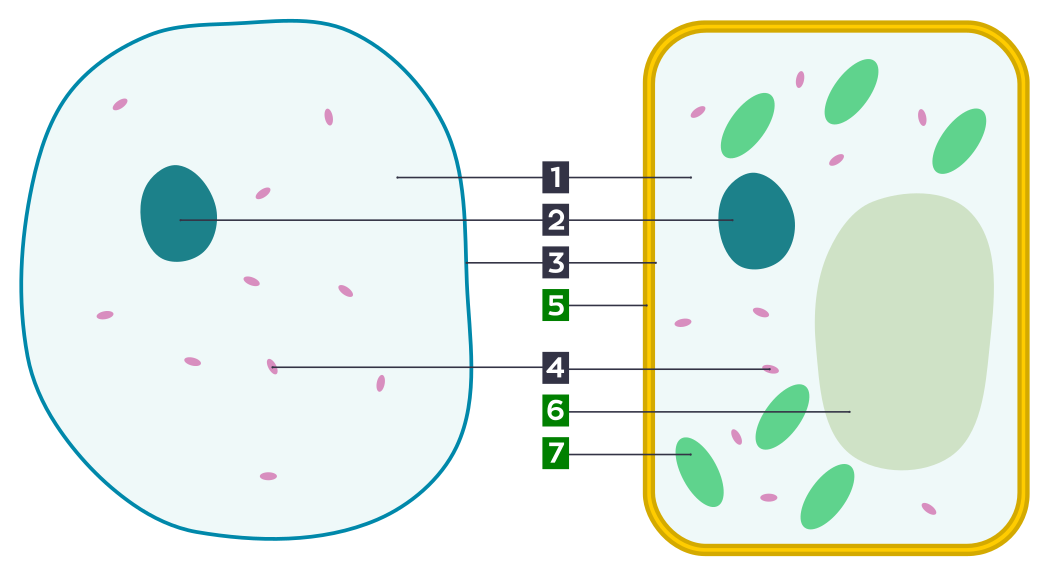
1. Cytoplasm
2. Nucleus
3. Cell membrane
4. Mitochondria
5. Cell wall
6. Permanent Vacuole
7. Chloroplast
500
Explain how chloroplasts and cell walls help plants survive in ways animals do not.
Chloroplasts allow plants to make their own food through photosynthesis. Cell walls provide support and protection, helping plants stay upright without moving.
500
In plants, which structures perform a transport function similar to the circulatory system?
Xylem and phloem
500
What is a food web, and how is it related to food chains?
A food web is the combination of several interconnected food chains. It shows how different organisms are linked through multiple feeding relationships within an ecosystem.