Logs :)
Expanding Log Expressions
Converting Log to Exp
Random
100
Logarithm property of a product?
Logarithm of a product:
= loga(MN)+logaM + logaN
100
Evaluate each expression.
Reminder: When a logarithm is written "log" without an explicit base, it refers to the common logarithm, log10
a) log8 1/8
b) log 1000
a) -1
b) 3
100
How can we rewrite this statement as a logarithmic equation?
be = n
logb n = e
100
What is the change of base formula for logarithms?
logab = logcb / logca
200
Logarithm property of a quotient?
Logarithm of a quotient:
= logaM/N−logaM - logaN
200
Use the properties of logarithms to expand log x/z4
Each logarithm should involve only one variable and should not have any exponents. Assume that all variables are positive.
logx - 4logz
200
How can we rewrite this statement as an exponential equation?
loga c = b
ab = c
200
Evaluate each expression.
(a) log6 6
(b) log4 1/64
(a) 1
(b) -3
300
Logarithm property of a power?
Logarithm of a power:
logaMp = p logaM
300
Use the properties of logarithms to expand the following expression.
log rad(xy7 / z3)
Each logarithm should involve only one variable and should not have any radicals or exponents. You may assume that all variables are positive.
1/2logx + 7/2logy - 3/2logz
300
Rewrite each equation as requested.
(a) Rewrite as an exponential equation.
log381 = 4
(b) Rewrite as a logarithmic equation.
8−1 = 1/8
(a) 34 = 81
(b) log81/8 = −1
300
Use the change of base formula to compute log83
Round your answer to the nearest thousandth.
0.528
400
Solve for x.
logx100 = 2
Simplify your answer as much as possible.
The answer is x=10
400
Use the properties of logarithms to expand log (z2x)
Each logarithm should involve only one variable and should not have any exponents. Assume that all variables are positive.
2logz + logx
400
Rewrite each equation as requested.
(a) Rewrite as an exponential equation.
ln5 = y
(b) Rewrite as a logarithmic equation.
ex = 4
(a) ey = 5
(b) ln4 = x
400
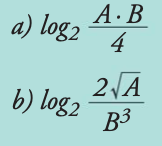
Knowing that log2 A = 3.5
and log2 B = –1.4, calculate: