General Log questions
Converting/ Evaluating
Solving equations
Graphing logs
Properties of Logs
100
The exponential form of this is what?
y=log_bx
b^y=x
100
Convert to log form:
2^x=8
log_2(8)=x
100
4^(2x-1)=64
x=2
or
(log_4(64)+1)/2
100
What is the range of every logarithmic function?
All real numbers
or
(-infinity, infinity)
100
log6 32 in its expanded form?
What is 2log6 3
200
What are logarithmic expressions equal to?
The exponent
200
Convert to exponential form (no solving):
log_(1/3)(x+2)=4
(1/3)^4=x+2
200
32^(x-2)=64
x=log_32(64)+2
200
Identify the vertical and horizontal shift of the following logarithmic function:
f(x)= 1/2 log(x+2)+1
2 to the left and 1 up
200
7log4 X + 4log4 Y in its condensed form?
What is log4 ( X7 . Y4)
300
A logarithmic function is the inverse of these functions
Exponentials
300
Evaluate:
log_6(36)
2
300
5*2^x+10=40
x=log_2(6)
300
What is an asymptote?
A line that a function approaches but never touches
300
5log7 w + 5log7 u + 15log7 v in its condensed form?
What is log7(w5 . u5 . v15)
400
What is the base of the following?
log(x)
10
400
Evaluate:
log_6(1/36)
-2
400
log_3(x-3)=2
x=12
or
3^2=3
400
What would be the asymptote for the following function?
log(x-5)+2
x=5
400
5log9 u - 12log9 v in its condensed form?
What is log9 u5/v12
500
The approximate value of e? (no calculator)
2.71
500
What is greater?
log_(1/2)1 or ln(e)
ln(e)
500
Solve for x:
log_x(216)=3
x=6
500
Graph the following:
f(x)= -3log_2x
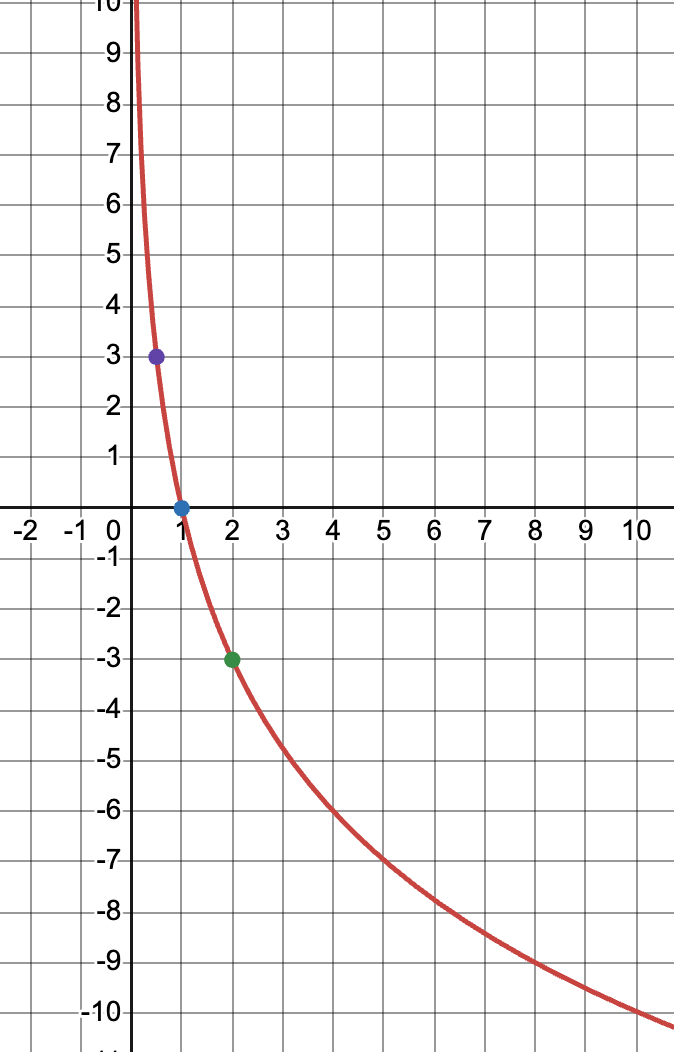
500
log7 ((a . b)5/c)4 in its expanded form?
What is 20log7 a + 20log7 b - 4log7 c