Terms and accents
Consonants
Vowels
Difficult phonemes
Sounds in context
Word stress
Rhythm and weak forms
Intonation
Transcription
Help the pupil
100
What is the difference between phonetics and phonology?
Phonetics is the study of human speech sounds in general. Phonology is the sound system of a given language, the sounds that carry meaning in it.
100
Voiced or voiceless? The first sound in zoo, sun, van and fan.
zoo /z/ and van /v/ are voiced. sun /s/ and fan /f/ are voiceless.
100
What is the difference between a monophthong and a diphthong? Give one example of each.
A monophthong keeps one vowel quality, as in sit /ɪ/. A diphthong glides from one vowel to another within one syllable, as in now /aʊ/.
100
Which phonemes distinguish jail and Yale?
/dʒ/ in jail and /j/ in Yale.
100
How is the past tense ending pronounced in walked, played and wanted?
/t/, /d/ and /ɪd/.
100
Mark the main stress in garden and begin.
ˈgarden and beˈgin.
100
Content word or function word? book, the, quickly, and, run
Content words book, quickly and run. Function words the and and.
100
Rise or fall? Why? Who would like a biscuit?
Fall ↘. It is a wh-question.
100
Which word is /tʃiːp/?
cheap
100
A pupil says /deɪ/ for they. What is the mistake, and what would you tell the pupil?
/d/ is used instead of /ð/. Put the tongue tip against or just between the upper teeth and let voiced air through, without a full closure.
200
Homophones or homographs? (a) sight and cite (b) lead (the metal) and lead (to show the way)
(a) Homophones, which sound the same but mean different things. (b) Homographs, which are spelled the same but mean different things.
200
Describe /b/ with three labels, voicing, place and manner.
A voiced bilabial plosive.
200
Which word contains a diphthong? cough, cause, coat
coat /kəʊt||koʊt/. cough /ɒ/ and cause /ɔː/ are monophthongs.
200
/s/ or /z/ at the end? eyes, ice, rice, rise
eyes /z/, ice /s/, rice /s/, rise /z/.
200
How is the 's pronounced in Mike's, Anna's and George's?
/s/, /z/ and /ɪz/.
200
Mark the stress in import in each sentence. They import cars. Car imports are rising.
to imˈport (verb, stressed after the prefix) and ˈimports (noun, stressed on the prefix).
200
Weak or strong form of to? I'd love to.
Strong, /tuː/. It comes at the end of the clause.
200
Read the pattern aloud. Does the voice rise or fall at the end, and what type of sentence is it?
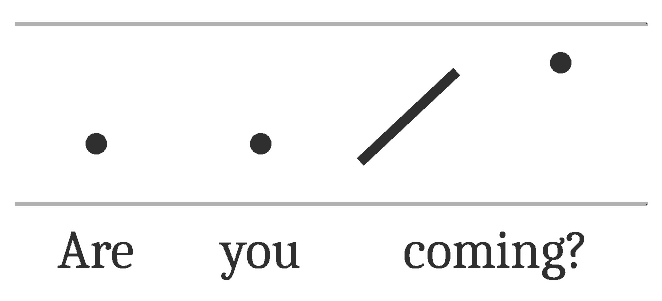
It rises ↗. It is a yes/no question.
200
Transcribe the words fish and chips.
/fɪʃ/ and /tʃɪps/.
200
A pupil says /sɪŋk/ for think. What is the mistake, and how could you help?
/s/ is used instead of /θ/. Move the tongue tip forward to the upper teeth, then practise sink and think in pairs.
300
Clear /l/ in lily and dark /l/ in Bill. Are they two phonemes or two allophones? Why?
Two allophones of the same phoneme /l/. Swapping them does not turn one word into another.
300
Which of these words end with a nasal? lamb, lamp, sing, sink, ten
lamb /m/, sing /ŋ/ and ten /n/. lamp ends in /p/ and sink in /k/.
300
Which vowels belong in positions 1, 2 and 3 in the vowel space?
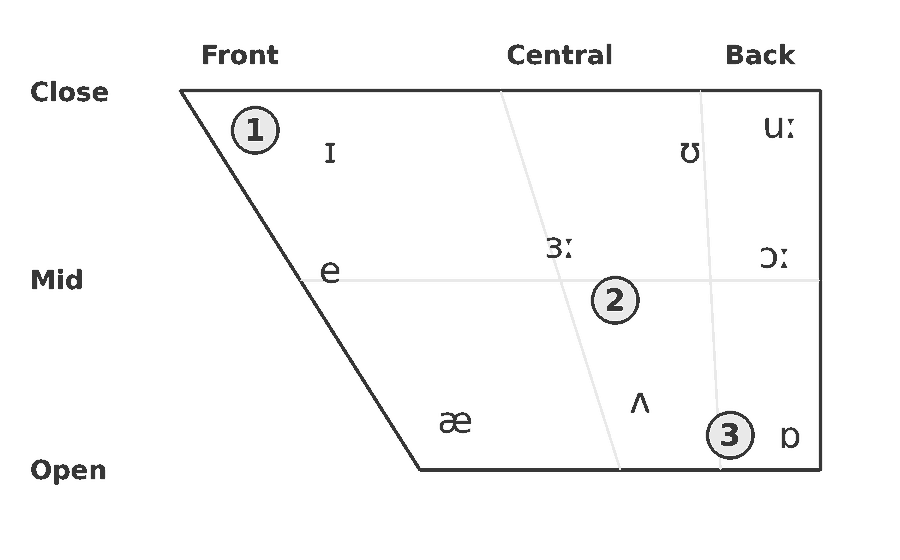
1 /iː/ (close front), 2 /ə/ (mid central), 3 /ɑː/ (open back).
300
Tricky reading. One student reads the sentence aloud to the team with ONE of the words in brackets. The team says which word they heard. I'd love some (peace / peas).
peace ends in voiceless /s/, peas in voiced /z/. Listen for the voicing in /z/.
300
a or an? ___ honour, ___ uniform, ___ MP, ___ one-way street. Explain.
an honour, a uniform, an MP, a one-way street. The choice follows the first sound, not the letter. honour starts with a vowel (silent h), uniform with /j/, MP with /e/ and one with /w/.
300
Mark the main stress in electric and explain why it falls there.
eˈlectric. The suffix -ic puts the stress on the syllable before it.
300
Give the weak forms of and, but and can.
and /ən/ (or /ənd/, /n/), but /bət/, can /kən/.
300
True or false? Every stressed syllable in a sentence has a tone glide.
False. Only the tonic syllable has a glide, normally the last stressed syllable of the clause.
300
Which homophones can /nəʊz||noʊz/ represent?
nose and knows.
300
A pupil reads houses as /ˈhaʊsɪs/. What would you point out?
Both s sounds are /z/ here, /ˈhaʊzɪz/. Let the pupil feel the vibration in the throat for /z/.
400
RP or GA? Which feature shows it? party /ˈpɑːrt̬i/
GA. The /r/ is pronounced before a consonant (GA is rhotic), and the t between vowels is voiced (the t-flap).
400
Which consonant belongs in the cell with the question mark?
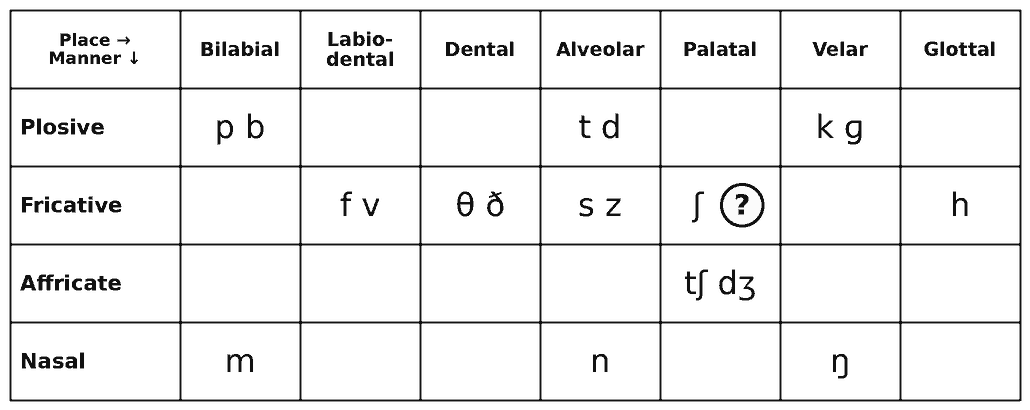
/ʒ/, the voiced palatal fricative, as in pleasure and vision.
400
Describe /uː/ with tongue height and the part of the tongue that is raised.
A close back vowel.
400
/ʃ/ or /ʒ/? pressure, usual, nation
pressure /ʃ/, usual /ʒ/, nation /ʃ/.
400
In fast speech, ten pounds often sounds like tem pounds. What is this called, and why does it happen?
Assimilation. The /n/ takes on the bilabial place of the following /p/ and becomes /m/.
400
Mark the main stress in technology and explain why it falls there.
techˈnology. Words of four or more syllables are often stressed on the third syllable from the end.
400
Tricky reading. One student reads the sentence aloud to the team with ONE of the words in brackets. The team says which word they heard. I (can / can't) come tomorrow.
can is weak and unstressed, /kən/. can't is stressed with a full vowel, /kɑːnt||kænt/.
400
Is this pattern RP or GA? How can you tell?
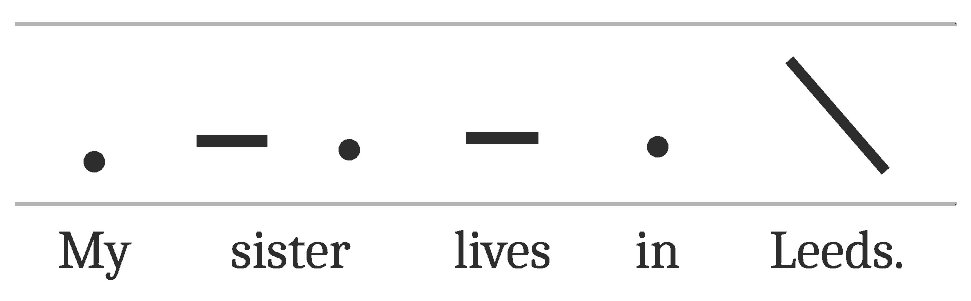
GA. The voice stays low and level until the last stressed syllable and then falls. RP would start high on the first stressed syllable and step down.
400
Transcribe mother's and watched.
/ˈmʌðəz||ˈmʌðərz/ and /wɒtʃt||wɑːtʃt/.
400
Why is the IPA useful when you teach pupils who struggle with English spelling? Give an example.
Spelling does not show the sounds reliably (the letter a in any, same and father, or ghoti for fish). Symbols show contrasts that spelling hides, such as /e/ and /æ/ or /v/ and /w/.
500
RP or GA? Which feature shows it? dance /dɑːns/
RP. RP has the long /ɑː/ in words like dance, after and ask, where GA has /æ/.
500
Odd one out! /m/ /n/ /ŋ/ /l/. Which one does not belong, and why?
/l/. It is a lateral. The other three are nasals.
500
Which vowel can never occur in a stressed syllable? Give a word where it occurs twice.
Schwa, /ə/, as in Canada /ˈkænədə/.
500
Tricky reading. One student reads the sentence aloud to the team with ONE of the words in brackets. The team says which word they heard. I (taught / thought) about it all day.
taught has the plosive /t/, with a closure at the alveolar ridge. thought has the fricative /θ/, with the tongue tip at the upper teeth and no closure.
500
In RP, why is an /r/ heard in far away but not in far? What is it called?
Linking r. RP is non-rhotic, so a final r is only pronounced when the next word begins with a vowel.
500
Explain the difference between a ˈhot dog and a ˈhot ˈdog.
a ˈhot dog is a compound, stressed on the first element, a sausage in a bread roll. a ˈhot ˈdog is a phrase with two stresses, a dog that feels hot.
500
Weak or strong forms, and why? It's for you, not from you.
Both are strong, /fɔː||fɔːr/ and /frɒm||frʌm/, since they are contrasted.
500
Mark the tones and explain. We bought bread, milk and cheese.
bread ↗, milk ↗, cheese ↘. The items in a list rise, and the last item falls.
500
Odd one out! /ʃ/ sure, machine, ocean, measure
measure, which has /ʒ/.
500
A pupil reads every question with a rise, including Where do you live? What would you point out, and how would you practise it?
Wh-questions normally fall. Practise pairs such as Do you live here ↗? and Where do you live ↘?, with hand movements or arrow cards.
600
RP or GA? Which feature shows it? hot /hɑːt/
GA. GA has a long /ɑː/ (or /ɔː/) where RP has the short /ɒ/, /hɒt/.
600
Which consonant is a voiceless palatal affricate? Give one word that begins with it and one that ends with it.
/tʃ/, as in cheese and watch.
600
Odd one out! /ɜː/ bird, word, heart, learn
heart, /hɑːt||hɑːrt/. The others have /ɜː/.
600
A Swedish learner pronounces vest as /west/. What is the error, and why might it happen?
/w/ is used instead of /v/. Swedish has no /w/, so learners are unsure of the contrast and may mix up the two sounds or overcorrect.
600
What happens to the /t/ in next question in fast speech? Name the process.
It drops out, /neks ˈkwestʃən/. This is elision.
600
Mark the stress in necessary and vocabulary, and give the rule.
ˈnecessary and voˈcabulary. With the suffix -ary, the stress falls on the fourth syllable from the end.
600
How many beats are there in The children were playing in the garden? What happens to the unstressed syllables?
Three, on chil-, play- and gar-. The unstressed syllables are squeezed in and reduced, with weak forms such as were /wə||wər/ and the /ðə/.
600
Tricky reading. One student says Thank you! to the team, either with a fall ↘ or with a rise ↗. The team says which tone they heard. Which one sounds more grateful?
The falling Thank you ↘ sounds grateful. The rising one sounds less polite.
600
Which letters of the alphabet are these? /dʒiː/, /waɪ/, /eɪtʃ/
G, Y and H.
600
A pupil does not hear the difference between ship and sheep. Suggest an activity that trains listening first and speaking second.
For example two picture cards. The teacher says one word and the pupils point. Then a pupil says a word and a partner points, so the pupil's own pronunciation is tested.
700
Define RP and GA without describing their pronunciation.
RP (Received Pronunciation, or Standard Southern British) is the standard British accent, a social rather than a regional accent. GA (General American) is a Mid-Western North American accent.
700
What do the final consonants in these words have in common? laugh, kiss, wish, bath
They are all voiceless fricatives, /f/, /s/, /ʃ/ and /θ/.
700
Which three words have the same vowel? blood, food, flood, good, love
blood, flood and love, all with /ʌ/. food has /uː/ and good has /ʊ/.
700
Tricky reading. One student reads the sentence aloud to the team with ONE of the words in brackets. The team says which word they heard. We had (bad / bed) weather all week.
bad has /æ/ and bed has /e/. In Swedish the two sounds are variants of one phoneme, so they are hard to hear apart, but in English they are separate phonemes.
700
Many RP speakers say law and order with an /r/ after law. What is this called, and how does it differ from linking r?
Intrusive r. There is no r in the spelling, whereas a linking r is spelled, as in far away.
700
Mark the stress in trainee and cassette, and explain.
traiˈnee and casˈsette. The suffixes -ee and -ette carry the stress themselves.
700
Swedish is also stress-timed. What makes English rhythm sound different?
In English, unstressed vowels are reduced, often to /ə/, and the stressed syllables stand out more. Unstressed Swedish vowels keep more of their quality.
700
Mark the tone of the tag and explain. The speaker is sure. Lovely weather, isn't it?
isn't it ↘. The speaker expects agreement and asks for confirmation, so the tag falls.
700
How many phonemes are there in knight, thought and box?
knight /naɪt/ three, thought /θɔːt/ three, box /bɒks||bɑːks/ four.
700
How could you use a tongue twister or a rhyme in class? What would it practise?
For example She sells seashells for /s/ and /ʃ/, or a nursery rhyme such as Humpty Dumpty for rhythm and stress-timing. Start slowly, then speed up.
800
What kind of accent is Estuary English, and what are three of its pronunciation features?
A social accent, like RP, placed between Cockney and RP. Features include no /r/ before consonants, /h/-dropping, glottal stops (butter /ˈbʌʔə/), a vocalised final /l/ (wall sounds like waw), longer vowels and stressed function words.
800
How do the final consonants in list A differ from those in list B? A rob, bag, said. B rope, back, set.
Voicing. List A ends in voiced plosives /b ɡ d/, list B in voiceless plosives /p k t/.
800
The letter a can stand for many vowel sounds. Give three words where it stands for three different vowels, and transcribe the vowels.
For example sat /æ/, same /eɪ/, father /ɑː/, call /ɔː/, any /e/, wash /ɒ/ or about /ə/.
800
Swedish speakers often fail to distinguish choose and shoes. Explain the error and why it happens.
They use /ʃ/ for the affricate /tʃ/ and leave out its /t/ part. Swedish has no /tʃ/, so learners replace it with the nearest fricative.
800
Name the process in each. (a) handbag /ˈhæmbæɡ/ (b) have to /ˈhæftə/ (c) last night /lɑːs ˈnaɪt/
(a) Assimilation, /n/ becomes /m/ before /b/ (and the /d/ drops out). (b) Devoicing, /v/ becomes /f/ before voiceless /t/. (c) Elision, the /t/ drops out between consonants.
800
Mark the stress in economy, economic and economist.
eˈconomy, ecoˈnomic, eˈconomist. The suffix -ic stresses the syllable before it, so the stress moves in economic.
800
Weak or strong form of there, and why? (a) There's a problem. (b) Put it over there.
(a) Weak, /ðə||ðər/, existential there. (b) Strong, /ðeə||ðer/, there as a place adverb at the end of the clause.
800
Did Peter take the bus to work? Answer with No, Peter took the train to work. Where is the glide, and what happens to to work?
The glide is on train, the word that corrects the question. The words after the glide, to work, stay low and level.
800
Transcribe banana in RP and GA and mark the stress.
/bəˈnɑːnə||bəˈnænə/.
800
Plan a two-minute warm-up that practises both a difficult phoneme and intonation.
For example, pupils ask each other questions with /θ/ words, such as Do you think it's Thursday ↗? and What do you think ↘? The partner checks both the /θ/ and the tone.