Composite Functions
Inverse Functions
Piecewise Functions
Ms. Escolero Trivia
100
Let f(x)=6x^2 and g(x)=14x+4
Find g(f(1)).
g(f(1))=88
100
Find the inverse for the following relation:
{(2,4), (4, 6), (-1, 3)}
{(4, 2), (6, 4), (3, -1)}
100
Using the graph below, complete the piecewise function by filling in the missing domain restrictions.
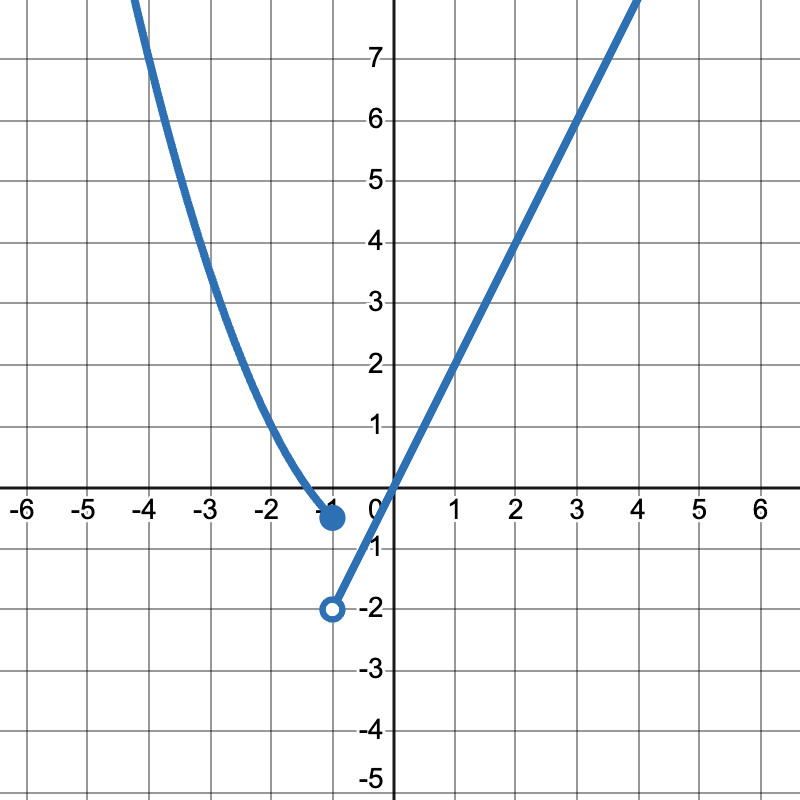
f(x)={(0.5x^2-1, ),(2x,):}
{(0.5x^2-1, x≤-1),(2x, x> -1):}
100
What other subject(s) does Ms. Escolero teach? (name at least one)
Geometry & AP Calculus AB
200
Let h(x) be the graph below.
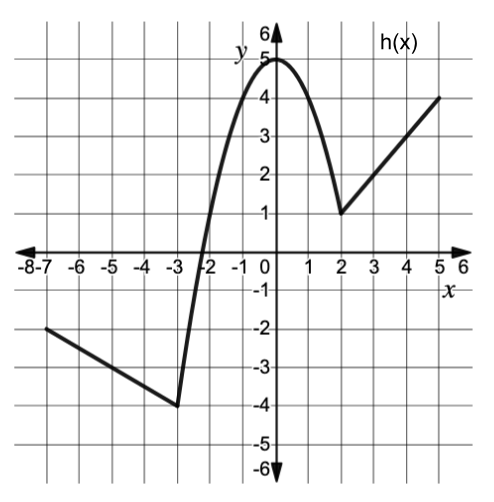
Find h(h(-2)).
h(h(-2)) = 4
200
Find the inverse of f(x)=1/3x-2 and state the domain of f(x) and f^-1(x)
f(x)=1/3x-2
Domain of f(x): -∞ < x < ∞
f^-1(x)=3x+6
Domain of f^-1(x): -∞ < x < ∞
200
Given g(x)={(2x+17, x<-1),(-3-x,-1≤x<4),(x^3,x≥4):}
Find:
1. g(0)
2. g(-1)
3. g(5)
1. g(0) = -3
2. g(-1) = -2
3. g(5) = 125
200
Where did Ms. Escolero get her bachelors degree from?
University of California, Riverside
300
Let g(x)=x-2 and f(x)=4x+3
Find (f∘g)(a). Simplify if possible.
f(g(x)) = 4a-5
300
Are g(x) = 1/4x-1 and h(x)=4x+4 inverses of each other? Justify your reasoning using the inverse composition rule.
Yes they are since
g(h(x)) = x and g(g(x)) = x.
300
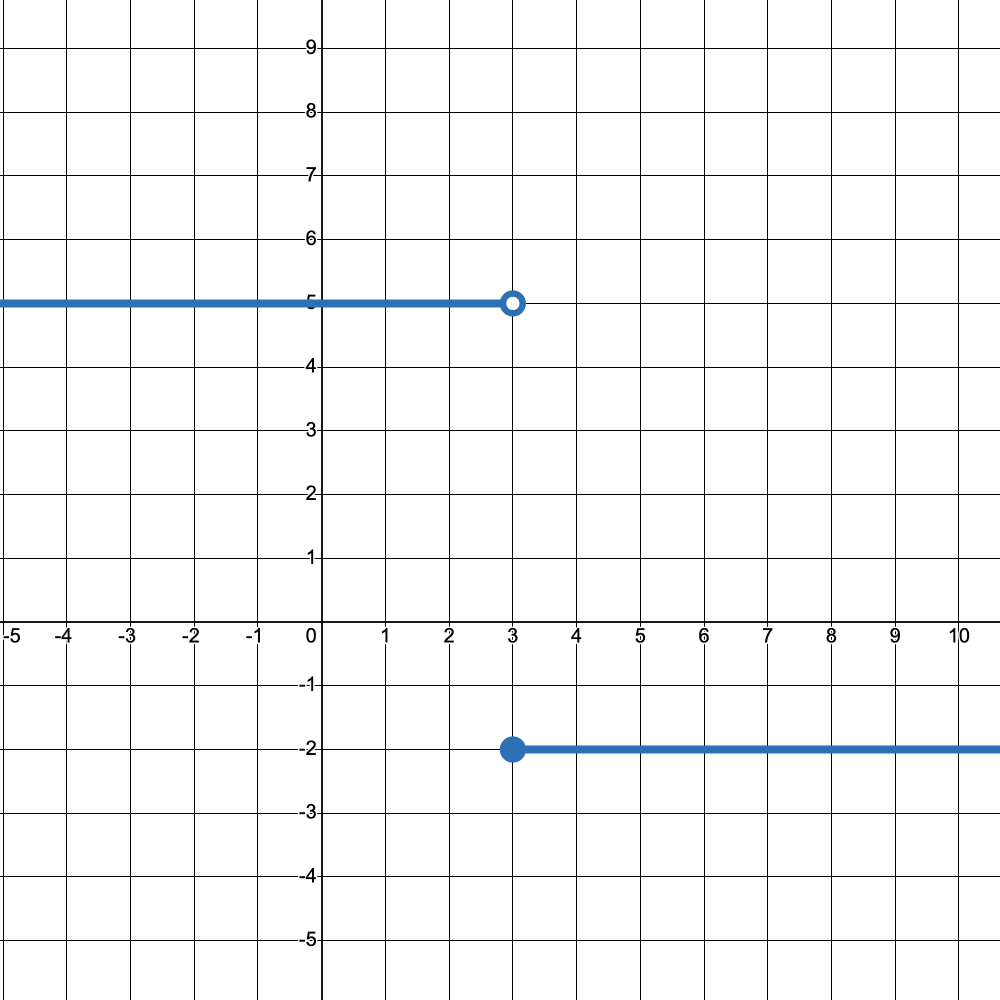
Graph the following function:
{(-2, x≥3),(5, x<3):}
300
What are Ms. Escolero's hobbies? (name at least one)
Running, Reading, Hiking, Crocheting, and Do Math!
400
Let h(x)=7/x and g(x)=-x^2.
Find g(h(b)). Simplify if possible.
g(h(b))=-49/b^2
400
Are f(x) = x^3+1 and g(x)=root(3)(x+1) inverses of each other? Justify your reasoning using the inverse composition rule
No they are not since
f(g(x)) = x+2 and g(f(x)) =root(3)(x^3+2)
400
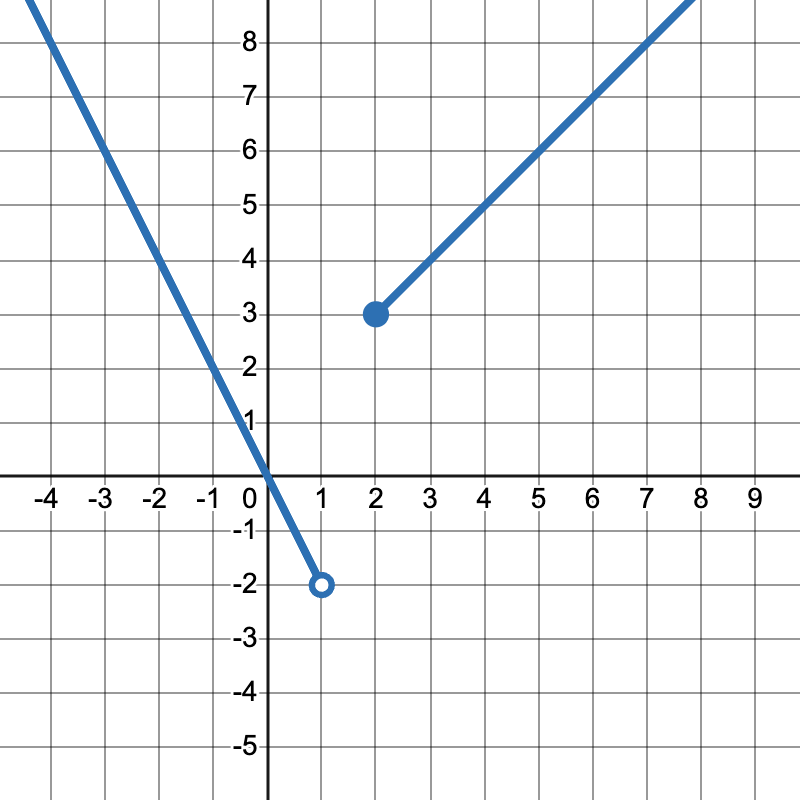
Graph the following function:
{(x+1, x≥2),(-2x, x<1):}
400
How many siblings does Ms. Escolero have?
4 brother and 4 sisters = 8 siblings
500
Let h(x)=7/x, f(x)=x-2 and g(x)=-x^2.
Find f(g(h(3.5))).
f(g(h(3.5))) = -6
500
Find the inverse of f(x)=x^2+4 and state the domain of f(x) and f^-1(x)
f(x)=x^2+4
Domain: 0 ≤ x < ∞
f^-1(x)=sqrt(x-4)
Domain: 4 ≤ x ≤ ∞
500
Write an equation for the following function.
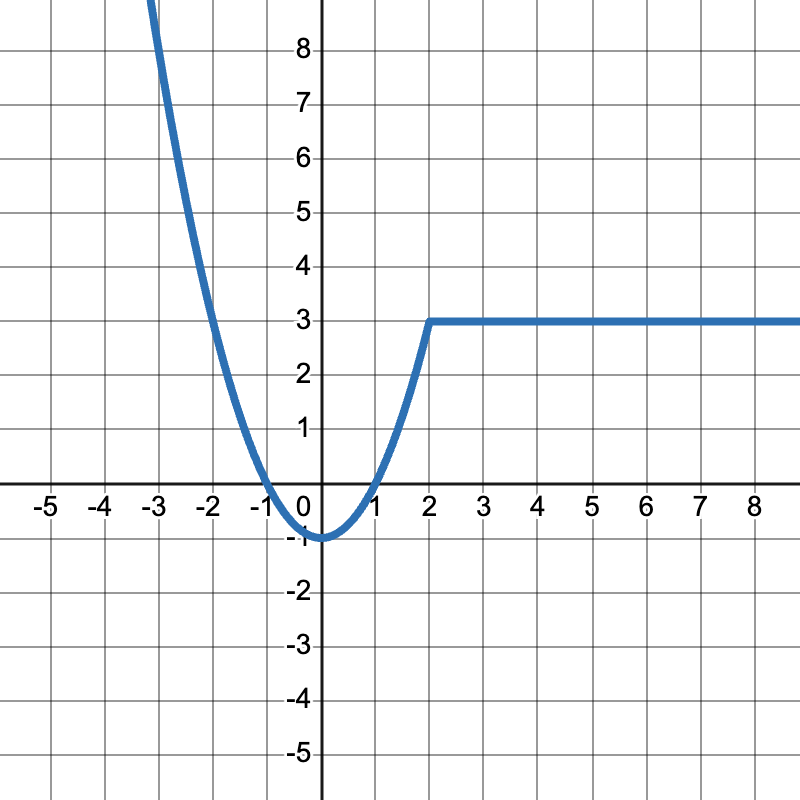
f(x)={(x^2-1,x<2),(3, x≥2):}
500
Name one of Ms. Escolero's top 2 artists.
Bad Bunny or Taylor Swift