Graph Stuff
Limits at Infinity
Optimization
Antiderivatives & Integration
Area and Riemann Sums
100
Find the slant asymptote of f(x).
f(x)=(6x^2+5x-8)/(3x+1)
y=2x+1
100
Evaluate the following limit:
lim_(x->oo)(-x^2-x)/(x+4
-oo
100
For rectangles that have a fixed perimeter of 200, what is the largest possible area?
2500
100
Evaluate (no simplifying needed).
int(sinx-cosx-csc^2x-secxtanx-cscxcotx)dx
-cosx-sinx+cotx-secx+cscx+c
100
Evaluate
sum_(i=1)^4 i^2(i-1)
70
200
What are some statements about f(x)? What are the intercepts and how many of each asymptote does it have?
f(x)=(x^2-4)/(x-5)
y-intercept is (0,4/5)
x-intercepts are (-2,0) & (2,0).
One V.A.
One slant asymptote.
200
Find the limit.
lim_(x->-oo)(2x+1)/(3x^2-x+6)
0
200
A vendor sells popcorn at a basketball game. It costs him 1 dollar to make each bag of popcorn and he has been told that if he sells each bag of popcorn for p dollars, then he can sell a total of q = 270-30p bags of popcorn. Find p that maximizes his profit.
5 dollars
200
Solve the following initial value problem.
y''=5cosx, y'(0)=1 y(0)=2
y=-5cosx+x+7
200
Find the right Riemann sum that approximates the area under the curve of
y = ln(x+1) on the interval [10,70] with 60 rectangles. Give answer in sigma notation.
sum_(i=1)^60ln(i+11)
300
Below is the graph of f'(x). What are the critical numbers and where is f(x) decreasing?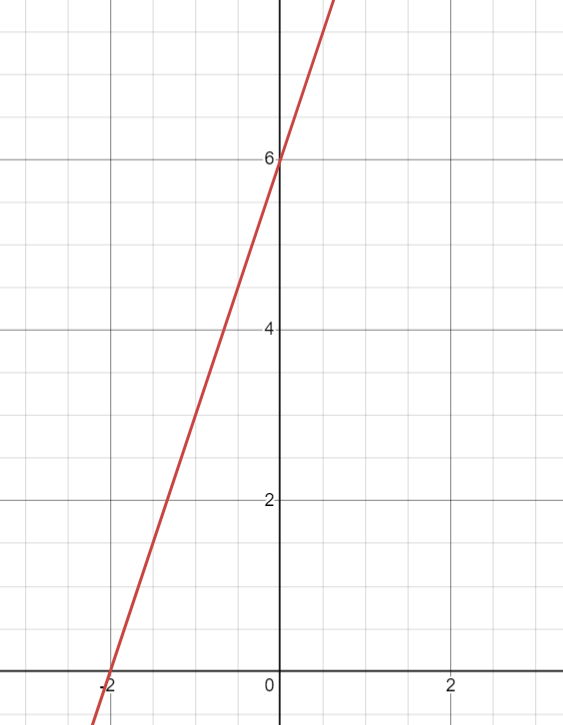
C.N x = -2
DEC on (-inf, -2)
300
Find the limit.
lim_(x->-oo)(-2x^3)/(x^2+2)
oo
300
A box with a square base and an open top must have a volume of 4000 cm^3. If the cost of the material used is 1 per cm^2, the smallest possible cost of the box is?
1200
300
A particle moving on a straight line has an acceleration of a(t)=2t where t is time in seconds and a(t) is in ft/sec^2. Its initial velocity is 10ft/sec, and its initial position is 0. What is its position after 3 seconds?
39ft
300
Use the left Riemann sum to approximate the area under f(x) from x = 0 to x = 6 with 3 rectangles.
f(x)=2x^2+1
86
400
Below is f'(x). What are the relative min/max, and inflection points?
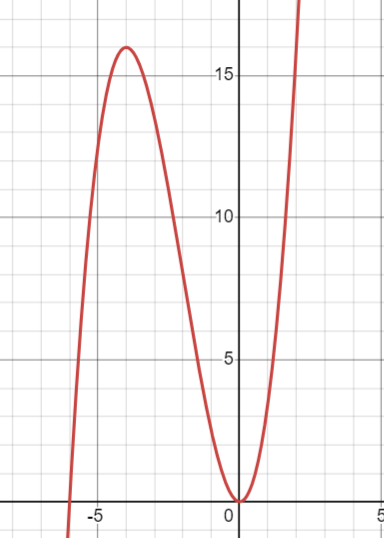
Rel min at x = -6
I.P at x = -4 and x = 0
400
Find the limit.
lim_(x->oo)(5x^2+9)/(6x^2-2x+5)
5/6
400
For a cylinder with a volume of 100, find the radius which minimizes the surface area. Recall that the volume of a cylinder and surface area are:
V=pir^2h
S.A.=2pirh+2pir^2
(50/pi)^(1/3)
400
Given g'(x) with g(1) = 1, find g(2).
g'(x)=2/x+1/(2sqrt(x)
2ln2+sqrt(2)
400
Find the right Riemann sum that approximates the area under the curve of
y = ln(2x+2) on the interval [0,4] with 8 rectangles. Give the answer in sigma notation.
sum_(i=1)^8(1/2)ln(i+2)
500
Consider f(x).
What are the asymptotes of f(x)?
f(x)=(x^2+2x+1)/(2x-8)
V.A. x = 4
Slant y = 1/2x+3
500
Find the limit.
lim_(x->oo)(-x^2+1)/(x-5)
-oo
500
Find the x coordinate of the point on the graph of y=4x-9 that is the closest to the point (0,-5).
16/17
500
Evaluate both.
int (6x^2+x^(2/3)/6) \ dx
int ((6x^2+1)/(8x)) \ dx
2x^3+1/10x^(5/3)+C
3/8x^2+1/8lnabsx+C
500
Consider f(x) on the interval of [0,2] with 2 rectangles. Using the right and left Riemann sums, find the difference between the right and left Riemann sums R - L.
f(x) = (x+1)^2
8