Macromolecules
Carbs/Lipids
Proteins/Nucleic Acids
Enzymes
Wild Card
100
What are the four types of macromolecules?
Carbohydrates, Lipids, Proteins, Nucleic Acids
100
Name a food rich in carbohydrates.
Pasta
Bread
Fruit
Potatoes
100
Proteins are made up of smaller building blocks called ____________________.
Amino Acids
100
An enzymes is an example of which macromolecule?
Protein
100
Which macromolecule contains Carbon, Oxygen, Hydrogen, Nitrogen and Phosphorous?
Nucleic Acids
200
True or False: Macromolecules are VITAL to the survival of living things.
TRUE
200
This macromolecule is not water soluble.
What are lipids?
200
Name two examples of nucleic acids.
DNA and RNA
200
An enzyme is a biochemical catalyst which ___________________________________.
Speeds up a chemical reaction.
200
_____________ are the compounds that enter into a chemical reaction, while ___________ are the compounds that results from a chemical reaction.
Reactants; Products
300
Which macromolecules serve as energy sources for cells?
Carbohydrates and lipids
300
Name two functions of lipids
Long-term energy storage
Create cell membranes
Insulation
Hydrophobic (not really a function, but I'll take it)
300
Nucleic acids are made up of smaller units called ____________ which are joined together.
Nucleotides
300
How do enzymes speed up chemical reactions?
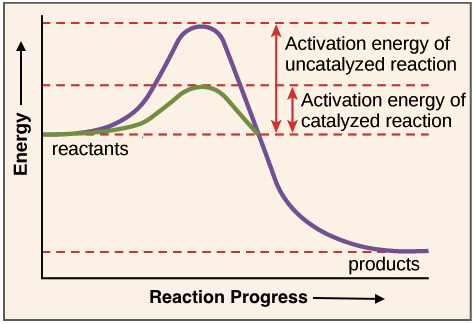
By LOWERING the ACTIVATION ENERGY
300
Enzyme activity can be affected by many factors; name TWO ..... name 3 for 100 extra points.
pH, temperature, enzyme/substrate concentration
400
Which 3 elements are found in ALL macromolecules?
Carbon, Hydrogen and Oxygen
400
What is the primary function of carbohydrates?
Provide quick energy
400
What is the function of nucleic acids?
To store information in the form of a code ("blueprint for life").
400
The place where an enzymes binds to the substrate is called the ____________________.
Active site
400
Draw an enzymatic reaction. (HINT include: active site, enzyme-substrate complex, enzyme, substrates, products)

500
List 4 DIFFERENT functions proteins can play in the body!
Aid in chemical reactions (enzymes)
Long term energy storage
Structure (hair, nails, skin, bones)
Sending messages across the body (insulin, hormones)
Transport things across body
Helps build muscle and move muscles
Makes antibodies to fight off germs
500
This type of lipid is a liquid at room temp
What is unsaturated fat (oil)
500
Enzymes help living organisms metabolize food. How does it do this?
What is speeding up metabolic reaction, which allows the organism to get energy quickly
500
Draw a graph of the energy required for a chemical reaction to take place with an enzyme present, lowering the activation energy
500
A group of students conducts research on enzyme activity and collects the data below.
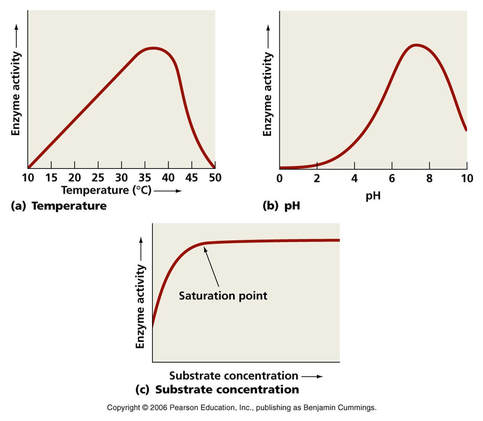
At what conditions (name all 3) is this enzyme most active???
Hint: At ____ Celcius, ____ PH, _______ concentration
around 37 degrees celcius
between 6 and 8 ph
Infinitely scaling for concentration BUT it slows down starting at the saturation point