Elements
Monomers/Polymers
Visual Cues/ Identification
Functions
Real World Application
100
The three elements present in carbohydrates and lipids
What are Carbon, Hydrogen, and Oxygen?
100
The general term that describes a long chain of repeating monomers linked together.
What is a polymer?
100
The macromolecule show in this picture

What is a carbohydrate?
100
The macromolecule that provides the fastest source of energy for cells
What are carbohydrates?
100
The name of the matching target molecule that is specific to an enzyme. It binds to the active site. The "Key"
What is a substrate?
200
The strict chemical ratio of C:H:O in carbohydrates.
What is 1:2:1?
200
The monomer building block of complex carbohydrates?
What is a monosaccharide/ simple sugar?
200
The structural feature that indicates a lipid is unsaturated
What is a bent hydrocarbon tail/ a double bond in the hydrocarbon tail?
200
Proteins that denature lose its shape. This mean it also loses this.
What is function?
200
The carbohydrate polymer that makes up plant cell walls, wood, paper, and cotton
What is cellulose?
300
Both carbohydrates and lipids consist primarily of Carbon, Hydrogen, and Oxygen. However, when comparing a fatty acid tail to a glucose molecule, which element is present in extremely low quantities in lipids?
What is oxygen?
300
The specific bond that links amino acid monomers together.
What are peptide bonds?
300
The macromolecule shown below
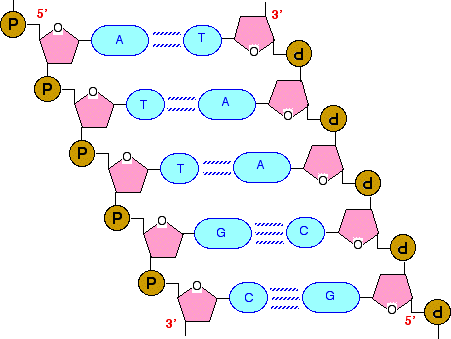
What is a nucleic acid?
300
What happens to an enzyme it binds, make products, and releases those products.
What is it remains unchanged and reusable for the next molecule binding?
300
The reason why lactose intolerance is more common as people older
What is because the human body naturally produces less lactase as we get older?
400
The parts of a nucleotide that make up the backbone of DNA
What are a phosphate group and a pentose-sugar?
400
The difference between "essential" amino acids and "non-essential" amino acids. How much of each are there?
Can only get essential amino acids from food. There are 9 essential amino acids and 11 non-essential amino acids.
400
The two groups that are attached to the central carbon of an amino acid with their chemical formulas?
What are the amino group (NH2) and the carboxyl group (COOH)?
400
Lactose-intolerant individuals lack the functional enzyme lactase in their small intestine. If they drink milk, the sugar lactose passes undigested into the large intestine, causing gas and cramps. Even though their body produces plenty of sucrase (the enzyme that digests table sugar), sucrase cannot break down lactose. Why can't the enzyme sucrase step in and digest lactose sugar when lactase is missing?
What is because enzymes are shape-specific, and the active site of sucrase only fits sucrose, not lactose?
400
The long-term macromolecule storage your body builds when it rearranges the C,H, and O atoms from excess glucose (sugar) in the body
What are lipids, fats, triglycerides?
500
A scientist creates an artificial nutrient gel containing only Carbon, Hydrogen, and Oxygen. Bacteria placed on the gel can make simple sugars, but they cannot duplicate their DNA or produce enzymes. Which two specific chemical elements are missing from the gel that prevented these two processes?
What are Nitrogen and Phosphorus?
500
A spider eats an insect trapped in its web. In its stomach, digestive enzymes break down the insect’s muscle proteins into individual amino acids. Later, the spider’s silk glands link those same amino acid monomers back together to spin a super-strong silk web. What chemical process breaks down the prey's protein polymers in the spider's stomach, and what opposite process links those harvested monomers together to create new silk polymers?
What is hydrolysis in the digestive system, followed by dehydration synthesis in the silk glands?
500
The macromolecule shown below. Hint: shape
What is a carbohydrate (chitin)?
500
During a heavy sprint, lactic acid builds up inside muscle cells, dropping the internal cellular pH from a neutral 7.2 down to an acidic 6.5. As a result, the runner's legs feel heavy and metabolic energy production slows down. How does the sudden increase in acidity affect the active sites of metabolic enzymes inside the muscle cells?
What is it alters the 3D shape of active sites so substrates fit less effectively?
500
Termites eat dry wood made almost entirely of carbohydrate polymers (cellulose). Microbes inside the termite's gut digest the wood into small sugar monomers. The termite's liver-like organ absorbs these sugars and uses their carbon and hydrogen atoms to manufacture fatty acid tails for its own cell membranes. How can an insect that eats only wooden furniture produce the lipid fats needed to build its own cell membranes? (Hint: monomer and elements)
What is by breaking the wood carbohydrates down into simple sugar building blocks, then rearranging those carbon and hydrogen atoms into fatty acid chains?