Building & Identifying Macromolecules
Carbohydrates
Proteins
Lipids
Nucleic Acids
100
Identify the Macromolecule shown below

Carbohydrate
100
List the elements that make up a carbohdyrate
CHO
100
List the elements that make up a protien
CHON, sometimes S
100
List the elements that make up a lipid
CHO, sometimes P
100
List the elements that make up a nucleic acid
CHONP
200
Identify which macromolecule is shown
Lipid (specifically a steroid)
200
List the monomer and polymer of carbohydrates
Monomer: Monosaccharides
Polymer: Polysaccharides
200
Which part of the amino acid varies among the 20 different amino acids?
The -R group (or side chain), attached to the center carbon
200
Identify the type of fatty acid shown
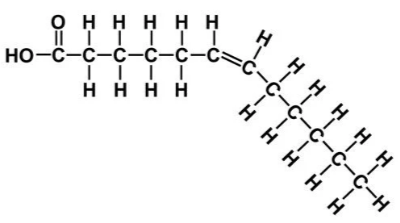
Unsaturated fatty acid
200
List the 3 parts of a nucleotide
Phosphate, sugar, nitrogen base
:max_bytes(150000):strip_icc()/what-are-the-parts-of-nucleotide-606385-FINAL-5b76fa94c9e77c0025543061.png)
300
A cell is joining individual monomers to construct a polymer. Water is removed during the process. What reaction is occurring?
Dehydration Reaction
300
Sucrose is made from two monosaccharides. Therefore, sucrose belongs to which saccharide class?
Disaccharide
300
Draw an amino acid. Label the amino group, center carbon, and the carboxyl group

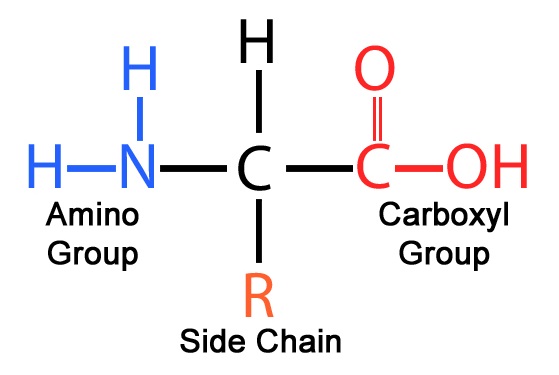
300
Which special lipid contains 4-5 carbon rings?
Steroids
300
Give 3 examples of nucleic acids
DNA, RNA, and ATP
400
A polymer is placed in a solution and breaks into smaller molecules after water is added. Identify the reaction and explain what happened.
Hydrolysis happened; water was added to break the polymer into it's monomers
400
A carbohydrate containing many linked sugar monomers would be classified as which type of saccharide?
Polysaccharide
400
Which letter is pointing to a peptide bond?
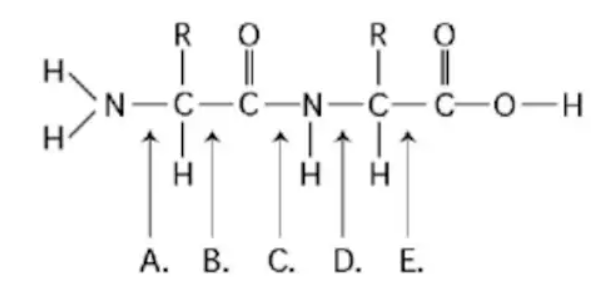
Letter C
400
Draw a phospholipid, label it, and describe it's function
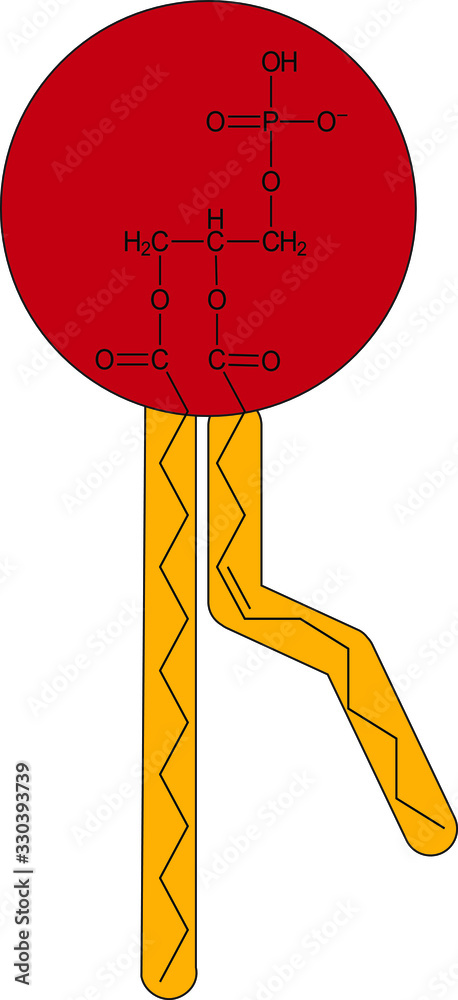
Controls what goes in and out of the cell

400
Explain why phosphorus labeling can be useful for identifying DNA in an experiment.
Nucleic Acids are the only macromolecule that contains phosphorous (besides one of the special lipids)
500
A researcher labels one component of a virus with a radioactive element associated with phosphorus and another component with an element associated with sulfur. After infection, the phosphorus label is detected inside the bacterial cells, while the sulfur label remains outside.
What type of macromolecule could be present in the bacteria cells?
Nucleic Acids; since these macromolecules contain P
500
Give the function of a carbohydrate, and explain the importance of it for biological life
Energy; our cells/bodies need energy to survive and carry out cellular functions
500
Explain one of the functions of a protein, and how that function is important for biological life
Answers will vary. Example: Enzymes, which speed up reactions. This is important for cellular work to be efficient. (Hormones and Antibodies are other examples)
500
Explain the function of a lipd, and how that function is important for biological life
Energy storage; cells need back up energy to do cellular work
500
Give the function of a nucleic acid, and explain the importance of it for biological life
Nucleic acids hold genetic information, which is important when passing along traits from one generation to the next