Predation
Larval Distribution
The Plankton
Plankton Abundance and Distribution
Journal Articles
100
What is the Lotka-Volterra prediction?
coupled oscillations where the prey peaks and the predator peaks shortly after
100
What are the 3 methods of larval release among invertebrates?
1. Direct release of offspring next to the adult
a. viviparous: release crawling juveniles, similar form as adults
b. oviparous: release egg cases which hatch juveniles
2. Lecithotrophic larvae: short-lived swimming larval phase
3. Planktotrophic larvae: extended swimming larval phase
100
What are 3 examples of phytoplankton and their type of covering + 3 examples of zooplankton and their taxonomic groups?
Phytoplankton:
1. Diatoms: silica shell
2. Dinoflagellates: cellulose plates
3. Coccolithophores: calcium carbonate plates (susceptible to ocean acidification)
Zooplankton:
1. Copepods (subclass Copepoda, superclass Crustacea)
2. Krill (order Euphausiacea, superclass Crustacea)
3. Salps - pelagic tunicates (phylum Chordata)
100
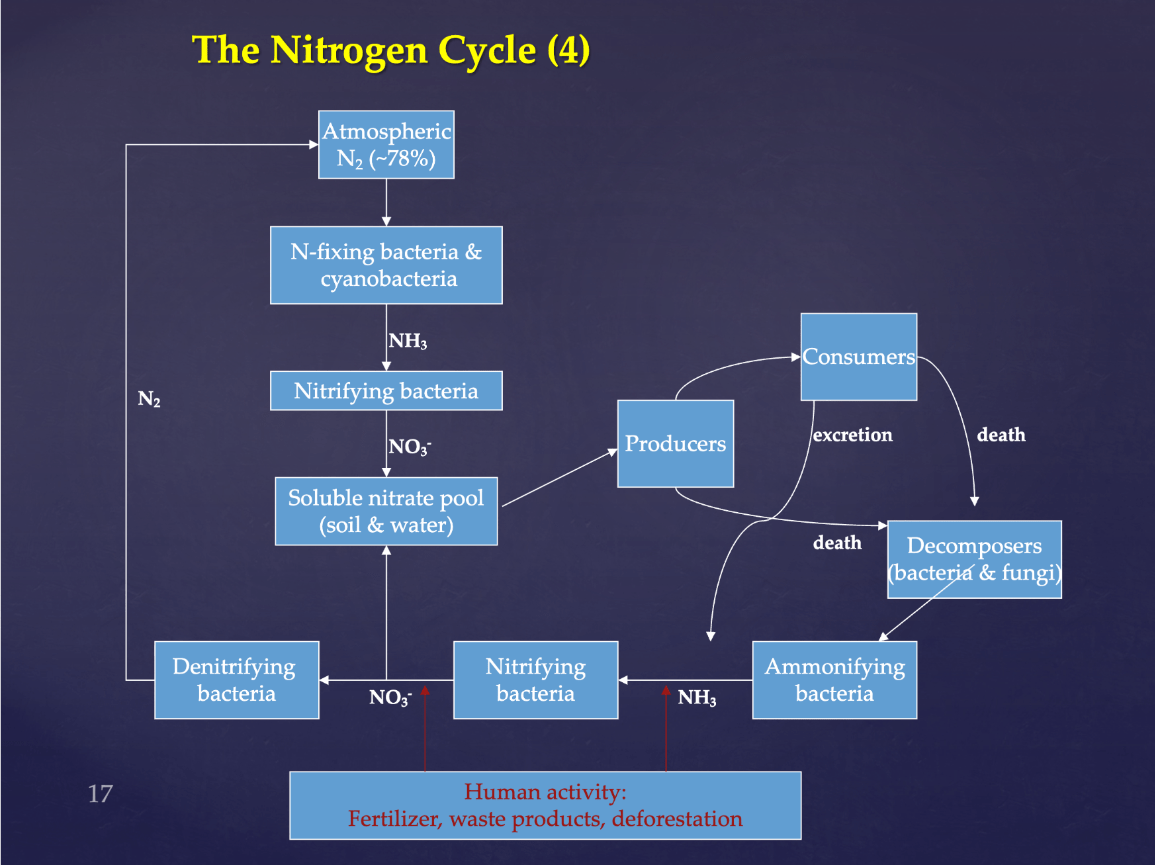
What are the inorganic and organic forms of N2?
What are the most/least abundant forms?
Inorganic Forms: Ammonium (NH4), Nitrite (NO2), and Nitrate (NO3)
Organic Forms: urea, amino acids, peptides
Most abundant: nitrate
Least abundant: organic forms + nitrite
100
Rice et al. (2014) describes the temperature size rule which states that.........
an increase in temperature decreases development time and final adult size
Higher metabolic cost = slower growth
Development rate increasing faster relative to growth rate = reaching maturity before maximum size
200
How does a keystone predator impact its environment?
- Reduces interspecific competition between prey and its competitors
- Prevents competitive exclusion by the dominant species
- Allows a higher species diversity
200
How do egg sizes differ between the 3 types of larval release? What about egg number? Larval mortality?
Direct release: largest egg size, fewest egg number, lowest larval mortality
Planktotrophic: smallest egg size, most egg number, highest larval mortality
Lecithotrophic: in the middle
200
What are planktonic strategies to maintain buoyancy?
1. Depend on currents and water turbulence
2. Reduce organism density
3. External shape that prevents sinking
4. Swim (flagella or undulations)
200
What are the limiting nutrients in ocean systems vs freshwater systems?
Ocean systems: nitrate, then phosphate
Freshwater systems: phosphorous, then nitrate
200
Rice et al. (2014) that studied climate change impact on zooplankton, found that increased temperature causes:
- two of the largest calanoid copepod genera did not appear in surveys after 1993
- reduction in body size of dominant copepod species
- increase in relative proportion of small copepod
300
What's the difference between mullerian and batesian mimicry?
Batesian: an unprotected species resembles one with an effective defense
Mullerian: resemble other distasteful prey, but also have their own defenses
300
What factors enable larvae to locate and settle on a favorable substrate?
1) timing of larval release
2) photopositive/photonegative behavior (Positive: larvae remain near the surface and feed on phytoplankton) (Negative: larvae move to bottom for settlement)
3) adaptation to local currents and tides
4) larval selectivity and settlement cues
300
Identify some of the main larval stages for groups.
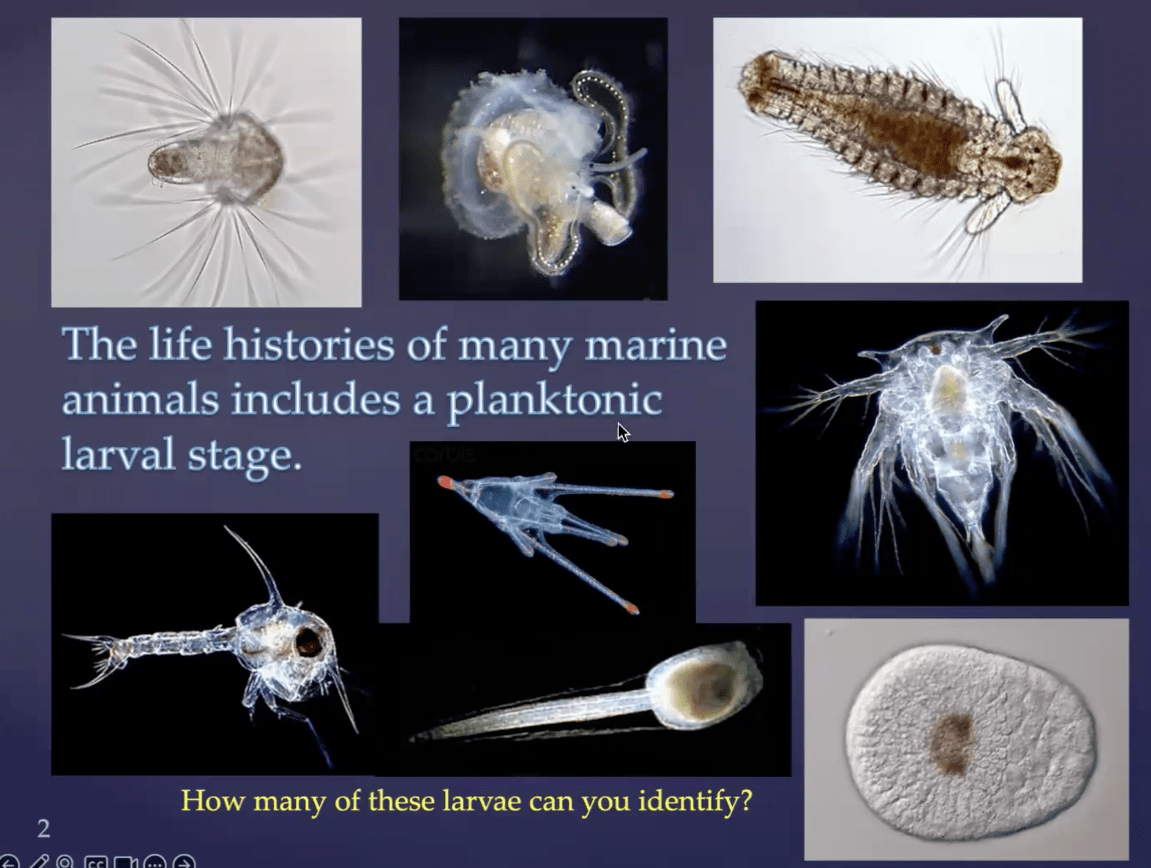
- Tadpole (Chordata)
- Veliger (2nd Gastropod Mollusca stage)
- Trocophore (1st Mollusca & Annelida stage)
- Polychaete (2nd Annelida stage)
- Nauplius (Crustacea)
- Zooea (crab 2nd larval stage)
- Pluteus (Echinodermata)
- Cyprid (barnacle 2nd stage)
- Megalops (crabs 3rd stage)
- Amphiblastula (Porifera)
300
What are some proposed hypotheses for zooplankton diel vertical migration?
1. Strong light hypothesis: zooplankton are affected by UV radiation (damages DNA), leave surface waters
2. Predation hypothesis: leave surface during daytime when they are visible to predators, return to surface waters at night to feed on the phytoplankton
3. Energy conservation hypothesis: it is energetically advantageous to spend the day in colder, deeper water where metabolic rate and energy needs are lower
4. Phytoplankton recovery hypothesis: zooplankton exploit the phytoplankton but dive to allow them to photosynthesize and recover during the day
300
In Koehn and Hilibish (1987), how did the lap94 allele impact mussels, and where did it have the highest frequency?
Mussels carrying the lap94 allele have higher amino acid concentrations
lap94 allele has higher frequency in oceanic populations than in estuarine populations
400
The success of mimicry depends on.....
1) relative abundance of model and mimic
2) discriminatory power of the dupe
3) model and mimic have same behaviors
4) model and mimic existing in same habitat
400
What are the benefits of a planktonic larvae? (even though there is a high mortality)
1) Avoidance of crowding
2) In a local catastrophe some offspring will escape and survive
3) Offspring are spread across habitat types
4) Wider geographic range
400
Describe the paradox of the plankton.
Mixing provides a homogenous, non-structured environment that has limited opportunity for niche diversification.
Well mixed environments are still able to maintain a large number (diversity) of phytoplankton despite constant competition for nutrients and light.
Long-term coexistence of plankton can possibly due to constantly changing conditions/differences in nutrient limitation among competing species.
400
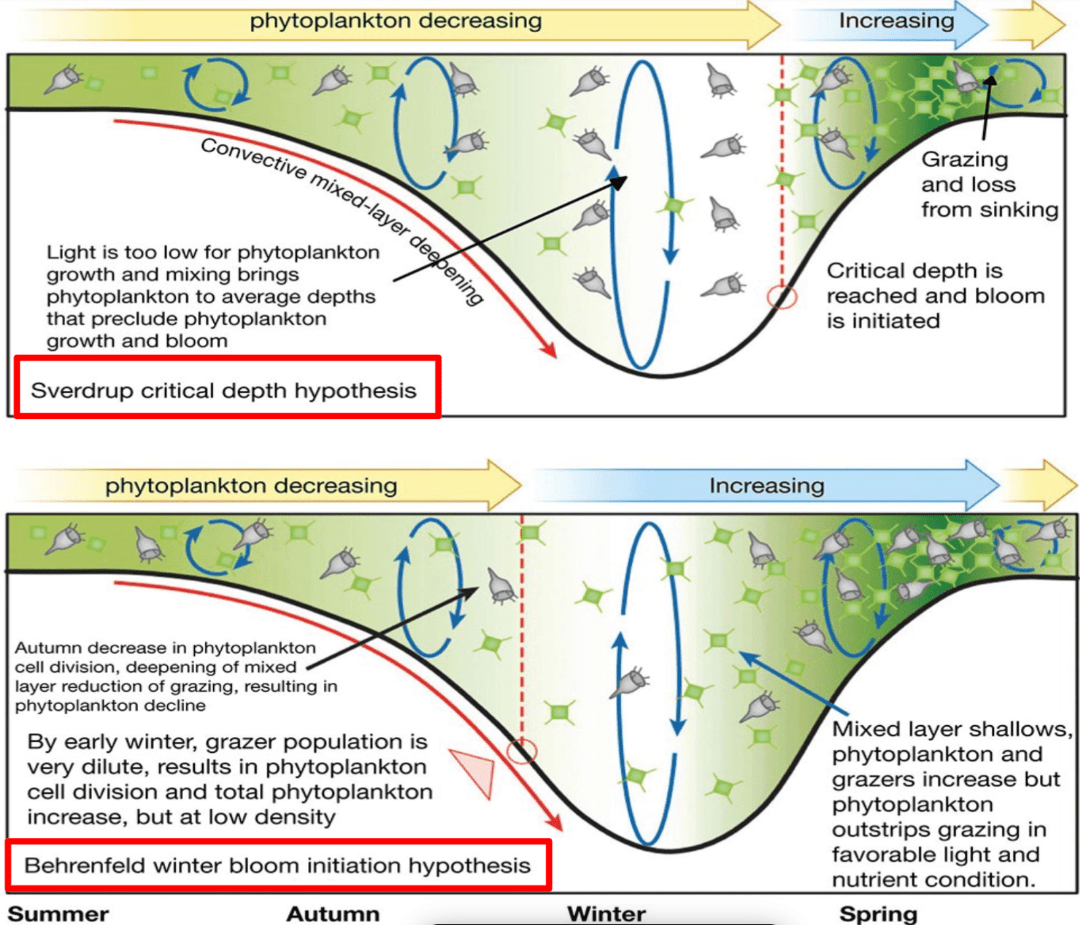
What does the Sverdrup model fail to explain and how does Behrenfeld's model address it?
The Sverdrup model fails to explain why many phytoplankton blooms begin in winter.
Behrenfeld's Model:
1. Although downward mixing is deep, nutrient availability allows slow phytoplankton growth
2. Zooplankton concentration is too low to prevent overall increase in phytoplankton abundance
3. As mixing layer decreases, phytoplankton density increases more rapidly than zooplankton grazing, resulting in a bloom
Comparison of the models:
400
In Lubchenco (1980), what are the upper and lower limits of Fucus sp. and Chondrus crispus set by?
Fucoids: lower limit set by competitions with Chondrus crispus, upper limit set by dessication. If Fucus colonizes a patch in the lower zone Chondrus settles beneath the Fucus canopy, eventually occupying it.
Chondrus: upper limit due to dessication, lower limit dependent on sea urchin grazing
500
Describe Huffaker's (1958) experiment.
Created a "patchy universe" to explore predator-prey relationships in mites
The universe: Arrays of oranges, separated by petroleum jelly barriers, intermixed with rubber balls that had no resources
The first attempt of his experiment consisted of 20 oranges alternating with rubber balls - found that predator drives prey to extinction, then starves
In Huffaker's more complex 3-dimensional universe, oscillations of predator and prey occur.
500
What are the two types of strategies for planktonic larvae of estuarine species?
Cost/Benefits of each?
Strategy 1: move upward during flood tides, and downward at ebb tide. (Stay within estuary)
Costs: Estuary is a nursery ground (more predators)
Benefits: Fewer lost out at sea, stay in suitable habitat
Strategy 2: move upward during ebb tide, and downward during flood tide. (larvae move out to coastal waters)
Costs: might not make it back
Benefits: less predation
500
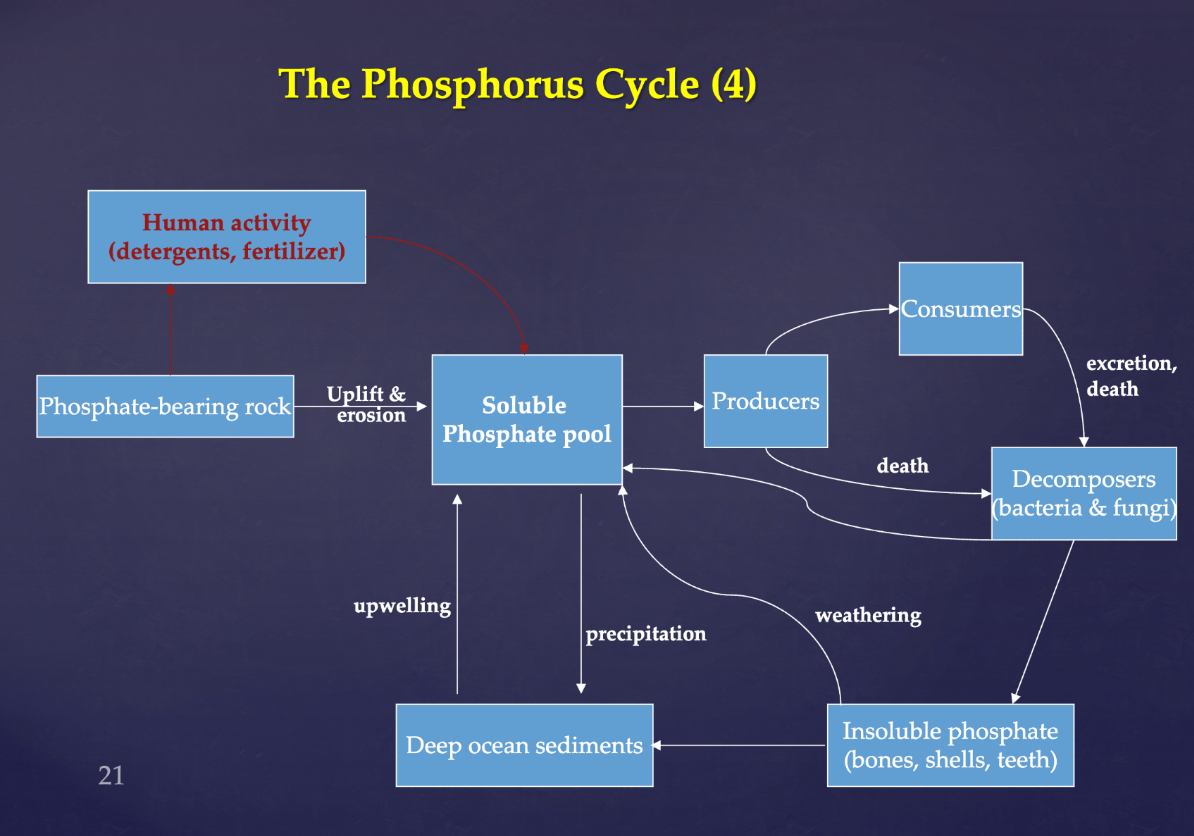
Outline the main points involved with the cycling of nitrogen and phosphorous in marine systems.
The nitrogen cycle is a biologically-based process (bacteria heavily involved) while the phosphorous cycle is more geochemically-based.
500
Describe the Sverdrup critical depth hypothesis.
1. In winter, extensive vertical mixing limits the phytoplankton growth, as there is no light available for photosynthesis
2. A lengthening photoperiod increases the compensation depth
3. The spring thermocline generated by solar heating stabilizes the water column, and mixing depth decreases
4. If the mixing depth is less than the critical depth a bloom may develop
5. Nitrates and phosphates are available to fuel the bloom as a result of vertical mixing during winter
500
In Koehn and Hilibish (1987) why is the lap94 allele not favored in adult mussels in estuarine habitats?
Too energy costly, lap94 expends nitrogen reserves, excrete more primary amines, greatest net loss of nitrogen nutrients