Mass
Concentration
States of Matter/Phase Changes
Chemical Reaction
Mixtures & Solutions
100
What is mass?
Mass is the amount of matter in an object.
100
Two solutions are made with the same amount of water.
Solution A is made with 15g of solid.
Solution B is made with 7g of solid.
Solution C is made with 24g of solid.
Which solution is the MOST concentrated?
Solution C is the MOST concentrated because it has the most solute.
100
Name the 3 states of matter.
Solid, Liquid, Gas
100
What was the name of the gas that was produced when we mixed baking soda and citric acid together?
Carbon Dioxide
100
What is the difference between a mixture and a solution?
They both involve mixing two or more things together, but solutions occur when one substance dissolves into another.
200
A student combined 40g of salt with 100g of water, then he let the solution set for many days until the water evaporated. What was the mass of solid remaining in the cup after all the water had evaporated?
40 g of salt would be remaining because solids don't evaporate with the water.
200
Two solutions are made with the same amount of water.
Solution A is made with 15g of solid.
Solution B is made with 7g of solid.
Solution C is made with 24g of solid.
Which solution is the LEAST concentrated?
Solution B is the LEAST concentrated because it has the least solute.
200
A cup of water is left on the counter all week. By the end of the week, most of the water is gone. What process was happening?
Evaporation
200
Combining calcium chloride and water together created a chemical reaction that produced ______ .
Heat - Calcium chloride is also referred to and used as as "road salt" for that reason.
200
Which tool is best to use when separating a mixture of water and gravel? (Sometimes more than one tool will work, but which would be the BEST?)
A screen. The water will pass directly though the small holes of the screen, but the gravel pieces are large enough to be kept on top of it. A filter could work, but it wouldn't be as efficient.
300
A student adds 4 spoons of solid to 50mL of water. The solution is clear with nothing on the bottom of the cup. One spoon of the solid has a mass of 5g. What is the mass of the solution?
4 x 5g = 20g of solid
50mL water + 20g solid = 70 grams
300
What is the word to describe a solution that is so highly concentrated that you can no longer dissolve any more solute into it?
Saturated
300
Which state of matter has molecules that are very tightly packed together?
Solid
300
When you mix baking soda and vinegar, what happens to the two materials inside the cup?
A - They create a chemical reaction that produces light.
B - They make a cool color.
C - No change occurs.
D - They create a chemical reaction that starts bubbling.
D - They create a chemical reaction that starts bubbling.
300
Dan combines salt and water. He stirs them together and after a few minutes, the water is foggy and there is salt buildup on the bottom of the cup. A girl uses a paper filter to separate the undissolved salt from the water. Why does the solid stay in the filter and the liquid goes through the filter?
The solid particles of salt are larger than the small holes in the filter, so they stay on top.
400
A student makes a batch of granola. He measures out these ingredients.
50 g of honey (H)
75 g of almonds (A)
25 g of berries (B)
100 g of oats (O)
Describe the relationship between the mass of the ingredients and the mass of the mixture before baking.
Answer: The mass of the ingredients individually will be the same as the mass of them mixed together.
400
Which solution would be more dense?
Solution A: 100mL of water and 20g of salt
Solution B: 100mL of water and 30g of salt
Solution B would be more dense than Solution A because it is more concentrated.
400
It's cold outside and the kids in the car notice their window fogging up and water drops forming. What process is happening?
Condensation
400
When you bend a glow stick, what happens to the two materials inside the glow stick?
A: They make a cool color.
B: They create a chemical reaction that produces heat and light.
C: They create a chemical reaction that starts bubbling.
D: No change occurs.
B: They create a chemical reaction that produces heat and light.
400
Explain the steps and tools needed to separate a mixture of water, gravel, paper clips, and pepper.
1. Use a magnet to separate the paper clips.
2. Use a screen to separate the gravel.
3. Use a filter to separate the pepper.
500
A student adds 12 spoons of solid to 100mL of water. The solution is clear with nothing on the bottom of the cup. One spoon of the solid has a mass of 5g. What is the mass of the solution?
12 x 5g = 60g of solid
100mL water + 60g solid = 160 grams
500
Which solution is the most concentrated?
Solution A: 50g salt, 100mL water
Solution B: 75g salt, 200mL water
Solution C: 20g salt, 300mL water
Solution A is the most concentrated.
500
Correctly identify these states of matter.
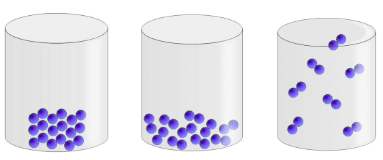
Solid, Liquid, Gas
500
When a chemical reaction occurs, ____________ .
A: things always blow up
B: heat is always produced
C: new products form
D: it forms a solution
C: new products form
500
What are two ways to prove that when citric acid dissolves in water, it's still there even though you can no longer see it?
1. You can evaporate the water, leaving behind citric acid crystals proving that it was still in the water.
2. Compare equal volumes of the solution and plain water on a balance. The citric acid solution will be heavier than the water, proving the citric acid is still in the water.