Trigonometric Equations
Law of Sines
Law of Cosines
Vectors
Polar Coordinates
100
SLO No. 1, 3, 4, 5, 17
Using algebraic techniques and the relevant trigonometric identities, solve the following trig equation for all solutions on the interval [0, 2π).
4sin(x) (sin(3x)cos(2x) - cos(3x)sin(2x)) – 3

4sin(x) (sin(3x)cos(2x) - cos(3x)sin(2x)) – 3
Use subtraction/difference identity
4sin(x) (sin(x)) – 3
4sin^2(x) – 3
sin^2 = ¾
x = sqrt(3/4) x = -sqrt(3/4)
x = sqrt(3) / 2 x = -sqrt(3) / 2
On [0, 2π):
x = π/3, 2π/3, 4π/3, 5π/3
All solutions:
x = π/3 + 2πk,
2π/3 + 2πk,
4π/3 + 2πk,
5π/3 + 2πk
100
SLO No. 14, 16
Side A is opposite of angle A, side B is opposite of angle B, and side C is opposite of angle C.
Solve for Side C. Round to 2 decimal places.

Law of Sines says sin(∠a) / a = sin(∠b) / b = sin(∠c) / c
sin(60°) / 8.5 = sin(∠a) / 4.2
4.2sin(60°) = 8.5sin(∠a)
4.2sin(60°) / 8.5 = sin(∠a)
∠a = asin(4.2sin(60°) / 8.5)
∠a = 25.34°
∠c = 180° - 25.34° - 60° = 94.60°
sin(60°) / 8.5 = sin(94.6°) / C
Csin(60°) = 8.5sin(94.6°)
C = 8.5sin(94.6°) / sin(60°)
Side C = 9.78
100
SLO No. 14, 16
Side A is opposite of angle A, side B is opposite of angle B, and side C is opposite of angle C.
Solve for angle A. Round to 2 decimal places.

a^2 = b^2 + c^2 - 2 * b * c * cos(angle)
so a^2 - b^2 - c^2= - 2 * b * c * cos(angle)
and (a^2 - b^2 - c^2) / -2 * b * c= cos(angle) so
angle = acos((a^2 - b^2 - c^2) / -2 * b * c)
if a = 11 and b = 42 and c = 36
angle = acos((11^2 - 42^2 - 36^2) / -2 * 42 * 36)
angle A = 13.62
100
SLO No. 6, 7, 8
Determine the magnitude and direction of the following vectors, and express them in component form. Round to 2 decimal places
-9i + 23j
-9i + 23j
2i - 3j
4i + 8j = <4, 8>
Magnitude = sqrt(4^2 + 8^2) = 8.94
Direction = atan(8/4) = 63.43°
-9i + 23j = <-9, 23>
Magnitude = sqrt(9^2 + 23^2) = 24.7
Direction = atan(23/-9) = 111.37°
2i - 3j = <2, -3>
Magnitude: sqrt(2^2 + 3^2) = 3.61
Direction: atan(-3/2) = 123.7°
100
SLO No. 18, 19, 20
Convert the cartesian coordinates to polar coordinates, and represent it in in 2 different ways. Then, plot it on the polar plane.
(x, y) = (4, 6.9282)
r = sqrt(x^2 + y^2)
and θ = atan(y/x)
so r = sqrt(4^2 + 6.9282^2) = ±8
and θ = atan(6.9282 / 4) = pi / 6
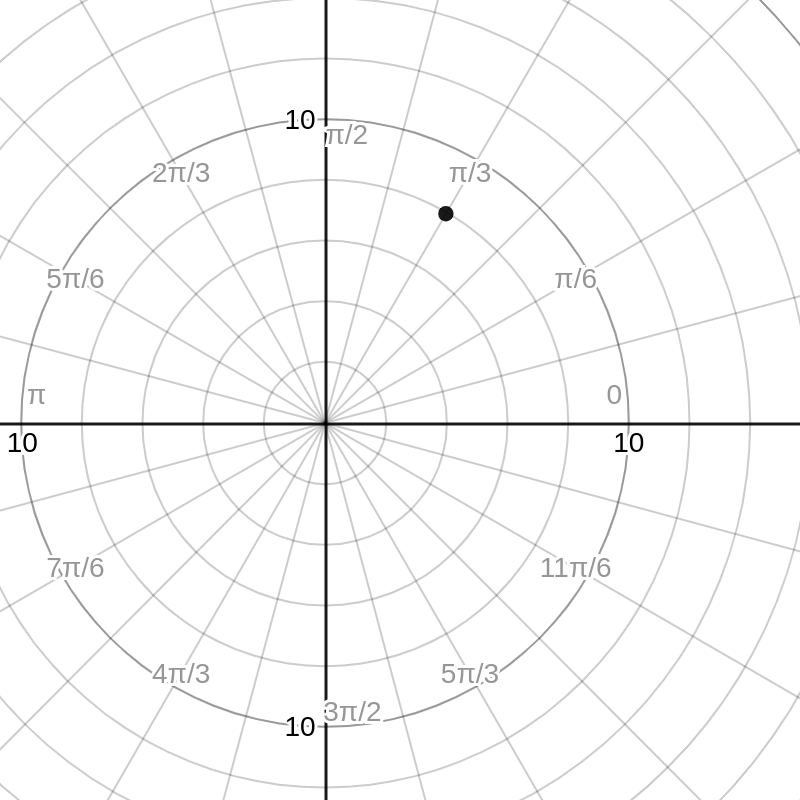
so (r, θ) = (8, π/3) = (-8, 4π/3)
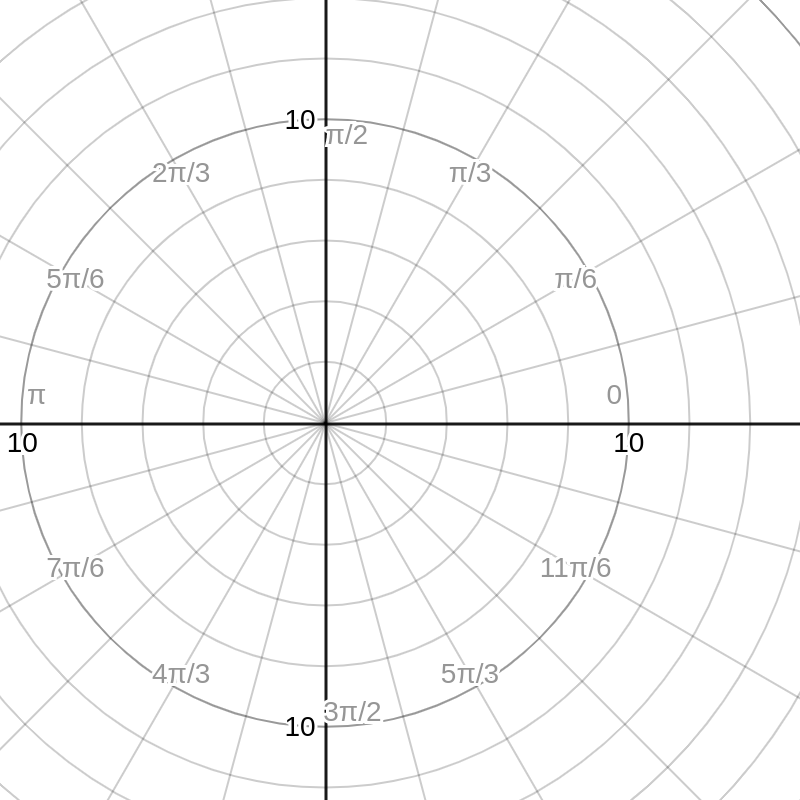
Proper location on the polar plane:
200
SLO no. 3, 4, 5, 17
Using algebraic techniques and the relevant trigonometric identities, solve the following trig equation for all solutions and solutions on the interval [0, 2pi).
2sin(x)^3 - ( 1 - ( 1 / sec^2(x) ) ) - 2sin(x) + 1

2sin(x)^3 - ( 1 - ( 1 / sec^2(x) ) ) - 2sin(x) + 1
Use 1 / sec^2 = cos^2
2sin(x)^3 - ( 1 - cos^2(x) ) - 2sin(x) + 1
Use pythagorean identity sin^2 + cos^2 = 1 so sin^2 = 1 - cos^2
2sin(x)^3 - sin^2(x) - 2sin(x) + 1
sub sin(x) for x
2x^3-x^2-2x+1
pull out x^2
x^2(2x - 1) - 2x + 1
x^2(2x - 1) - (2x - 1)
pull out (2x - 1)
(2x - 1)(x^2 - 1)
factor x^2 - 1
(2x - 1)(x + 1)(x - 1)
x = 1/2 x = 1 x = -1
On [0, 2π):
x = π/6, π/3, 5π/6, 3π/2
All solutions:
x = π/6 + 2πk,
π/3 + 2πk,
5π/6 + 2πk,
3π/2 + 2πk
200
SLO No. 14, 16
Side A is opposite of angle A, side B is opposite of angle B, and side C is opposite of angle C.
Solve for Side A and Side B. Round to two decimal places.

Law of Sines says sin(∠a) / a = sin(∠b) / b = sin(∠c) / c
∠c = 180° - 25° - 30° = 125°
sin(125°) / 13 = sin(25°) / B
Bsin(125°) = 13sin(25°)
B = 13sin(25°) / sin(125°)
B = 6.71 in
sin(125°) / 13 = sin(30°) / C
Csin(125°) = 13sin(30°)
C = 13sin(30°) / sin(125°)
B = 7.94 in
200
SLO No. 13, 14, 16
Side A is opposite of angle A, side B is opposite of angle B, and side C is opposite of angle C.
Solve for Side B. Use the 2 given sides and the included angle to determine the area. Round to 2 decimal places.

Law of Cosines says b^2 = a^2 + c^2 - 2ac * cos(angle) so
b = sqrt(a^2 + c^2 - 2ac * cos(angle))
b = sqrt(19^2 + 15^2 - 2 * 19 * 15 * cos(30°))
Side B = 9.61
Area of triangle with 2 sides and included angle =
(side1 * side2 * sin(angle)) / 2
so area = (19 * 15 * sin(30°)) / 2
area = 71.25
200
SLO No. 10
Add and subtract the 2 vectors given.
<5, 10>
3i - 5j
Adding them is just adding the components:
< 5 + 3, 10 - 5 > = < 8, 5 >
Subtracting them is just subtracting each component:
< 5 - 3, 10 + 5 > = < 2, 15 >
200
SLO No. 18, 19, 20
Convert the given polar cordinates to cartesian coordinates, and determine if the they are equal. Round to one decimal place.
(-6, 4π / 3)
(6, π / 6)
x = rcos(θ) and y = rsin(θ)
so x = 6cos(π / 3) and y = 6sin(π / 3)
so x = 3 and y = 5.2
and
so x = -6cos(4π / 3) and y = -6sin(4π / 3)
so x = 3 and y = 5.2
(x, y) = (3, 5.2)
The two are equal, since the conversion is results the same, but also because the radius was flipped and the angle had 180 degrees added.
300
SLO no. 1, 3, 4, 5, 17
Using algebraic techniques and the relevant trigonometric identities, solve the following trig equation for all solutions and solutions on the interval [0, 2pi).
4cos^2(x) – 2sqrt(3)cos(x) = -2cos(-x)cos(2x) + 2sin(-x)sin(2x) + sqrt(3)

4cos^2(x) – 2sqrt(3)cos(x) = -2cos(-x)cos(2x) + 2sin(-x)sin(2x) + sqrt(3)
4cos^2(x) – 2sqrt(3)cos(x) = -2(cos(-x)cos(2x) - sin(-x)sin(2x)) + sqrt(3)
Use addition formula
4cos(x)^2 – 2sqrt(3)cos(x) = -2cos(-x + 2x) + sqrt(3)
Move right side to left side
4cos (x)^2 – 2sqrt(3)cos(x) + 2cos (x) – sqrt(3)
Sub cos(x) for x
4x^2 – 2sqrt(3)x + 2x – sqrt(3)
Pull out 2x
2x(2x – sqrt(3)) + (2x – sqrt(3))
Pull out (2x - sqrt(3))
(2x – sqrt(3)) (2x + 1)
x = sqrt(3) / 2 x = -1/2
On [0, 2π):
x = π/6, 11π/6, 2π/3, 4π/3
All solutions:
x = π/6 + 2πk,
11π/6 + 2πk,
2π/3 + 2πk,
4π/3 + 2πk
300
SLO No. 14, 16
Three points in space exist as point A, point B, and point C. Point A is 30 inches from point B, and point C is 10 inches from point A. If the angle at point C is 45 degrees, find the distance from point B to point C. Round to three decimal places.
Law of Sines says sin(∠a) / a = sin(∠b) / b = sin(∠c) / c
∠c = 45°, and side C = point A to point B = 30 in
and point B to point C = side A
so we need ∠a to solve for side A
sin(45°) / 30 = sin(∠a) / 10
sin(45°) / 30 = sin(∠a) / 10
10sin(45°) = 30sin(∠a)
10sin(45°)/30 = sin(∠a)
∠a = asin(10sin(45°)/30)
∠a = 13.63°
sin(45°) / 30 = sin(13.63°) / x
xsin(45°) = 30sin(13.63°)
x = 30sin(13.63°) / sin(45°)
x = 36.225 in
300
SLO No. 14, 16
Kacy and Jack were standing out in a field, 50 meters from each other. If Jack walks 10 meters forwards in a straight line 45 degrees to the left of Kacy, how far is Jack from Kacy’s original location?
Law of Cosines says
b^2 = a^2 + c^2 - 2ac*cos(angle) so
b = sqrt(a^2 + c^2 - 2ac*cos(angle))
We are given 50 meters, 10 meters, with included angle 45 degrees.
b = sqrt(50^2 + 10^2 - 2 * 50 * 10 * cos(angle))
b = 43.5 meters apart
300
SLO No. 6, 8
Given the magnitude 5 and direction π/3, determine the component form of the vector and express it in terms of I and J.
x = 5 * cos(π/3), y = 5 * sin(π/3)
< 2.5, 4.3 > = 2.5i + 4.3j
300
SLO No. 20, 21
Convert the following 2 equations from rectangular form to polar form.
y = 18
(x-2)^2 + (x - 3)^2 = 5
y = 18
since y = rsin(θ)
rsin(θ) = 18
r = 18 / sin(theta)
(x-2)^2 + (x – 3)^2 = 5
(rsin(θ) - 2)^2 + (rcos(θ) - 3)^2 = 5
r^2sin^2(θ) - 4 + r^2cos^2(θ) - 9 = 5
r^2sin^2(θ) + r^2cos^2(θ) = 18
r^2(sin^2(θ) + cos^2(θ)) = 18
r^2 = 18
r = ±sqrt(18)
400
SLO no. 2, 3, 4, 5, 17
Using algebraic techniques and the relevant trigonometric identities, solve the following trig equation for all solutions and solutions on the interval [0, 2pi).
2cos((a + b) / 2)sin((a - b) / 2) = ( -0.5(cos(a - b) - cos(a + b)) ) / sin(a)

2cos((a + b) / 2)sin((a - b) / 2) = ( -0.5(cos(a - b) - cos(a + b)) ) / sin(a)
Use Product-to-Sum Identity
sin(a) - sin(b) = ( -0.5(cos(a - b) - cos(a + b)) ) / sin(a)
Use Sum-to-Product Identity
sin(a) - sin(b) = -sin(a)sin(b) / sin(a)
Cancel out sin(a)
sin(a) - sin(b) = -sin(b)
Add sin(b) to both sides
sin(a) = 0
On [0, 2π):
x = 0, π
All solutions:
x = πk
400
SLO No. 14, 16
Rohan had 3 tasks to complete today. He had to go to work, get a haircut, then come home, respectively. These 3 locations form a triangle. The distance between his home and work is 430 yards, and the angle at the haircut place measures 60 degrees. If the distance between his home and the haircut place is 200 yards, how far will Rohan have to travel to get to the haircut place? Round to one decimal place.
Law of Sines says sin(∠a) / a = sin(∠b) / b = sin(∠c) / c
sin(60°) / 430 = sin(∠a) / 200
200sin(60°) = 430sin(∠a)
200sin(60°) /430 = sin(∠a)
∠a = asin(200sin(60°) /430)
∠a = 23.08°
∠b = 180° - 23.08° - 60° = 92.92°
sin(60°) / 430 = sin(92.92) / x
xsin(60°) = 430sin(92.92)
x = 430sin(92.92) / sin(60°)
x = 492.9 yards
400
SLO No. 14, 16
Jim and Nancy each have a compass, which they are using to measure which direction they are walking in. Jim walks 10deg north of east, and Nancy walks 35 deg south of west. If Jim walks 5 units per minute, and Nancy walks 7 units per minute, how far apart will they be after 5 minutes? Round your answer to four decimal places.
After 5 minutes,
Jim travelled 5 * 5 = 25 units, and
Nancy travelled 5 * 7 = 35 units.
Law of Cosines
b^2 = a^2 + c^2 - 2ac*cos(angle) or
b = sqrt(a^2 + c^2 - 2ac*cos(angle))
so answer = sqrt(25^2 + 35^2 - 2 * 25 * 35 * cos(135°))
Nancy and Jim are approximately 55.5647 units apart after 5 minutes.
400
SLO No. 10
Multiply the vectors given by a scale factor of 3:
<10, 17>
<3, 1>
Multiplying vectors is as simple as multiply each component by the scalar.
<10, 7> * 3 = < 10 * 3, 7 * 3 > = <30, 21>
<3, 1> * 3 = < 3 * 3, 1 * 3 > = <9, 3>
400
SLO No. 20, 21
Convert the equations from polar form to rectangular form, then match the equation to its graph.
r = -5cos(θ)
r = 8 / (sin(θ) - 7cos(θ))
SOH opposite / hypotenuse
CAH adjacent / hypotenuse
TOA opposite / adjacent
For:
r = -5cos(θ)
cos = ajacent / hypotenuse
where hypotenuse = r
and adjacent = x
so r = -5x / r
r^2 = -5x
we can use x^2 + y^2 = r^2
so x^2 + y^2 = -5x or x = (x^2 + y^2) / -5
For:
r = 8 / (sin(theta) - 7cos(theta))
r(sin(theta) - 7cos(theta)) = 8
Since sin = y/r and cos = x/r
r(y / r - 7x / r) = 8
y - 7x = 8
y = 7x + 8
500
SLO no. 2, 3, 4, 5, 17
Using algebraic techniques and the relevant trigonometric identities, solve the following trig equation for all solutions and solutions on the interval [0, 2pi).
(sec^2(2x) - 1) - ( sin(4x) / (1 + cos(4x)) ) - (2sqrt(3)tan(x)) / (1 - tan^2(x)) + sqrt(3)

(sec^2(2x) - 1) - ( sin(4x) / (1 + cos(4x)) ) - (2sqrt(3)tan(x)) / (1 - tan^2(x)) + sqrt(3)
Use pythagorean identity tan^2 + 1 = sec^2 therefore tan^2 = sec^2 - 1, and use Half-Angle formula.
tan^2(2x) – tan(2x) - (2sqrt(3)tan(x)) / (1 - tan^2(x)) + sqrt(3)
Reformat to fit Double-angle formula for tan
tan^2(2x) – tan(2x) – sqrt(3) (2tan(x)) / (1 - tan^2(x)) + sqrt(3)
Use Double-angle formula
tan^2(2x) – tan(2x) – sqrt(3)tan(2x) + sqrt(3)
Sub tan(2x) for x
x^2 – x – sqrt(3)x + sqrt(3)
Pull out x
x(x – 1) – sqrt(3)x + sqrt(3)
Pull out sqrt(3)
x(x – 1) – sqrt(3)(x – 1)
Pull out (x - 1)
(x – sqrt(3))(x – 1)
x = sqrt(3) x = 1
tan(2x) = sqrt(3) and tan(2x) = 1
On [0, 2π):
x = π/8, π/6, 5pi/8, 2π/3, 9π/8, 7π/6, 13π/8, 4π/3
All solutions:
x = π/8 + πk / 2,
π/6 + πk / 2
500
SLO No. 14, 16,
A triangle is formed between 2 phone towers and a mountain. The distance between the 2 phone towers is 300 yards, and the angle at the mountain measures 45 degrees. If the angle at one phone tower 1 measures 30 degrees, how far apart are each of the phone towers from the mountain?
Law of Sines says sin(∠a) / a = sin(∠b) / b = sin(∠c) / c
sin(45°) / 300 = sin(30°) / x
xsin(45°) = 300sin(30°)
x = 300sin(30°) / sin(45°)
distance between phone tower 2 and mountain = 212.13
Angle at phone tower 2 = 180° - 30°- 45° = 105°
sin(45°) / 300 = sin(105°) / x
xsin(45°) = 300sin(105°)
x = 300sin(105°) / sin(45°)
distance between phone tower 1 and mountain = 409.8
500
SLO No. 12, 14, 16
Aubrey, Layla, and Eva were talking in a group. Aubrey was standing 7 feet from Layla, Layla was standing 8 feet from Eva, and Eva was standing 12 feet from Aubrey. Solve for the three angles, and figure out its area. Round to one decimal place.
Law of Cosines says
b^2 = a^2 + c^2 - 2ac*cos(angle) so
b^2 - a^2 - c^2= -2ac*cos(angle) and
(b^2 - a^2 - c^2) / -2ac = cos(angle) so
angle = acos((b^2 - a^2 - c^2) / -2ac)
Angle one = acos((b^2 - a^2 - c^2) / -2ac)
Angle two = acos((a^2 - b^2 - c^2) / -2bc)
Angle three = acos((c^2 - a^2 - b^2) / -2ab)
if a = 7, b = 12, c = 8
Angle one = 106.1°
Angle two = 34.1°
Angle three = 39.8°
Area is determined by Heron's formula
s = (a + b + c) / 2
if a = 7, b = 12, c = 8
then s = 13.5
area = sqrt(s(s - a)(s - b)(s - c))
if if a = 7, b = 12, c = 8, s = 13.5
then area = 26.9
500
SLO No. 7, 8, 10, 11, 20
Augustina was traveling by boat to France. The windspeed was measured to be 10 mph bearing N20°S. The water current was moving 4 mph bearing W30°N. Express the vector for windspeed and the vector for the water current in component form, and in terms of I and J. What direction is Augistina's boat moving in, and how fast is it moving?
Windspeed vector: < 10cos(90 – 20), 10sin(90 – 20) > = < 3.4, 9.4 > = 3.4i + 9.4j
Water current vector: < 4cos(180 – 30), 4sin(180 - 30) > = < -3.5, 2 > = -3.5i + 2j
True velocity vector = < 3.4 + -3.5, 9.4 + 2 > = < -0.1, 11.4 >
Speed = sqrt(0.1^2 + 11.4^2) = 11.4
Direction = atan(11.4 / 0.1) = 89.5°
500
SLO No. 22
Determine the equation for the following graphs, and classify the name of the shape.
Graph 1:
Graph 2:
Graph 3:
Graph 4:
Graph 5:
Graph 6:
Graph 7: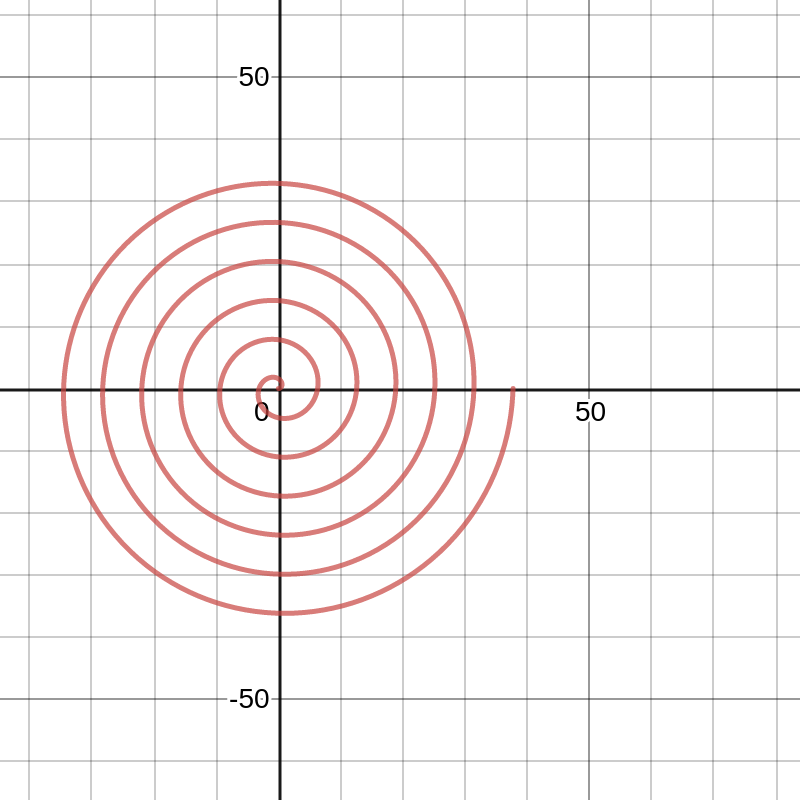
Graph 1 is a Limaçon, the equation is r = 3 - 2sin(θ)
Graph 2 is also a Limaçon, the equation is r = 1 + 3cos(θ)
Graph 3 is a rose curve, the equation is r = 10sin(3θ)
Graph 4 is also a rose curve, the equation is r = 2cos(4θ)
Graph 5 is a lemniscate, the equation is r^2 = 5^2 * sin(2θ) or r = sqrt(5^2 * sin(2θ))
Graph 6 is a Limaçon, but also a cardioid, and the equation is r = 10 + 10cos(θ)
Graph 7 is a spiral, the equation is r = θ