Log Functions
Properties of Logs
Common/Natural Logs
Computing or Solving
Randomness
200
The exponential form of this is what?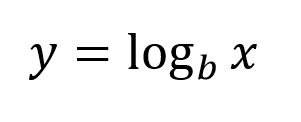
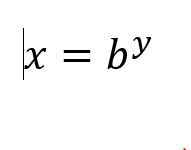
200
Why is this the definition of one of the properties of logarithms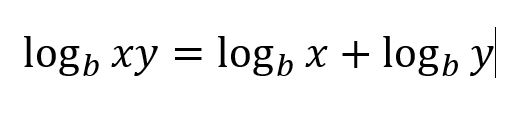 ?
?
Since logarithms deal with exponents or powers, if you multiply two of them, the result should be addition.
200
This number is the base of the Natural Logarithm
What is e or Euler's number (2.718281828)
200
This can be simplified without a calculator to get full credit.
log_9 x=5/2
What is 243
200
If two equations are inverse functions, then they can be reflected about what line?
What is y=x
300
The one word description of a logarithm
exponent or power
300
This can be written as a single log:
4log2A+6log2B
What is log2A4B6
300
A logarithm with no explicit base is named this type of a logarithm
What is a Common Logarithm
300
Solve for x: 7x=738
x=log(738)/log(7) =3.393
300
Plutonium-241 decays according to the function A(t)=A_0e^(-0.053t) where t is the time in years. Find the half life if you start with 500 g.
What is 13 years
400
A logarithmic function is the inverse of these functions.
What are Exponential Functions
400
This can be written as a single logarithm
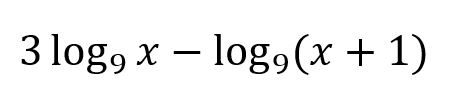
What is: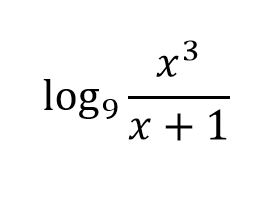
400
The value of log 10000 is this.
What is 4?
400
This can be simplified:
log_5 (8-3x)=3
x=-39
400
A midwestern city with a population of 1 million finds its population is increasing at a rate of P(t)=P_0e^(0.4t) how long will it take for the population to reach 2.3 million people?
What is 2.1 years
500
Express in log form: 9x=50
What is log950=x
500
This can be written as the sum and difference of multiple logarithms:
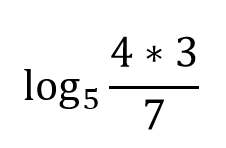
What is:
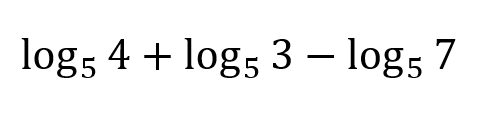
500
This has an exact value:
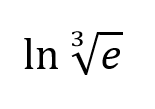
What is 1/3
500
Solve for x: Round to 3 decimal places
log (9x-5)=3+log(x-2)
What is x=2.023
500
Solve for x: Round answer to 3 decimal points
3^(x-4)=7^(2x+5)
What is: -5.057
600
Express in exponential form:
log_12 x=5
What is
12^5=x
600
This is a property of logarithms and has a value:
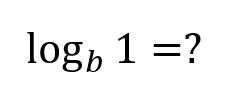
What is zero
600
Compute using the change of base theorem:
log37. Write exact solutions.
What is
log 7/ log3
600
Solve for x:
e^(1-3x)*e^5x=2e
What is x=0.347
600
Find the inverse of the following equation and state the domain of the inverse:
f(x)=(2x+6)/(x-3)
What is:
f^-1(x)=(3x+6)/(x-2)
D=(-oo,2)U(2,oo)