When did we learn this again???
You're just a bump on a LOG
You gotta follow the LAW!
$$$$$$
That's EXPONENTIAL!
100
A large koi pond is filled from a garden hose at the rate of 10 gal/min. Initially the pond contains 150 gal of water.
Find a linear function V that models the volume of water in the pond at any time t.
If the pond has a capacity of 1,250 gal, how long does it take to completely fill the pond?
V = 10t + 150
t = 11
100
What is the word that indicates the COMMON logarithm? And what is its base?
(Hint: it's one of the buttons on your calculator!)
"LOG", base 10
100
Solve for x:
\log_6(x)=5
x = 7,776
100
This is the equation for what?
A(t)=P(1+\frac{r}{n})^{nt}
Compound Interest
100
A radioactive mass decays so that at time t (in days) the mass remaining is m(t) kg, and is given by the function:
m(t) = 23e^{-0.0016t}
How many kg was the mass initially?
23 kg
200
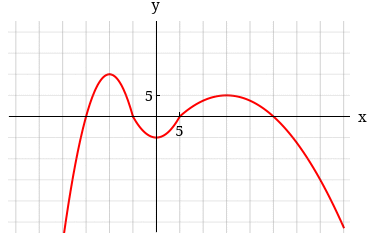
Find all minimums/maximums, and find where the graph is increasing and decreasing.
Min: (0, -5)
Max: (-10, 10)
Max: (15, 5)
Increasing: (-\infty, -10) \cup (0, 15)
Decreasing: (-10, 0) \cup (15, \infty)
200
What is the word that indicates the NATURAL logarithm? And what is its base?
(Hint: it's one of the buttons on your calculator!)
"LN", base e
200
Solve for x:
log_11(1/(161,051))=x
x = -5
200
What are the corresponding values of n if interest is compounded annually, semiannually, quarterly, monthly, weekly, and daily?
Annually: n = 1
Semiannually: n = 2
Quarterly: n = 4
Monthly: n = 12
Weekly: n = 52
Daily: n = 365
200
A rabbit population grows in such a way that the number of rabbits n(t) after t years is given by the function:
n(t) = 14e^{0.51t}
How many rabbits are there after 11 years?
3,824 rabbits
300
If P(x) = x^3+5x^2-4x-20 ,
is c = -5 a zero of P(x)?
Yes
300
Evaluate the logarithm:
\log_3(81)
4
300
COMBINE the logarithm using the Law(s) of Logarithms:
\ln(q)+\ln(t)+\ln(\pi)
\ln(qt\pi)
;)
300
This is the equation for what?
A(t)=Pe^{rt}
Continuously Compounded Interest
300
An initial bullfrog population of 100 has been growing over the years at a relative growth rate of 40.55%. How many bullfrogs will there be in 14 years?
29,207 bullfrogs
400
Find the OTHER zeros of P(x) = x^3+5x^2-4x-20
(other than -5!)
Zeros: -2, 2
400
Evaluate the logarithm:
\log(\frac{1}{100})
-2
400
EXPAND and SIMPLIFY the logarithm using the Law(s) of Logarithms:
\log_2(\frac{5s^3}{4t})
\log_2(5) + 3\log_2(s) - (2+\log_2(t))
\text{or}
\log_2(5) + 3\log_2(s) - 2 - \log_2(t)
400
You invest $4,000 at an interest rate of 9.1% percent, compounded continuously. How much is in your account after 6 years?
$6,905.34
400
An initial bullfrog population of 100 has been growing over the years at a relative growth rate of 40.55%. How many years will it take to reach 45,000 bullfrogs? (round to the nearest whole number.)
15 years
500
For the equation 5x^2-2 , find f(a), f(a+h), and the difference quotient (where h does not equal 0).
DQ: \frac{f(a+h)-f(a)}{h}
f(a) = 5a^2-2
f(a+h) = 5a^2 + 10ah + 5h^2 - 2
DQ = 10a + 5h
500
Find the domain of the logarithm:
log_7(x^2-4)
(-\infty, -2) \cup (2, \infty)
500
DAILY DOUBLE!
Solve for x:
2log(x)=log(2)+log(2x+6)
x = 6
500
You invest $7,600 at an interest rate of 4.5%, compounded continuously. How long will it take for your investment to triple? (Round to the nearest whole number)
24 years
500
Radium-221 has a half-life of 30 seconds. How long will it take for 64% of a sample to decay?
(round your answer to the nearest whole number.)
44 seconds