Don't forget about ussss... (Derivatives)
Ur new bestie!
(Integrals)
(Integrals)
G.R.A.P.H.S
Max Profit, Max Happy
100
Differentiate the following function:
f(x) = ln(x)(3x^2-1)
f'(x) = (3x^2-1)/x+6xln(x)
100
Evaluate the integral:
\int \ 3/x^4 + 3 \ dx
-1/x^3+3x+C
100
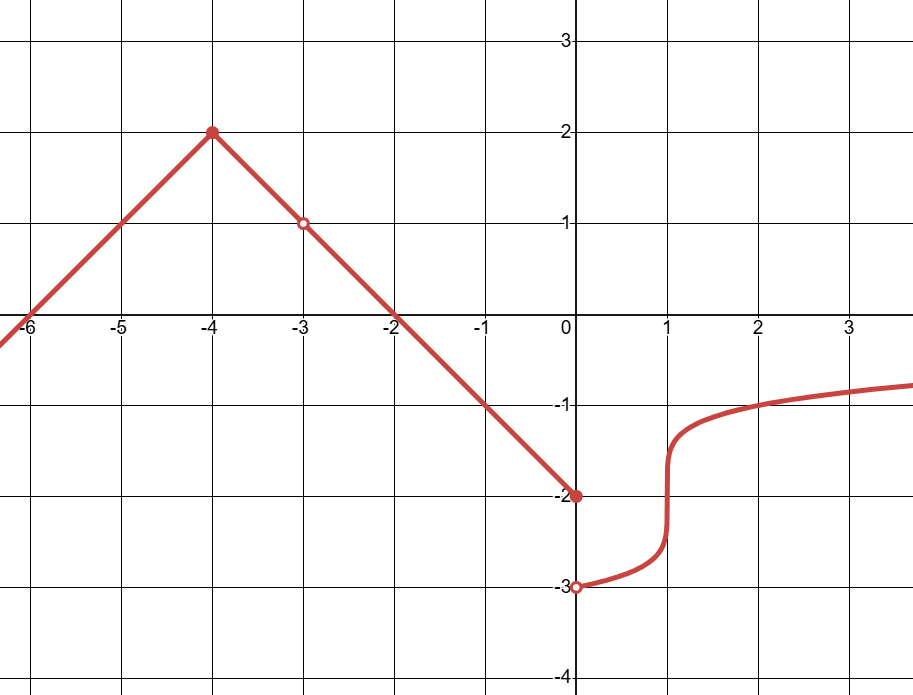
What are the names of the discontinuities and where are they located? For what values of x is this function NOT differentiable?
Removable discontinuity at x = -3
Jump discontinuity at x = 0
Not differentiable on x = -4, -3, 0, 1
100
If R(q) = 5q-0.2q^2 and
C(q) = 0.48q - 210, find the Profit and Marginal Profit functions.
P(q) = -0.2q^2+4.52q+210
MP(q) = -0.4q+4.52
200
Differentiate the following function:
g(x) = (e^{4x^3})^7
g'(x) = 84x^2(e^{4x^3})^6
200
Evaluate the integral:
\int \ (12x^3 + 8x^2 - 10x) \ dx
3x^4 +8/3x^3-5x^2 + C
200
What is the Net Signed Area and Total Area of the graph below?
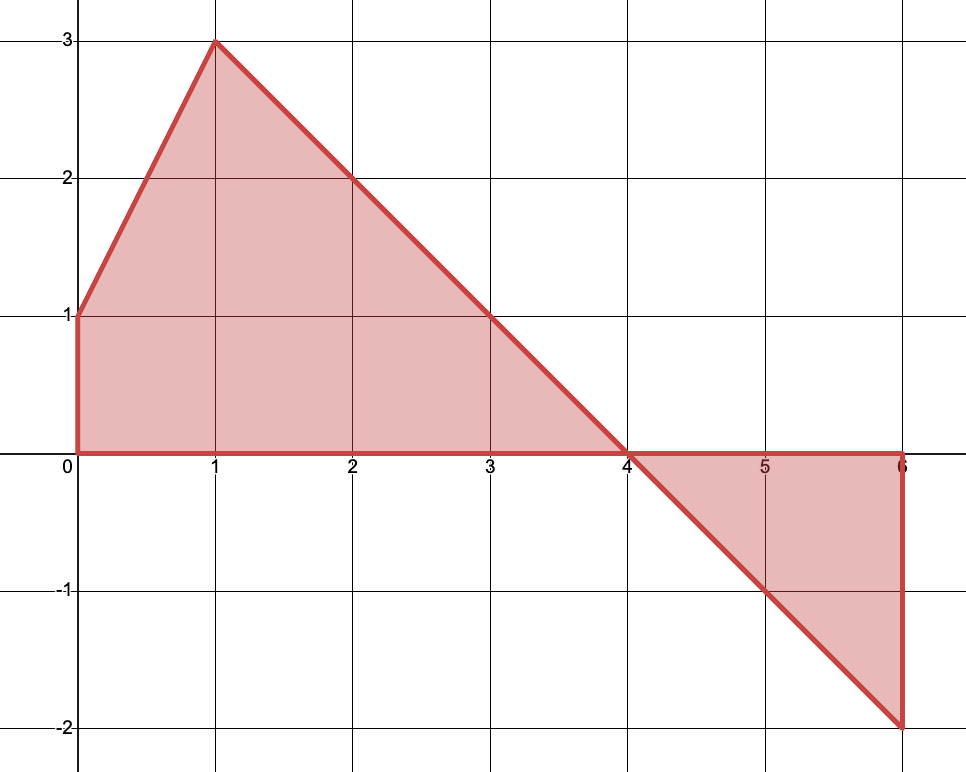
Net Signed Area: 4.5
Total Area: 8.5
200
If the Profit function is
P(q) = -0.2q^2+4.52q+210
find the quantity q (in thousands) that would maximize profit and find the maximum profit (in thousands).
(Give the exact value of q, but round the max profit to 1 decimal place.)
q = 11.3 thousand items
Max Profit: $235.5 thousand
300
Differentiate the following function:
h(x) = (x+1)/\sqrt{x}
h'(x) = (x-1)/(2\sqrt{x^3})
or
h'(x) = 1/(2\sqrt{x}) - 1/(2\sqrt{x^3})
300
Evaluate the definite integral:
\int_1^9 \ 7/sqrt{x}-5 \ dx
-12
300
** DAILY DOUBLE **
Find the left and right endpoint approximations for f(x) = x^2+1 on [0, 4] with n = 4 subintervals.
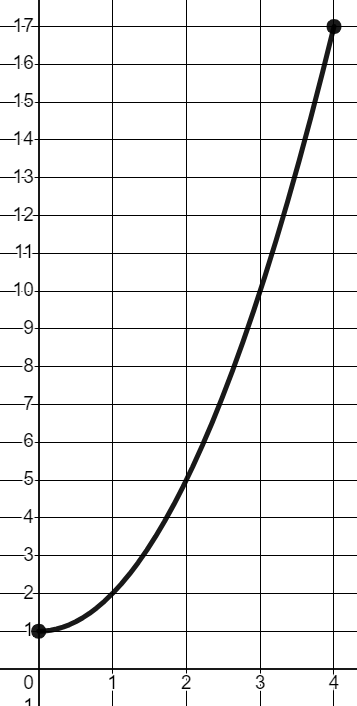
Left Endpoint Approximation = 18
Right Endpoint Approximation = 34
300
If the demand, q, is q = 120-p^2 for a price of $p per item. Use the principles of Elasticity of Demand to determine the price per item that would maximize revenue?
$6.32 per item would maximize revenue