Polynomials
Exponents
Radicals
Complex Numbers
Random
100
Rewrite in standard form, state the degree, and classify the name by its number of terms
3x-5+2x^4
2x^4-3x+5
Trinomial, 4th degree
100
Simplify (positive exponents only):
(3x^4)^2
3^2x^8
9x^8
100
Simplify
sqrt(32)
4sqrt(2)
100
i^2 =
-1
100
In the trinomial below, identify any coeffients and constants
3x^2-10x-8
Coeffiecients: 3 and -10
Constant: -8
200
Simplify
(3x^2+5x-2)+(x^2-3x+4)
4x^2+2x+2
200
Simplify (positive exponents only):
(15b^7)/(5b^2)
3b^5
200
Simplify
sqrt(4x^7)
2x^3sqrt(x)
200
Simplify
sqrt(-18)
3isqrt(2)
200
When operating on fraction, when do we need to find common denominators? Two correct answers
When adding or subracting
300
Simplify
(2x^3-2x+1)-(2x^3-3)
(-2x+4)
300
Rewrite the rational exponent into radical form:
125^(2/3)
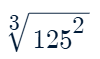
300
2sqrt(3) - 8sqrt(3)
-6sqrt(3)
300
Simplify
(5+2i)-(3-6i)
2+8i
300
Find the excluded value of:
(2x-6)/(3x-15)
x cannot equal 5
400
Simplify
(x-5)(x+2)
x^2+2x-5x-10
x^2-3x-10
400
Simplify (positive exponents only):
(x^4*x^3)/(x^9)
1/(x^2)
400
Simplify


400
Simplify
i^31
-i
400
Simplify and write as a final complex number:
(3-6i)^2
-27-36i
500
Simplify
(x-2)(x^2+4x-3)
x^3+2x^2-11x+6
500
Simplify
9^(3/2)
sqrt(9^3)
sqrt(3*3*3*3*3*3)
27
500
Simplify
sqrt(3) (4 + sqrt(12))
4sqrt(3) + 6
500
(3+4i)(3-4i)
9-16i^2
9+16
25
500
Rationalize the denominator:
(3sqrt3)/sqrt2
(3sqrt6)/2