Exponential & Logarithmic Functions
Compound Interest & Effective Rates
Limits
100
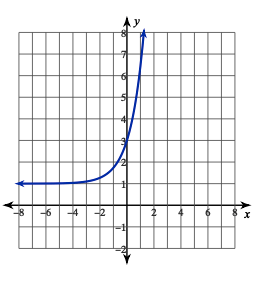
Graph the exponential function
y=2e^x+1
by creating a table of values.
100
Find the interest earned on $11,000 invested for 8 years at 8% interest compounded quarterly.
$9,729.95
100
lim_{x_to \infty} f(x)=
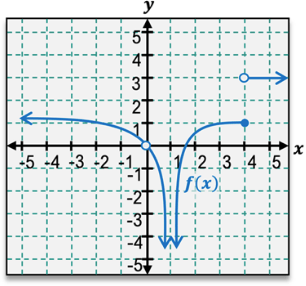
3
200
Write the logarithmic equation
ln(x)=3
in exponential form.
e^3=x
200
Find the effective rate corresponding to the stated rate: 5% compounded monthly. Round to two decimal places.
5.12%
200
lim_{x_to 4^-} f(x)
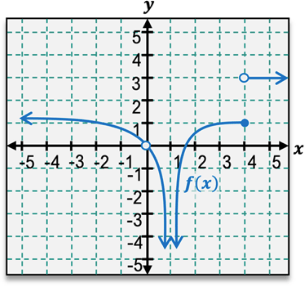
1
300
Solve and round your answer to three decimal places.
5^x=15
1.683
300
You know you'll need to buy a car in 6 years. If you can find a used one for $15,000, how much should you invest now (at 6% compounded quarterly) so that you'll have enough savings to buy the car?
$10,493.16
300
lim_{x_to 1^+} f(x)
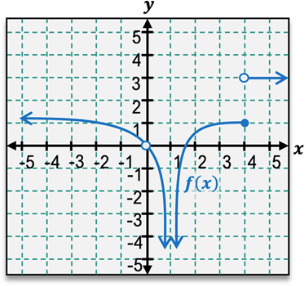
-\infty
400
Solve and round your answer to three decimal places:
5e^{-3x}=30
-0.597
400
Assume that the cost of a car is $20,000. With continuous compounding in effect, find the number of years it would take to double the cost of the car at an annual inflation rate of 4%. Round to the nearest year.
17 years
400
Find the value of the limit algebraically.
\lim_{x \to \infty} \frac{4x+1}{7x^2-7}
0