Functions, inverse, and miscellaneous
Abs value, quadratic, polynomials
Exponential, Log
Unit Circle, Angles
Solving Trig
100
Describe the following transformations:
-f(x)
f(-x)
f(x+c)
Reflection over x
Reflection over y
Left c
100
Solve 5|x+3|-8=7
x=0 or -6
100
Solve the following:
4 2x-1=27
2x=7
x=ln7/ln2
100
Find a coterminal angle for pi/6
13pi/6
(add 2pi)
100
Solve on [0,2pi)
2cosx-1=0
sinx=1/2
x=pi/6, 7pi/6
200
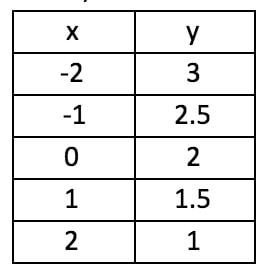
Evaluate the following:
f(1)
f-1(1)
f-1(3)
f(1) = 1.5
f-1(1) = 2
f-1(3) = -2
200
Sketch the following:
f(x) = -1/5(x-3)2
Reflected down
Stretched by 1/5
right 3
Desmos
200
Expand
log(x2y3/z-2w4)
log(x2y3/z-2w4)=2log(x) + 3log(y) +2log(z) -4log(w)
200
What quadrant is 7pi/4 and what is the reference angle?
Q4
reference angle: pi/4
200
Verify the following identity:
sin(t) tan(t) + cos(t) = sec(t)
sin(t) sin(t)/cos(t) + cos(t) = sec(t)
sin2(t)/cos(t) +cos2(t)/cos(t) = sec(t)
1/cos(t) = sec(t)
sec(t) = sec(t)
300
Let f(x) = 2x+5 and g(x) = 3x2
Find f(g(x))
f(g(x))= 2(3x2) +5 = 6x2 + 5
300
For the following polynomial, describe the end behavior.
f(x) = -3x4+2x5-7x+9
Leading term: 2x5
As x goes to inf, y goes to inf
as x goes to -inf, y goes to -inf
300
Give the equation of an exponential function that passes through the given points:
(1,6) & (3,54)
f(x) = 2(3)x
Plug in both points and solve for a & b
6 = a(b)1
54 = a(b)3
300
For this function, find:
i. amplitude
ii. period
iii. phase shift
iv. midline
f(x) = 3sin(2(x-pi))+4
Amplitude = 3
period=2pi/2=pi
phase shift = pi
midline = 4
300
A 24 ft. long wire cable connects the top of a flag pole to an anchor located 12 feet from the base of the pole. What angle does the cable make with the ground?
cos-1(12/24) = cos-1(1/2) = pi/3 or 60 degrees
400
What is the domain of the following function?
f(x) = (x-5)1/2/x-3
[5,inf)
400
Find the axis of symmetry, vertex, and intercepts of the following:
f(x) = x2-5x+6
Axis of symmetry: x=-b/2a = 5/2
Vertex: (5/2, -1/4)
y-intercept: (0,6)
x-intercepts: (3,0),(2,0)
400
Write the following in terms of the natural log:
log4(x)
ln(x)/ln(4)
This is the change of base formula
400
Find the value of all six trig functions for the following angle:
3pi/4
sin(3pi/4)=sqrt(2)/2
cos(3pi/4)=-sqrt(2)/2
tan(3pi/4)=-1
csc(3pi/4)=sqrt(2)
sec(3pi/4)=-sqrt(2)
cot(3pi/4)=-1
400
Solve:
4sin2x-2=0
sin2x=1/2
sinx=+/- sqrt(2)/2
x=pi/4, 3pi/4, 5pi/4, 7pi/4
500
Describe the following processes:
- Determining if something is a function
- One-to-one
- Where is it increasing decreasing
- local max
Vertical line test
horizontal line test
increasing vs decreasing slopes
where the function switches from increasing to decreasing is max and decreasing to increasing is min
500
Find the average rate of change for the following:
f(x) = x2+5
over the interval [x,x+h]
(x+h)2+5 - x2-5/h
Average rate of change = 2x+h
500
Solve the following:
log2(x) + log2(x+5) = log2(14)
x2+5x=14
x2+5x-14=0
(x+7)(x-2)=0
x=2
-7 is extraneous
500
If sin(t) = 5/13 and t is in Q2,
what is sec(t)?
cos(t) = -12/13 by pythagorean theorem
so, sec(t) = -13/12
500
solve
2 cos2(x) − sin(x) − 1 = 0
2(1-sin2x)-sin(x)-1=0
2-2sin2x-sin(x)-1=0
-2sin2x - sinx +1 =0
-2x2-x+1=0
-(2x2+x-1)=0
(2x-1)(x+1)=0
x=1/2, -1
sin(x) = 1/2,-1
x=pi/6,5pi/6, 3pi/2