Mathematicians
A&T Facts
Algebra
Calculus
Advanced
100
I am most famous for my theorem on right triangles
What is Pythagorus?
100
The year NCAT was founded
What is 1891?
100
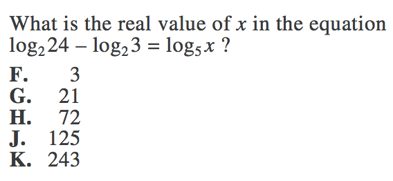
x=125
log2(24/3) = log2(8). In this particular case, we are asking: “To which power must 2 be raised to equal 8?” Which the answer is 3. 23=8
Now we must raise 5 to the power 3. 53=125
100
Find this equation's derivative: 4x^3 + 7x^2 + 2x + 3
What is the derivative of 12x^2 + 14x + x
100
Two dice are rolled, find the probability that the sum is
a) equal to 1
b) equal to 4
The sample space S of two dice is shown below.
S = { (1,1),(1,2),(1,3),(1,4),(1,5),(1,6)
(2,1),(2,2),(2,3),(2,4),(2,5),(2,6)
(3,1),(3,2),(3,3),(3,4),(3,5),(3,6)
(4,1),(4,2),(4,3),(4,4),(4,5),(4,6)
(5,1),(5,2),(5,3),(5,4),(5,5),(5,6)
(6,1),(6,2),(6,3),(6,4),(6,5),(6,6) }
Let E be the event "sum equal to 1". There are no outcomes which correspond to a sum equal to 1, hence
P(E) = n(E) / n(S) = 0 / 36 = 0
b) Three possible outcomes give a sum equal to 4
E = {(1,3),(2,2),(3,1)}, hence.
P(E) = n(E) / n(S) = 3 / 36 = 1 / 12
200
I invented calculus
What is Isaac Newton?
200
The oldest dorm on campus
What is Cooper Hall?
200
In a geometric sequence in which all of the terms are positive, the second term is 2 and the fourth term is 10. What is the value of the seventh term in the sequence?
a7=50√5
Here, we don’t know the common ratio, so let it be r.
a2=2
a3=2r
a4=2r2
But we know the numerical value of the fourth term.
2r2=10
r2=5
r=√5
Each time, we multiply by the square root of 5.
a4=10
a5=10√5
a6=(10√5)=10*5=50
a7=50√5
200
Find dy/dx and d^2y/dx^2 of the following equation y=3x^4-4x^(3/2)
What is 12x^3-6x^(1/2) and 48x^2-3x^(-1/2)
200
Solve y'+xy=xy3
y=±1/√1+Cex2
300
I make differential equations transform
What is Laplace?
300
The original name of NCAT
Agricultural & Mechanical College for the Colored Race
300
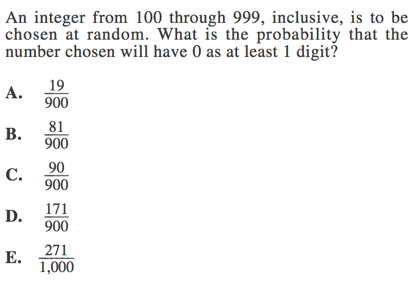
171/900
We know that our numbers are inclusive, so our first number will be 100, and will include every number from 100 though 109. That gives us 10 numbers so far.
From here, we can see that the first 10 numbers of 200, 300, 400, 500, 600, 700, 800, and 900 will be included as well, giving us a total of:
10*9
90 so far.
Now we also must include every number that ends in 0. For the first 100 (not including 100, which we have already counted!), we would have:
110, 120, 130, 140, 150, 160, 170, 180, 190
This gives us 9 more numbers, which we can also expand to include 9 more in the 200’s, 300’s, 400’s, 500’s, 600’s, 700’s, 800’s, and 900’s. This gives us a total of:
9*9
81
Now, let us add our totals (all the numbers with a units digit of 0 and all the numbers with a tens digit of 0) together:
90+81
171
There are a total of 900 numbers between 100 and 999, inclusive, so our final probability will be:
300
Determine the length of x=1/2y2 for 0 ≤ x ≤ 1/2. Assume y is positive
1/2(√2+ln(1+√2))
300
Use Gaussian Elimination to solve system of equation
x1 + 5x2 =7
-2x1 - 7x2 = -5
x1 = -8
x2 = 3
400
I sent a man to the Moon with my calculations while working for NASA
What is Katherine Johnson?
400
The Greensboro Four
What is Ezell Blair Jr., Franklin McCain, Joseph McNeil & David Richmond?
400

D= 64
This means that 3x, 4y, and 7z all equal some number, which we will call n;
3x = n
4y = n
7z = n
Find LCM which is 84.
So if n = 84, then we get the following three equations
3x = 84
4y = 84
7z = 84
Solving for each variable, we get
x = 28
y = 21
z = 12
If we add them together, we get
x + y + z = 28 + 21 + 12 = 61
400
Integrate ∫cos5x/3+sin5x dx
(1/5)ln|3+sin5x| +C
400
Prove: If n and m are both odd, then n+m is even.
Suppose n and m are odd integers.
Then n=2k+1 and m=2l+1 for some k,l∈Z, by the definition of an odd integer. Therefore n+m=(2k+1)+(2l+1)=2(k+l+1). Since k and l are integers, so is k+l+1 Hence n+m=2p with p=k+l+1∈Z. By the definition of an even integer, this shows that n + m is even.
500
I am considered the father of Geometry
What is Euclid?
500
One of the goals of Preeminence 2020
- Intellectual climate
- Faculty excellence
- Research Activity
- Entrepreneurship and civic engagement
- Diversity and inclusiveness
- Academic and Operational excellence
500
The average (arithmetic mean) high temperature for x days is 70 degrees. The addition of one day with a high temperature of 75 degrees increases the average to 71 degrees.
Quantity A = x Quantity B= 5
(A) Quantity A is greater.
(B) Quantity B is greater.
(C) The two quantities are equal.
(D) The relationship cannot be determined from the information given.
Quantity B is greater.

In this formula, 71 is the average, 70x + 75 is the total, and there are x + 1 days. Substituting this information into the formula gives: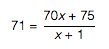
Cross-multiply to get 71x + 71 = 70x + 75. Next, simplify to find that x = 4.
500
Use the trapezoidal rule with n = 6 to approximate ∫14 1/x (ln(4) = 1.386294361)
1.405
500
Prove using mathematical induction that for all n ≥ 1
1+4+7+···+(3n−2) = n(3n−1).
For any integer n ≥ 1, let Pn be the statement that 1+4+7+···+(3n−2) = n(3n−1).
Base Case. The statement P1
1=1(3-1)/2 says that which is true.
Inductive Step. Fix k ≥ 1, and suppose that Pk holds, that is, 1+4+7+···+(3k−2)= k(3k−1).
It remains to show that Pk+1 holds, that is,
1+4+7+···+(3(k+1)−2)= (k+1)(3(k+1)−1).
1 + 4 + 7 + · · · + (3(k + 1) − 2) = 1 + 4 + 7 + · · · + (3(k + 1) − 2) = 1 + 4 + 7 + · · · + (3k + 1)
= k(3k−1)+2(3k+1)
= 3k2 −k+6k+2)
= 3k2 +5k+2)
= (k+1)(3k+2)
= (k+1)(3(k+1)−1).
Therefore Pk+1 holds.
Thus, by the principle of mathematical induction, for all n ≥ 1, Pn holds.