Vocabulary
Order of Operations
Area & Perimeter
Quadrilateral Shapes
Multiplication/Powers of 10
Lines & Line segments
100
A letter that is in place of a number in an equation.
What is a variable?
100
What is the value of 2(32 + 21)
3 x 3 = 9 + 21 = 30 times 2 = 60
100
What is the perimeter of this compound rectangle?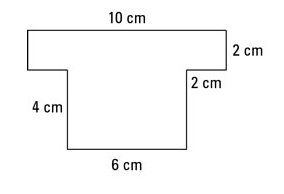
10 + 2x2 + 2x2 + 4x2 + (10 - 2x2) =
10 + 4 + 4 + 8 +10-4 =
18 + 18 - 4 = 18 + 14 = 32 cm
(this is not squared because we are talking about the 1 dimensional = perimeter (straight lines only)
100
A quadrilateral that has 8 sides.
What is an octagon?
100
How many powers of 10 are there in 104?
There are 4, meaning the number is equal to: 100,000.
100
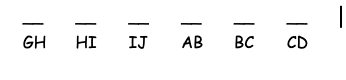
Name a line segment found on one of these lines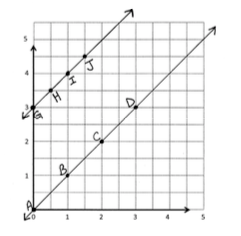 :
:
200
What do we use PEMDAS for?
- Parenthesis, Exponents, Multiplication, Division, Addition, Subtraction
What is the rule for the Order of Operations?
200
What is the value of:
2(14 - 6 x 2) =
2(14 - 12) = 2(2) = 4
200
What is the area of this figure?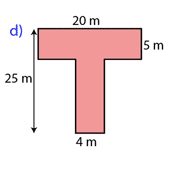
Top rectangle = 20 x 5 = 100m2
Bottom rectangle = 25 - 5 = 20 x 4 = 80 m2
100+ 80 = 180 m2 (meters squared)200
Name this shape:

What is a kite?
200
What is the value of 103 divided in half?
1,000 divided by 2 = 500
200
How many line segments are there on the top line that begins with point G?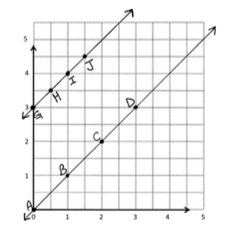
There are three.
300
The measurement of the outside sides of a shape.
What is perimeter?
300
What is the value of:
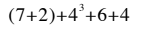
7 + 2 = 9 4x4x4 = 64 + 6 + 4
9 + 64 + 10 = 83
300
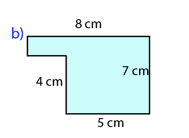 What is the area of this shape?
The area is:
8 - 5 = 3
7 - 4 = 3
So the small rectangle is 3 x 3 = 9
the large square is 7 x 5 = 35.
35 + 9 = 44 cm2 (centimeters squared)
300
What is the area of this parallelogram?
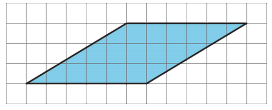
The area is 3 multiplied by 6 = 18 units2
300
How many zeros are there in the quotient of this equation's answer?
14,100 divided by 102 = ?
There won't be any zeros because the quotient is 141.
300
Name the line segment that intersects with 
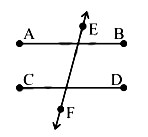
Line segment EF intersects with line segment AB.
400
The measurement of the entire space a shape covers.
What is Area?
400
Explain how to solve this expression and why you have to solve the way you do:
3 (63 - 3)
You have to solve the exponent first; an exponent tells you how many times you have to multiply the base by itself; for this equation you would multiply 6 x 6 x 6 first then subtract the 3; then multiply that product by 3.
3(6 x 6 = 36 x 6 = 216 - 3)
3 x 213 = 639
400
What is the area and perimeter of this shape?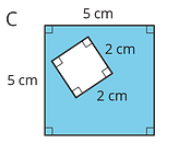
Area (5 x 5) - (2 x 2) = 25 - 4 = 21 cm2
Perimeter of the outside = 5 x 4 = 20 cm
Perimeter of the inside 2 x 4 = 8 cm
400
Name this shape:

What is a rhombus / quadrilateral?
400
In this equation, which way do the digits move on a place value chart to show they have been multiplied?
What is the product of this equation?
12.5 x 103 =
They move to the left 3 place values making a new product of 125,000.
400
Are any of these line segments perpendicular? Please explain your answer.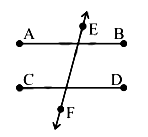
No, none of the intersecting line segments make right angles, so there can't be any perpendicular lines.
500
The bottom part of this expression is called the:
52
What is the base?
"It's all about that base, 'bout that base ... "
500
Solve this expression:
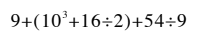
9 + (1000 + 8) + 6 =
9 + 1008 + 6 = 1008 + 15 = 1023
500
Give and explain how you would calculate the area of this parallelogram?
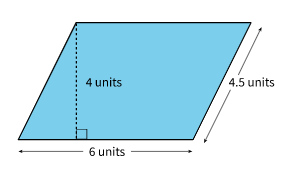
First, decompose the triangle from the left and move it to connect to the right; then I would multiply the height by the base = 4 x 6 = 24 units2
500
Name this shape:

What is a trapezoid?
500
What is the value of 254 times 104 ?
2,540,000
500
Describe these two lines:
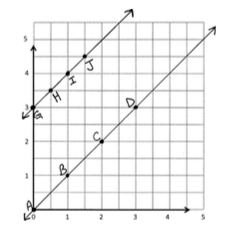
Line GHIJ is parallel with line ABCD.