Matter
Atoms
Compounds
Change of State
Mixtures and Solutions
Final Jeopardy
100
Anything that has volume and mass is called a(n)….
A. Element B. Matter C. Atom D. Proton
B: Matter
100
What subatomic particle has an overall negative electric charge and is found outside the nucleus of an atom?
A. Electron
B. Proton
C. Neutron
D. Acid
A: Electron
100
A substance that is composed of atoms of two or more different elements that are chemically combined is called a(n)…….
A. Mixture B. Solution C. Compound D. Acid
C: Compound
100
True or False: Gases have no definite shape and no definite volume.
True
100
A combination of two or more components that retain their identities is called a(n)……
A. Mixture B. Base C. Solution D. Compound
A: Mixture
200
What two things must you add together to get an elements mass number?
A. Protons and Electrons B. Electrons and Neutrons
C. Protons and Neutrons D. Neutrons and Ions
C: Protons and Neutrons
200
True or False: The nucleus of an atom has an overall positive electric charge.
True
200
True or False: Table salt (NaCl) is an example of a solution.
False (NaCl is a compound)
200
Process by which a cooling gas changes into a liquid and releases thermal energy.
A. Evaporation B. Freezing
C. Sublimation D. Condensation
D: Condensation
200
A solution containing a substance that produces hydrogen ions (H+) in water is called a(n)…..
A. Compound B. Acid C. Base D. Mixture
B: Acid
300
What are the two most abundant elements in the universe?
A. Oxygen and Nitrogen B. Hydrogen and Oxygen
C. Carbon and Hydrogen D. Hydrogen and Helium
D: Hydrogen and Helium
300
A substance that cannot be broken down into simpler substances by physical or chemical means is called a(n)….
A. Atom B. Nucleus C. Matter D. Element
D: Element
300
A mixture such as beach sand or oil and water in which the components are not uniformly distributed throughout its volume and can easily be seen separately is called a(n)
A. Solution B. Homogeneous Mixture
C. Heterogeneous Mixture D. Acidic Mixture
C: Heterogeneous Mixture
300
Process by which a solid slowly changes into a gas without first entering the liquid state.
A. Condensation B. Sublimation
C. Deposition D. Evaporation
B: Sublimation
300
A solution with a pH value of 10 is a……
(A). Acid (B). Base (C.) Neutral
B: Base
400
All elements on the periodic table are classified and arranged according to each elements……
A. Physical Properties B. Amount of matter
C. Chemical Properties D. Atomic Mass
C: Chemical Properties
400
What two subatomic particles are found in the nucleus of atoms?
1 correct = 400 points
2 correct = 800 points
1. Protons
2. Neutrons
400
An atom of the element Iron contains 26 protons, 30 neutrons, and 26 electrons. What is the atomic number and mass number of Iron?
1 correct = 400 points
2 correct = 800 points
Atomic Number = 26 (Number of Protons)
Mass Number = 56 (Protons + Neutrons)
400
Melting, freezing, evaporation, condensation, sublimation, and deposition are all processes that causes changes in the state of matter. Which three of these processes need the release of thermal energy to occur?
1 correct = 400 points
2 correct = 800 points
3 correct = 1,200 points
1. Freezing
2. Condensation
3. Deposition
400
Which is the more acidic solution: A solution with a pH value of 5 or a solution with a pH value of 2?
The solution with a pH value of 2 is more acidic.
500
What are the four states of matter?
1 correct = 500 points
2 correct = 1,000 points
3 correct = 1,500 points
4 correct = 2,000 points
1. Solid
2. Liquid
3. Gas
4. Plasma
500
What are the three subatomic particles found in all atoms?
1 correct = 500 points
2 correct = 1,000 points
3 correct = 1,500 points
1. Protons
2. Neutrons
3. Electrons
500
An atom of the element silver contains 47 protons, 61 neutrons, and 47 electrons. What is the atomic number and mass number of silver?
1 correct = 500 points
2 correct = 1,000 points
Atomic Number: 47 (Number of Protons)
Mass Number: 108 (protons + Neutrons)
500
Melting, freezing, evaporation, condensation, sublimation, and deposition are all processes that causes changes in the state of matter. Which three of these processes need the absorption of thermal energy to occur?
1 correct = 500 points
2 correct = 1,000 points
3 correct = 1,500 points
1. Melting
2. Evaporation
3. Sublimation
500
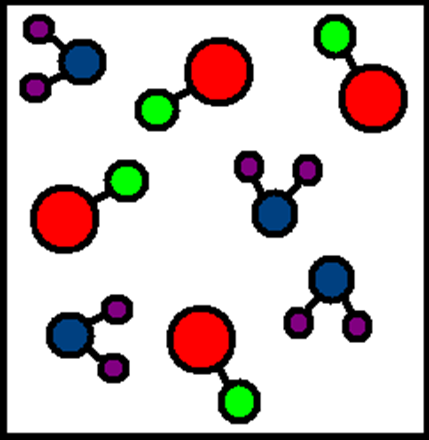
Mixture
500
What is the state of matter that occurs when collisions between particles are so violent that electrons are knocked away from atoms creating hot, highly ionized electrically conducting gases?
Plasma