Matter & Phase Change
Energy
Element, Molecules & Compounds
Properties
Measurements
100
Identify the states of matter
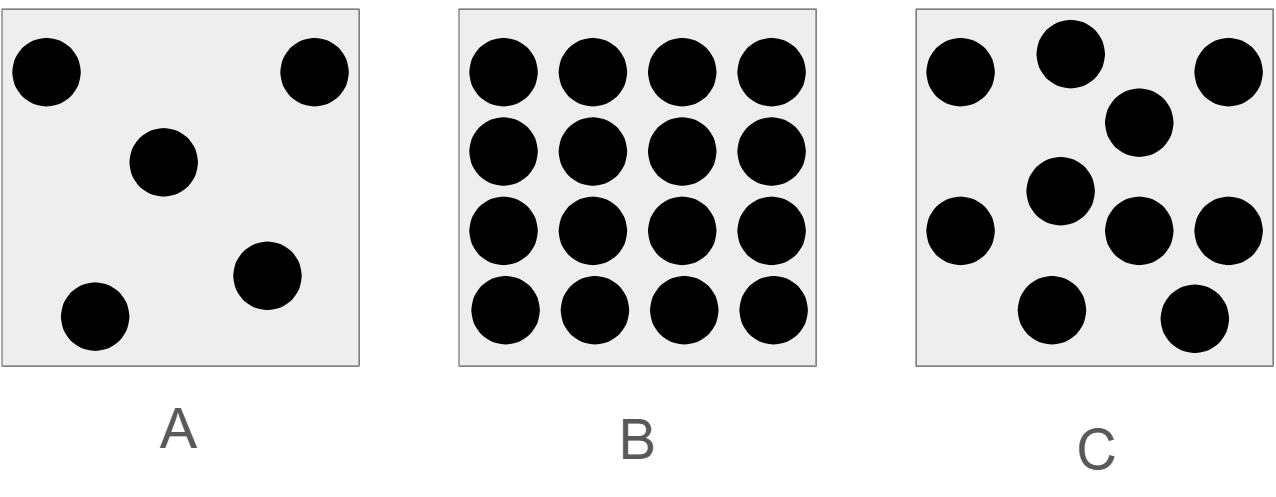
A: Gas
B: Solid
C: Liquid
100
Heat creates what kind of energy?
A) Gravitational energy
B) Chemical energy
C) Kinetic energy
C) Kinetic energy
100
Atoms are the smallest particles of elements. What is the minimum number of atoms (particles) needed to be...
A) an element
B) a molecule
C) a compound
A) 1
B) 2
C) 2
100
What kinds of properties are the following:
Color, State of Matter, Mass, Volume, Density, Melting, Boiling Point, Solubility, Conductivity, Malleability, Hardness, Magnetism, Odor
A) Physical properties
B) Chemical Properties
C) Joined Properties
A) Physical properties
100
Why does a giant block of ice take more total heat energy (Joules) to melt than a tiny ice cube?
A) It is much more dense.
B) It melts at a much colder temperature.
C) It has more atoms, so it takes more energy to get them all moving.
C) It has more atoms, so it takes more energy to get them all moving.
200
What happens to atoms (particles) as heat is added?
A) They grow physically larger in size and become much heavier.
B) They gain kinetic energy and begin to move, spread out, and vibrate faster.
C) They lose kinetic energy, slow down, and lock tightly together.
B) They gain kinetic energy and begin to move, spread out, and vibrate faster.
200
As heat increases kinetic energy increases. What is the specific name for the total kinetic energy of moving atoms?
Thermal Energy
200
A) Mixtures of different types of compounds that can be easily filtered by hand.
B) Pure substances made of only one exact type of atom.
C) Liquid substances that always turn into a gas when they freeze.
B) Pure substances made of only one exact type of atom.
200
A student is trying to identify an unknown clear liquid left in a beaker. She measures its physical properties and sets up a density tower. She records her data in the table below:
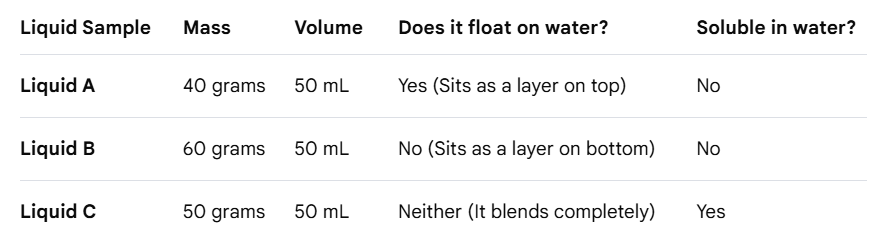
The student knows that pure cooking oil has a density less than water, meaning it will always float on top of water and refuse to mix with it. Based on the table, which liquid sample is most likely the cooking oil?
A) Liquid A
B) Liquid B
C) Liquid C
A) Liquid A
200
What type of measurement do scientists use to measure the amount of atoms (the amount of stuff) in an object?
A) Weight
B) Volume
C) Mass
C) Mass
Mass measures the total number of atoms in a thing, and weight measures the pull of gravity on that thing. The more atoms (the more mass) a thing has, the more force on that thing gravity has.
Weight is measured in: Newtons and Pounds
Mass is measured in: Grams and Kilograms
300
Which situation best describes what's happening?
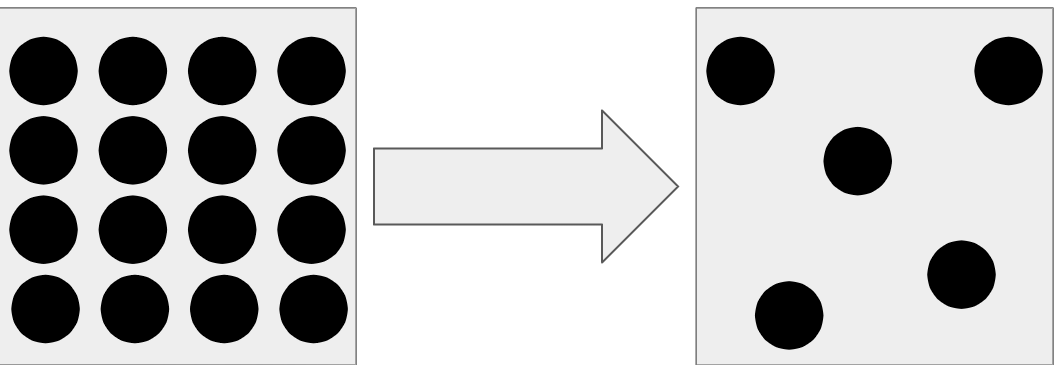
A) Chunks of dry ice are sitting on a table at a Halloween party, absorbing heat from the room and turning directly into a foggy gas.
B) An ice cube is left out on a hot sidewalk, melting into a puddle of liquid water.
C) Liquid water is placed inside a freezer, losing heat until it turns into a solid ice block.
- A) Chunks of dry ice are sitting on a table at a Halloween party, absorbing heat from the room and turning directly into a foggy gas.
300
What does Kinetic Energy measure?
A) How heavy or large an atom is.
B) How strong the glue is that holds a shape together.
C) How much motion and speed an object's particles (atoms) have.
C) How much motion and speed an object's particles (atoms) have.
300
When does an element like Oxygen stop being just an element?
A) When it chemically joins with a completely different element, like hydrogen, to form a compound ([Red-Yellow]).
B) When two matching oxygen atoms grab hands to form a twin molecule ([Red-Red]).
C) When it is physically poured into a cold room and its particles slow down.
A) When it chemically joins with a completely different element, like hydrogen, to form a compound ([Red-Yellow]).
300
What physical property is evident when you see different materials separating and stacking into layers?
A) Density
B) Volume
C) Solubility
A) Density
300
When measuring a solid, liquid, or gas you look for visual clues, If you see things layering this means you are measuring using what?
A) Density
B) Mass
C) Volume
A) Density
Density is how tightly packed those atoms are inside that space. It answers the question: How crowded is the box?
Mass is the total number of atoms packed inside an object. It answers the question: How many pieces are inside this thing?
Volume is the amount of physical space an object takes up. It answers the question: How big is the box holding those pieces?
400
Paul forgot his candy bar in his car on a warm day. When he went back for it later, it had melted. Which statement best explains how the candy bar melted?
A) The warm temperature in the car increased the kinetic energy of the candy bar’s molecules, causing it to change from a solid to a liquid.
B) The candy bar lost kinetic energy because the warm air trapped the molecules and crushed them into a liquid.
C) The chemical bonds inside the chocolate broke apart, turning the candy bar into an entirely new substance.
A) The warm temperature inside the car increased the average kinetic energy of the candy bar’s molecules, causing it to change from a solid to a liquid.
400
As heat is added to an object the kinetic energy in that object increases leading to a change in state. Which of the states of matter has the most kinetic energy? Which has the least?
Solid, Liquid, Gas
Highest Kinetic Energy: Gas
Lowest Kinetic Energy: Solid
Remember Kinetic Energy is the motion of the particles, more Kinetic Energy = faster moving particles.
400
What happens when two or more atoms lock together using invisible electrical forces to create a brand-new substance?
A) Physical mixing
B) Chemical joining
C) Thermal cooling
B) Chemical joining
400
What physical property is changing when you break, cut, or take away some of the physical pieces that build an object?
A) Mass
B) Volume
C) Density
A) Mass
400
Jackie is packing her soft school backpack. First she puts in a textbook, then a soccer ball, and then a thick winter jacket. As she adds more items, what property of her backpack is increasing because it is stretching to fill more space?
A) Mass
B) Volume
C) Density
B) Volume
500
Paul threw the melted candy bar into the fridge. After an hour, it went from a liquid back to a solid. Why did the candy become solid?
A) The cold air inside the refrigerator added mass to the candy bar, making it too heavy to stay liquid.
B) The refrigerator added thermal energy to the chocolate, causing the molecules to speed up and pack tightly together.
C) The cold refrigerator removed heat from the chocolate, decreasing the average kinetic energy of the molecules until they slowed down and locked into place.
C) The cold refrigerator removed heat from the chocolate, decreasing the average kinetic energy of the molecules until they slowed down and locked into place.
500
How would you describe the energy of atoms (particles) in a solid?
A) High energy, causing them to slide past each other.
B) Low energy, causing them to lock in place and vibrate.
C) Zero energy, causing them to float away as a gas.
B) Low energy, causing them to lock in place and vibrate.
500
What makes a Compound unique compared to Elements and Molecules?
A) It lets different atoms mix in a bucket without snapping together.
B) It is only made of matching twins like [Red-Red], so it stays the same.
C) It forces different atoms to bond like [Red-Yellow], creating a brand-new substance.
C) It forces different atoms to bond like [Red-Yellow], creating a brand-new substance.
500
What physical property is changing when an object expands, stretches, or takes up more physical space in a container?
A) Density
B) Mass
C) Volume
C) Volume
500
How would you remove the mass of an object?
A) Take the object to the Moon where there is less gravity pull.
B) Break, cut, or take away some of the physical atoms that build the object.
C) Put the object in a cold freezer until its particles stop moving.
B) Break, cut, or take away some of the physical atoms that build the object.