Definitions
Heating/Cooling
Phase Changes
Temperature
Infrastructure/shields
100
This is everything that has mass and takes up space. This includes everything you can see and touch.
Matter.
100
When we heat something, it's particles move: faster or slower?
Faster.
100
What are the 3 states of matter?
Solid, liquid, and gas
100
A liquid ________ is a glass (or plastic) tube filled with liquid, like coloured alcohol or mercury. This tube has numbers on it that show temperature, like a ruler.
Thermometer.
100
What is the frozen layer serving as an insulating barrier in safeguarding ecosystems beneath bodies of water.
Ice.
200
What is the freezing point of water?
0 degrees Celsius.
200
True or false: As particles move faster, the attractive forces between them weaken and the space between them increases.
True.
200
What is it called when a substance changes from one form to another? For example, ice melting into water or water boiling into steam.
Phase change.
200
When substances are cooled, they generally ________. (looking for a specific word).
Contract.
200
Why does ice float on water?
Ice is less dense than liquid water.
300
These are the super tiny pieces that make up matter. They are always moving, even if we can't see them (like air).
Particles.
300
When we cool something down, the attractive forces between the particles get: stronger or weaker?
Stronger. (The particles come closer together as the attractive forces increase, and the space between them decreases).
300
When matter goes through a phase change, its _____ might change, but its mass stays the same.
Volume.
300
When substances are heated, they generally ________ (looking for a specific term).
Expand.
300
Expansion joints in bridges allow for ________ of materials due to temperature changes.
Movement.
400
Water has two unusual properties that make it stand out from other substances. It has greater volume in _____ (liquid or solid) form than in _____ (liquid or solid) form.
It is also less dense in _______ (liquid or solid) form that in ________ (liquid or solid) form.
You must get all 4 blanks correct to get the points.
solid, liquid, solid, liquid
400
Describe what is happening to the particles in the snow in this picture. 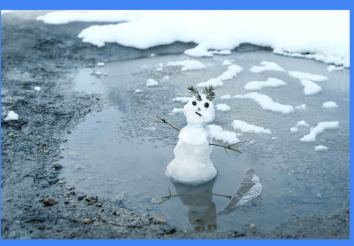
The particles move faster because the snow is being heated, which adds energy to the particles and the attractive forces weaken.
400
Condensation is when a ______ (gas, solid, liquid) turns into a _______ (gas, solid, liquid).
It's when a gas turns into a liquid.
400
A thermometer works because of a process called thermal ________.
Expansion.
400
Why are cracks in the roads formed?
Concrete expands in hot weather and contracts in cold weather. This causes cracks in the road surface.
500
What is the principle of conservation of mass?
Mass is neither created nor destroyed before and after phase changes.
500
What is intermolecular force?
a) The force between molecules that helps hold them together or pulls them apart.
b) Is a special force that makes things come closer to each other, even if they're not touching.
c) A bond formed by sharing protons between atoms.
d) A force that holds atoms together inside a molecule
a.
500
There are 6 parts of phase changes.
1) Evaporation.
2) Condensation
3) Melting
4) Freezing
5) Deposition
What is the sixth?
Sublimation.
500
Explain how a thermometer works. (How does the liquid move up and down?)
The liquid in a thermometer moves up and down based on whether it is heated or cooled down. As the liquid heats up, it takes up more space and moves up the thermometer. As the liquid cools down, it takes up less space and moves down the thermometer.
500
How can bridges collapse and fail?
Metals like steel expand and contract in extreme temperature and can lead to bridges collapsing if it is not accounted for when planning.