Simplifying Trig Expressions
Vectors
Law of Sines & Law of Cosines & Area
Solving Trig Equations
Sum & Difference & Double Angle Identities
100
(1-sin^2x)/(csc^2x-1)
(1-sin^2x)/(csc^2x-1)
(cos^2x)/(cot^2x)
cos^2xdivide(cos^2x)/(sin^2x)
cos^2x*(sin^2x)/(cos^2x)
sin^2x
100
Add the Vectors Together
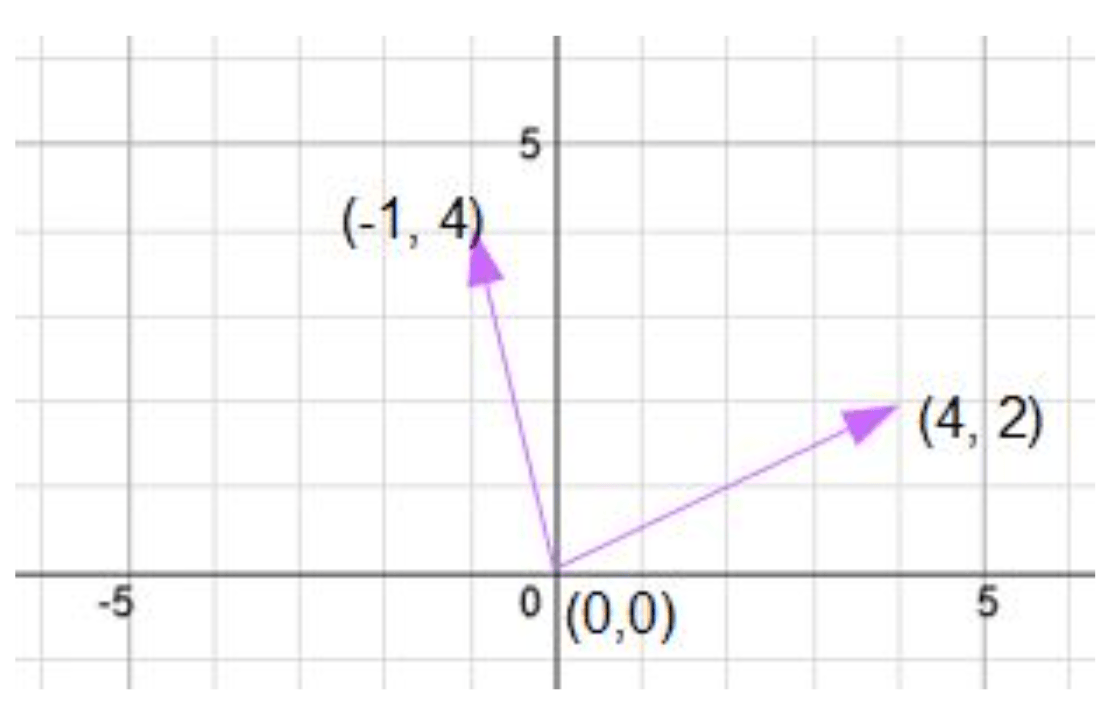
<3, 6>
100
Find x.
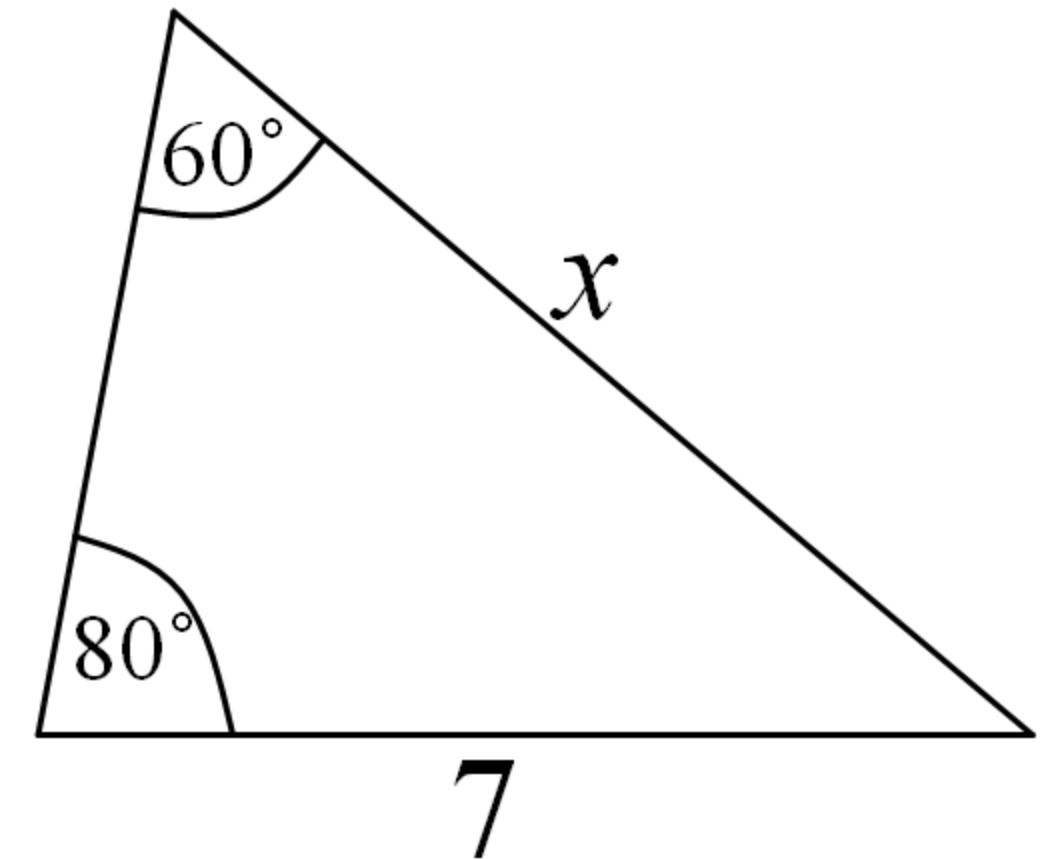
Law of Sines:
sin60/7=sin80/x
7sin80=xsin60
x=(7sin80)/(sin60)=7.960
100
Solve cosx=sqrt3/2 between [0, 2pi).
cosx=pi/6 and (11pi)/6
100
Determine the EXACT value of cos(105*).
cos(A+B)=cosAcosB - sinAsinB
cos(45+60)=cos45cos60 - sin45sin60
cos(45+60)=(sqrt2/2)(1/2)-(sqrt2/2)(sqrt3/2)
cos(45+60)=(sqrt2-sqrt6)/4
200
tan^2x-tan^2xsin^2x
tan^2x-tan^2xsin^2x
tan^2x(1-sin^2x)
tan^2x(cos^2x)
(sin^2x)/(cos^2x)cos^2x
sin^2x
200
Add the vectors.
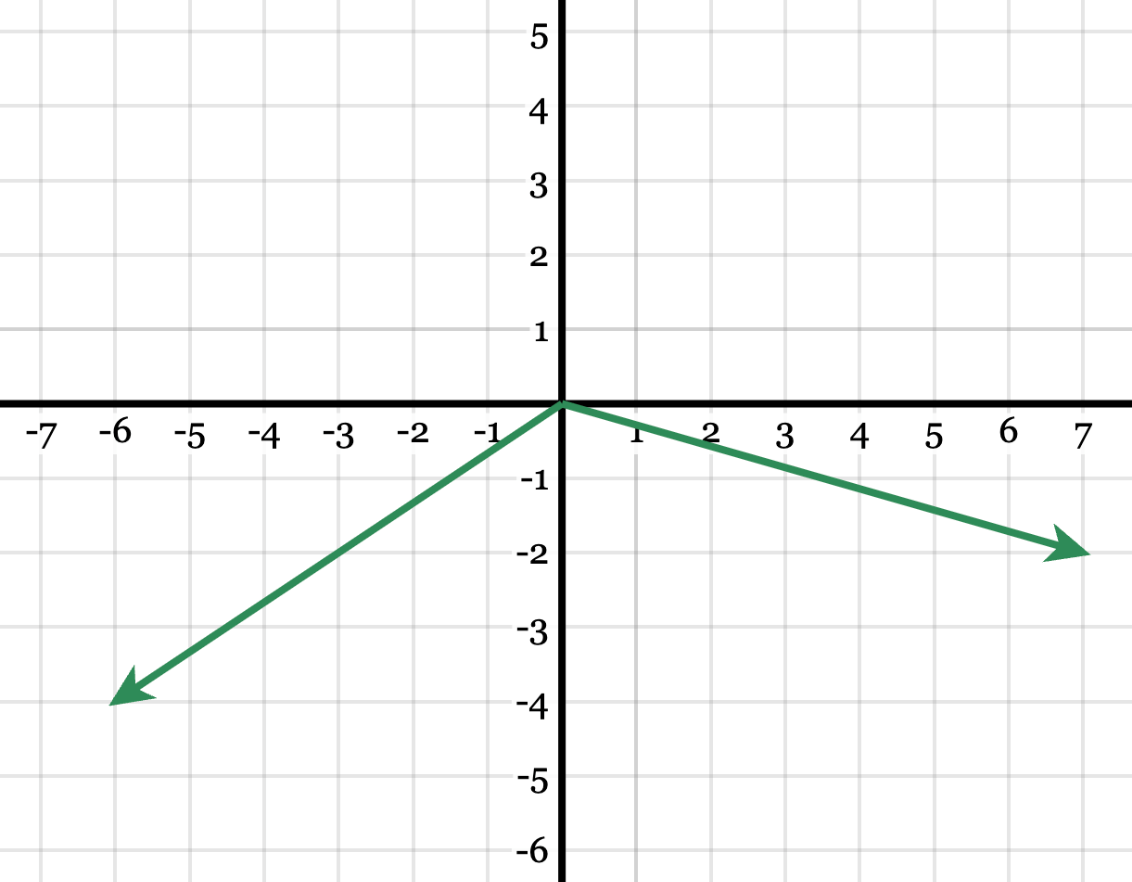
u = <-6, -4> and v = <7, -2>
add the x's: -6+7 add the y's: -4+-2
u+v = <1, -6>
200
Find the missing side.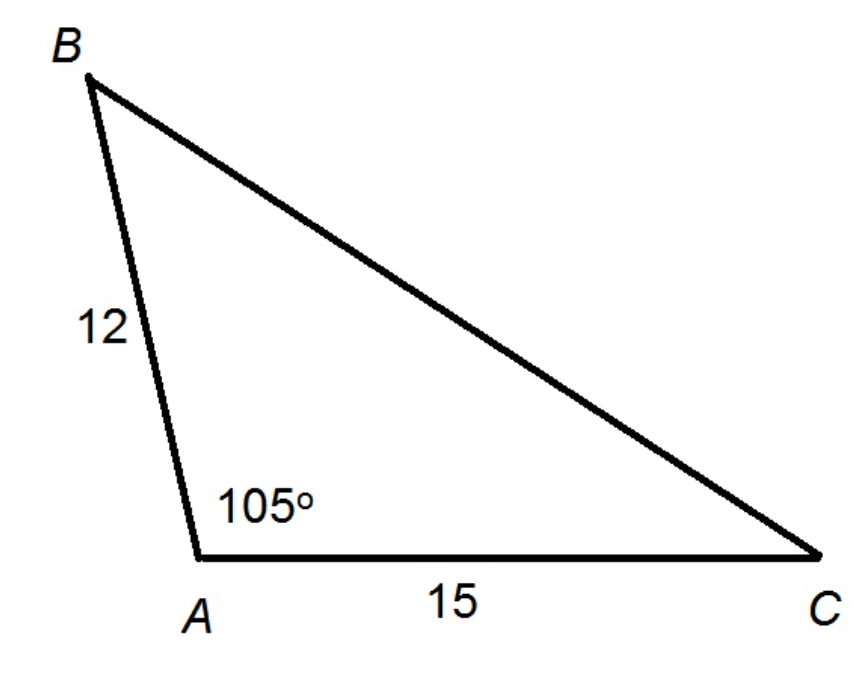
SAS: Law of Cosines
c^2=a^2+b^2-2abcosC
c^2=12^2+15^2-2(12)(15)cos105
c=sqrt(12^2+15^2-2(12)(15)cos105)
c=21.498
200
Solve sinx=-(sqrt3)/2
between [0, 2pi).
x=(4pi)/3 and (5pi)/3
200
Determine the EXACT value of sin(75*).
sin(A+B)=sinAcosB + cosAsinB
sin(45+30)=sin45cos30 + cos45sin30
sin(45+30)=(sqrt2/2)(sqrt3/2)+(sqrt2/2)(1/2)
sin(45+30)=(sqrt6+sqrt2)/4
300
Which is equivalent to csc^2x-sec^2x ?
a) sin^2x-cos^2x
b) cot^2x-tan^2x
c) sin^2x+cos^2x
d) cot^2x+tan^2x
e) 1
csc^2x-sec^2x
use Pythagorean identities
(cot^2x+1) - (tan^2x+1)
distribute the negative to the second part
cot^2x+1 - tan^2x-1
the one's cancel and you get Choice B: cot^2x-tan^2x
300
Given vector v=⟨6,3⟩ and u=⟨1,−2⟩, determine the value of v+4u in component form.
v=⟨6,3⟩ and u=⟨1,−2⟩
<6, 3> + 4<1, -2>
<6, 3> + <4, -8>
<10, -5>
300
Find the area of the triangle.
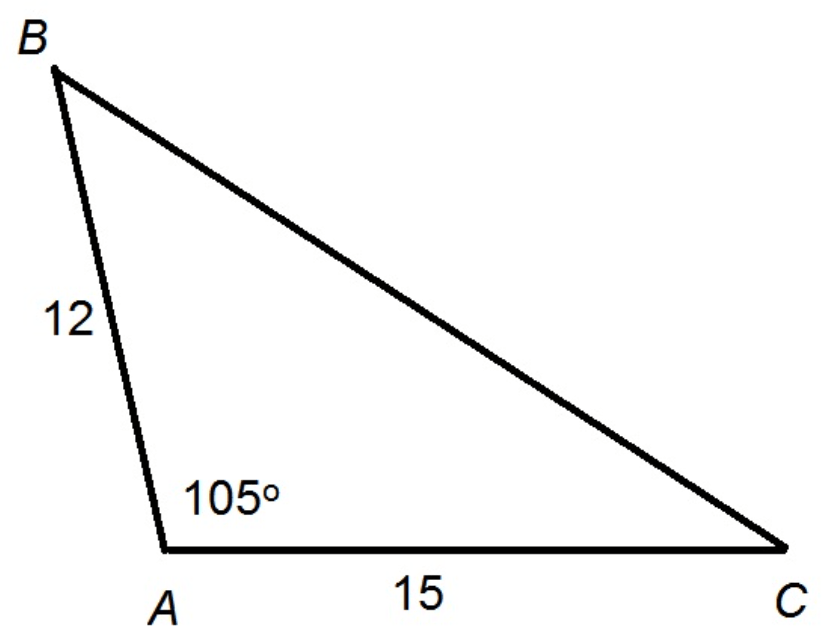
Area =
1/2*a*b*sinC
1/2*12*15*sin105
86.933
300
Solve:
2cos^2x-cosx=0 between [0, 2pi).
GCF Factor:
cosx(2cosx-1)=0
ZPP: cosx=0 and 2cosx-1=0
ZPP: cosx=0 and cosx=1/2
x = pi/2 and (3pi)/2 and pi/3 and 5pi/3
300
Determine the EXACT value of sin(2x) if
cosx=-5/13 in Quadrant 2.
sin(2x)=2sinxcosx
sin(2x)=2(12/13)(-5/13)
sin(2x)=-120/169
400
HONORS ONLY:
(sec(pi/2-x))/cotx
(sec(pi/2-x))/cotx
cscx/cotx
1/sinxdividecosx/sinx
1/sinx*sinx/cosx
1/cosx = secx
400
Given vector v=⟨6,3⟩ and u=⟨1,−2⟩, determine the magnitude of vector v.
use vector v <6, 3>
magnitude:
sqrt(x^2+y^2)
sqrt(6^2+3^2)
sqrt(45)
400
Find the measure of angle X.
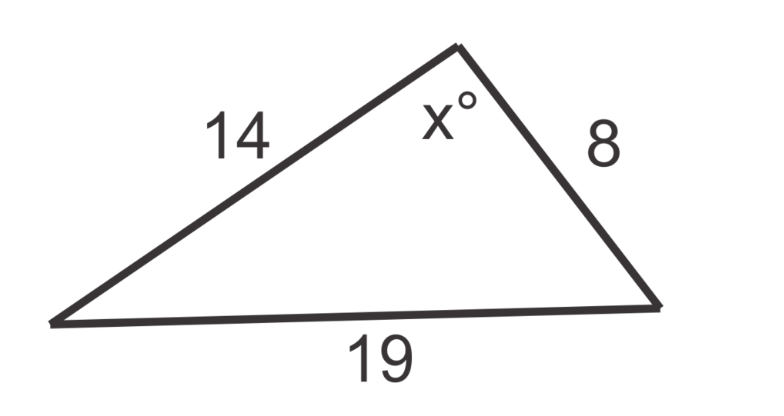
SSS: Law of Cosines
c^2=a^2+b^2-2abcosC
19^2=8^2+14^2-2(8)(14)cosX
361=260-224cosX
x=cos^-1((361-260)/(-224))
x=116.8
400
HONORS ONLY:
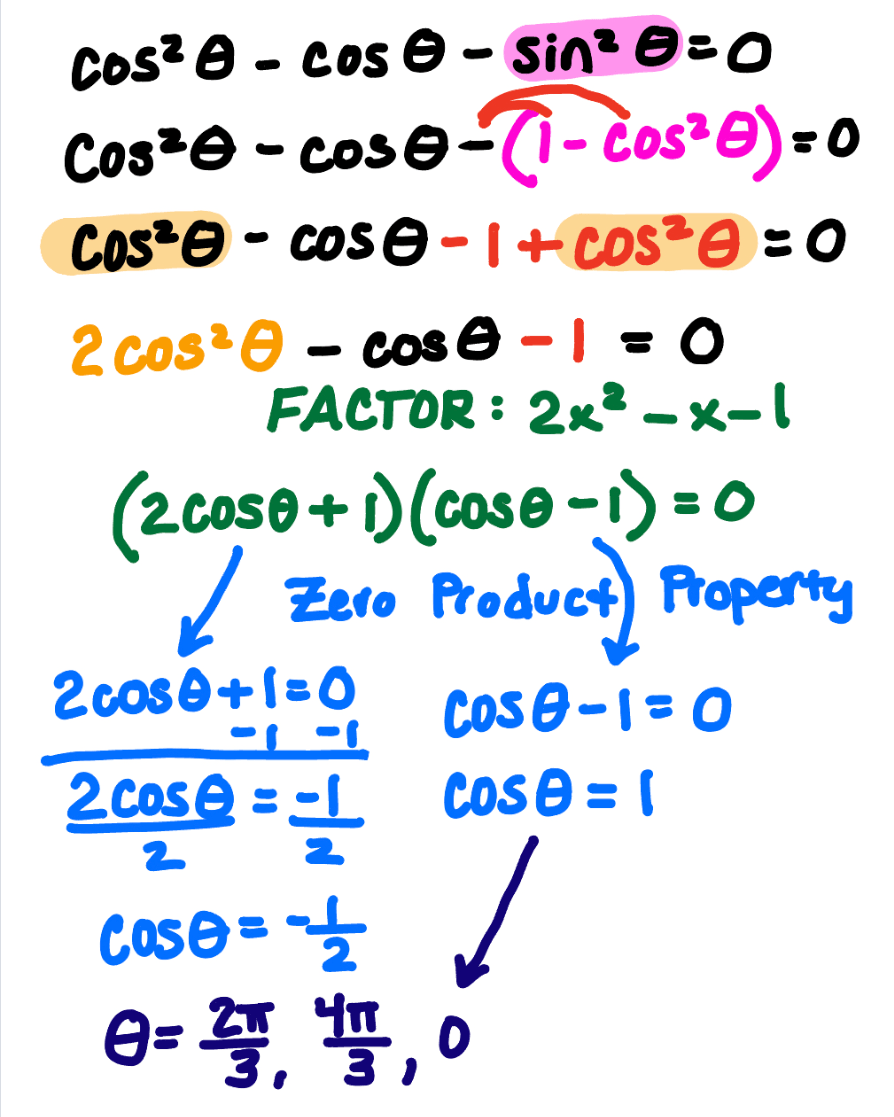
cos^2theta-costheta-sin^2theta=0
Solve the above equation between [0, 2pi).
theta=0, (2pi)/3, (4pi)/3
400
Find the exact value of cos(2x) if
sinx=-4/5 and
cosx=-3/5 .
cos(2x)=cos^2(x)-sin^2(x)
cos(2x)=(-3/5)^2 -(-4/5)^2
cos(2x)=9/25 - 16/25
cos(2x)=-7/25
500
HONORS ONLY:
tanx*(csc^2x-1)
tanx*(csc^2x-1)
tanx*cot^2x
tanx*cotx*cotx
tanx*1/tanx*1/tanx
1/tanx = cotx
500
What is w*v ?
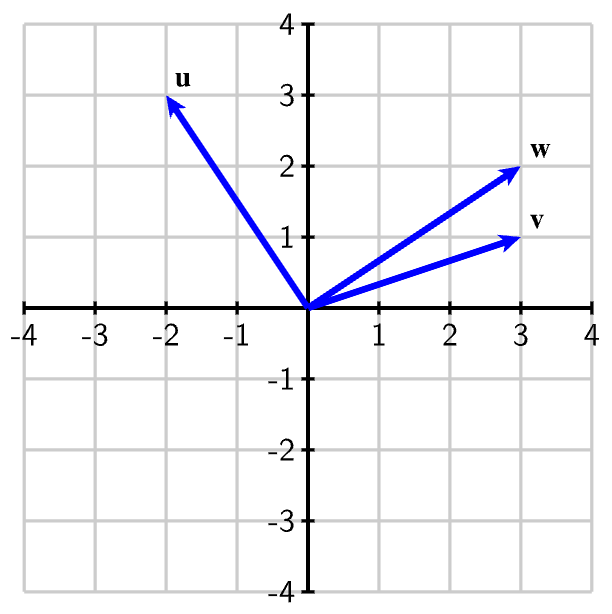
*multiply the x's and multiply the y's, then add them together* w = <3, 2> and v = <3, 1>
(3*3)+(2*1)
9+2
11
500
HONORS ONLY:
Find the measure of angleADB and angleACB.
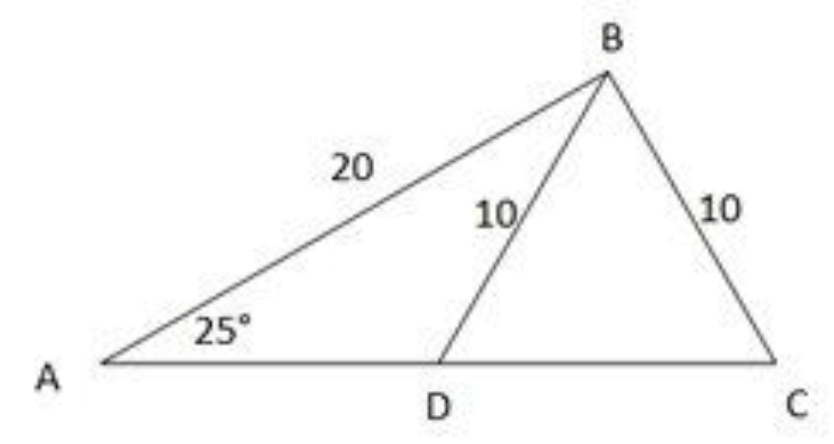
Law of Sines:
angle ACB: sin25/10=sinx/20
10sinx=20sin25
x=sin^-1((20sin25)/10)=57.697
angle ADB: 180-57.697=122.303
500
HONORS ONLY:
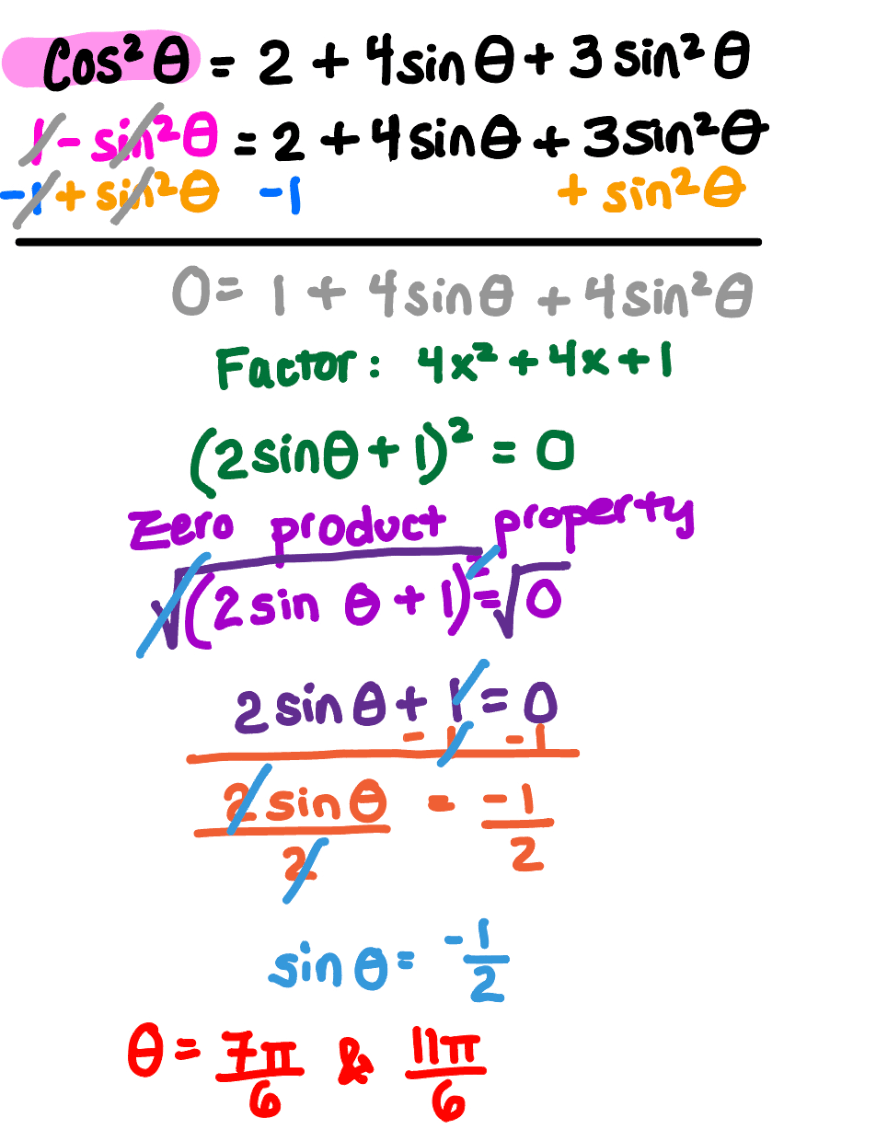
cos^2theta=2+4sintheta+3sin^2theta
Solve the above equation between [0, 2pi).
theta = (7pi)/6 , (11pi)/6
500
Simplify the expression using identities.
2/(secx*sin2x)
2/(secx*sin2x)
2/((1/cosx)*(2sinxcosx))
1/sinx
cscx