Indications for MCS
Design of Ventricular Assist Devices
Patient selection for MCS
Patient Outcomes MCS
Heart Transplant Candidates
Donor Allocation & Immunosuppresion
Rejection
Outcomes after Heart Transplantation
Complications after Transplantation
100
The goal of mechanical circulatory support (MCS) is to provide hemodynamic support to a patient in one of three clinical scenarios: ___, ___, ___
- Bridge to recovery
- Bridge to transplant
- Destination therapy
** It is legally and morally essential to have a candid discussion with each patient about which ventricular assist device strategy is being used. Patients should also understand that they may move between strategies as their clinical circumstances change.
100
An MCS pump may be positioned ____ (outside the body) or _____ (contained within the body)
Extracorporeally or intracorporeally
100
true/False: The presence of portal hypertension with liver cirrhosis is a contraindication for MCS support.
TRUE
100
THe most commonly used MCS is the IABP. What are the EKG triggers for inflation and deflation of the balloon?
Balloon is inflated at the onset of diastole which correlates roughly to the middle of the twave, and is deflated at the onset of LV systole- at the peak of the R wave
100
A patient with advanced heart failure and marked reduction in functional capacity despite implementation of all conventional therapies should be considered for
heart transplant
100
Globally, transplant centers are divided - approximately half use induction therapy. Name twos risk and two benefits of induction therapy post orthotrophic heart transplant.
Benefits: Minimize risk of rejection and minimize steroid use; "renal sparing" approach - prevent early post transplant acute kidney injury by giving induction and delaying initiation of calcinerin inhibitors
Risks: infection, malignancy, and potential for mortality as a consequence
100
This diagnostic test remains the gold standard for diagnosisng acute cellular rejection.
endomyocardial biopsy
Unlike in renal and liver transplants, no reliable serolic markers for rejction in the cardiac transplant have been identified.
Biopies are grade from OR (no rejection), 1R (mild), 2R (moderate), 3R (severe)
100
The majority of US programs perform routine surveillance heart biopsies at minimum for
1 year
100
Orthotrophic heart transpalnt patients are at increased risk of developing this malignancy. Bonus (50pts): what is the Diagnosis and management?
Post-Transplant Lymphoproliferative Disorder
200
The most common indication for mechanical circulatory support (MCS) is _____. Define this term and name three scenarios where this type of support may be indicated.
Bridge to recovery - use of mechanical circulatory support in patients with acute cardiogenic shock or acute decompensated heart failure that is refractory to optimal medical management; there is reasonable expectation that the myocardial injury is reversible.
- acute MI, acute myocarditis, myocardial stunning from cardiotomy
200
An intra-aortic ballon bump (IABP) is positioned in the descending aorta and inflated during ___ and deflated during ___.
diastole (increasing diastolic pressure and coronary perfusion); deflated in systole (lowering LV afterload).
200
This is the hemodynamic abnormality most closely associated with worsening renal function during in-hospital diuresis
elevated central venous pressure
200
What is the name of the clinical trial that showed that in acute myocardial infarction complicated by cardiogenic shock, that there is no difference in mortality at 30 days with the use of balloon pump vs optimal medical therapy in those who underwent revascularization (PCI or Bypass)?
SHOCK II trial
There was also no significant difference in time to hemodynamic stabilization, length of stay in the ICU, serum lactate levels, dose and duration of catecholamine therapy and renal function.
There have not been adequately powered RCTs comparing IABP therapy with OMT for cardiogenic shock outside the context of AMI
200
In a cardiopulmonary stress test, the peak VO2 level is considered an indication for cardiac transplantation.
A peak VO2 less than 10 mL/kg/min
A peak VO2 Less than 14 mL/kg/min is a poor prognosis
200
Name the two most commonly used agents for induction therapy. BONUS (50 pts): name a risk/benefits associated with each
Basiliximab and Antithymocyte globulins (ATGs)/Tcell cytolytic agents
Basiliximab - chimeric mouse-human monoclonal antibody to the alpha chain of IL2 receptor of Tcells
* Registry analysis: Survival equivalent with no induction or ATGs and reduced with basiliximab.
More deaths due to malignancy seen in ATG group.
200
This type of rejection is driven by T-cell response and IL2 release.
what is cell mediated rejection or "acute cellular rejection"
This is a t-cell mediated response, moderated by IL2 which is released from CD4 and CD8. Acute rejection can occur in the first week to several years after transplant. Up to 30% of patients experience acute cellular rejection in the first year.
200
The convention for surveillance coronary angiography for the lifetime of a orthotrophic heart transplant candidate is
yearly
200
These statins have been associated with outcome benefits in survivial, severity of rejection, incidence of cardiac allograft vasculopathy and even malignancies in orthotrophic heart transplant recipients
Pravastatin and simvastatin
300
As a rule, patients should be excluded from consideration for temporary Mechanical circulatory support if ________ or _______. In these clinical scenarios, MCS is considered futile.
Myocardial recovery is unlikely and the option of heart transplantation or implantation of a long term, durable VAD is not feasible.
300
What does the dicrotic notch represent on an intraaortic balloon pump tracing? In the aortic pressure tracing, what changes do you expect to see with the assisted aortic end-diastolic pressure and assisted systole?
Balloon inflation begins immediately after aortic valve closes. The pump augments diastolic blood flow by increasing peak aortic pressures during diastole. Balloon deflation before systole decreases ventricular afterload, with lower aortic end-diastolic pressure and lower peak systolic pressure. 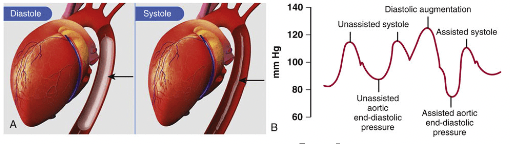
300
TRUE/FALSE: Acute onset of renal failure requiring RRT is a contraindication to initiate MCS.
False. However, AKI requiring RRT may be an obstacle for succesful long term support for bring to transplant or destination therapy.
300
What is the impact of VA-ECMO on myocardial oxygen demand?
It increases myocardial oxygen demand. VA-ECMO increases systemic afterload which results in LV distension and results in higher filling pressures and volume which ultimately increases myocardial oxygen demand.
300
35 year old male with nonischemic cardiomyopathy and a history of cocaine abuse is being considered for a heart transplant. In regards to his substance abuse, he must demonstrate
cessation and 6 months of abstinence
300
Name the two commonly used calcinerin inhibitors, their mechanism of action and their side effects.
cyclosporine (developed in 1984) and tacrolimus.
MOA: bind to specific proteins to-> Suppress immune system by blocking Tcell activation/proliferation by inhibiting its key signaling phosphatase calineurin
SE: Nephrotoxicity and hypertension are common side effects. Tacrolimus was developed to reduce these side effects. Others: Hirsutism, gingival hyperplasia, hyperlipidemia, neuropathy.
300
Rejection is categorized by timing, histologic and immunologic criteria into three categories: hyperacute, acute and ______.
what is chronic?
300
Which combination of donor and recipient has the highest risk for CMV infection?
- CMV positive donor in a negative CMV recipient
- CMV positive donor in a positive CMV recipient
- CMV negative donor in a positive CMV recipient
CMV positive donor in a negative CMV recipient
300
Name the most common reason for re-transplantation s/p orthotrophic heart transplant.
cardiac allograft vasculopathy
Annual incidence: 5-10%
20% at 1 year, 40-50% at 5 years
400
these terms reflect the unknown efficacy of mechanical circulatory support to reverse the clinical conditions that represent relative barriers to heart transplantation
Bridge to decision; bridge to candidacy
400
In addition to being classified as extracorporeal or intracorporeal, MCS devices are classified by the following two other characteristics:
Ventricle assisting: Biventricular (biVAD), RVAD, LVAD
Flow characteristics: pulsatile flow or continuous flow
400
A cardiac index less than 1.8 to 2.2, SBP less than 90, PCWP greater than 20, and evidence of poor perfusion constitute general indications for initiation of MCS. Name three signs of poor perfusion.
Oliguria, rising creatinine, elevated lactate, elevated liver transaminases, mental status changes, cool extremities.
400
The name of the percutaneously implanted device that connects the LA to the aorta direct?
Tandem heart
400
A 60 year old female with advanced heart failure on chronic inotrophic support and a history of breast cancer is being considered for heart transplant. Her malignancy should not be an issue as long as:
It is in remission or it has a disease free interval of 5 years or longer.
400
Nephrotoxicty from calcinerin inhibitors may be potentiated by use of this other drug.
use of NSAIDs. NSAIDs should strictly be avoided in orthotrophic transplant recipients.
400
This type of rejection is irreversible
chronic rejection or late graft failure
occurs months to years after transplant
The underlying pathophysiology is not well understood; proposed mechanisms include antibody-mediated and chronic ishcemia (coronary artery vasculopathy)
400
At what LDL level should a paitent receive statin therapy after orthotrophic heart transplant?
All recipients should receive statins regardless of their LDL level
400
According to the International Society of Heart and Lung transplantation (ISHLT), cardiac allograft vasculopathy (CAV) has the following nomenclature: CAV 0-3. Please explain each classification.
CAV 0 = no detectable lesions
CAV 3 = severe allograft vasculopathy (> 50% LM disease, > 70% in all 3 systems or CAV 1 or CAV 2 with EF < 35%)
500
Name the trial evaluated the use of a durable implantable LVAD compared with optimal medical therapy for refractory chronic advanced heart failure. What were the results?
REMATCH (Randomized Evaluation of Mechanical Assistance in the Treatment of Congestive heart failure). LVAD therapy halved the mortality seen int he control population (RR 0.52 (95% CI 0.34-0.78)). Despite serious adverse events (stroke, infection, bleeding, device malfunction) attributed to the MCS, LVAD patients had better QOL than those receiving optimal medical therapy.
500
How do newer generation pumps (Heart Mate 3, Heartmate II, Heartware ventricular assist device) differ from older generation, pulsatile flow, volume displacement pumps (heartmate XVE and Novacor)
Newer continous flow pumps are smaller, capable of similar degree of pumping support (6 to 10 L/min), more durable, and functionally dependent on both preload and afterload
500
Patients with heart failure from a nonischemic cause are more likely to develop significant RV failure and have a 3-4 fold risk of requiring BiVAD support = worse survivial, greater need for mechanical ventilation before MCS insertion than LVAD support only. What is the preoperative RA pressure goal that is important for reducing the need for post operative RV support?
10-12 mm Hg
500
The MOMENTUM 3 trial compared the Heartmate 3 LVAD to the Heartmate 2 LVAD. What were the results of the stud in regards to mortality? Pump replacement? Strokes? Major Bleeding.
HM3 and HM2 had similar mortality. However, the HM3 had less frequent pump replacement, strokes and major bleeding events.
500
Please describe the graphical relationship between age and mortality with heart transplantation.
A. Linear
B. Inversely related
C. U-Shaped
D. Sigmoid Shaped
There is a “U-” shaped relationship historically regarding mortality post heart transplant, with increased mortality in those younger than 18 years of age and those older than 65 years of age.
500
The most common reason for failure to wean a heart transplant recipient from cardiopulmonary bypass is _____. For this reason, the most important and essential element of assessing suitability for cardiac transplantation is to measure the ___.
right sided heart failure, evidenced by low cardiac output despite rising central venous pressure.
Measure PVR and assess reversibility
High fixed PVR 3-6 WU is a contraindication for heart transplant
* Intraoperative TEE may show dilated, poorly contracting RV and underfilling, vigorously contracting left ventricle
* Treatment inotropes, pulmonary vasodilators
500
This type of rejection is mediated by pre-existing antibodies to allogenenic antigens on the vascular endothelial cells of the donor organ.
Hyperactue rejection
mechanism: Antibodies fixing completment which promotes intravascular thrombosis with subsequent rapid occlusion of graft vasculature and resultant overwhelming graft failure
500
Which of the following is true about heart transplant recipients?
1) cardiac allograft vasculopathy usually presents with typical angina
2) Rejection is usually symptomatic
3). The major source of information for heart transplantation survival is based on the ISHLT registry
The major source of information for heart transplantation survival is based on the ISHLT registry
500
92% of transplant recipients have this complication at 5 years and it is associated with the use of calcineurin inhibitors
Hypertension
600
Double Jeopardy (1000 pts):
Name a clinical scenario that would place a patient on the heart transplant list in each allocation criteria. Status/Tier
Status 1, Status 2, Status 3, Status 4, Status 5, Status 6, Status 7
Status 1: VA ECMO, nondischargable BiVAD, MCS with lifethreatening Vtach
Status 2: Intra-aortic balloon pump, Acute percutaneous endovascular circulator support (Impella), VT/VF not requiring mechanical circulatory support, Total Artifical Heart, dischargeable BiVAD or RVAD
Status 3: LVAD for 30 days, multiple inotropes or single high dose inotrope with continuous hemodynamic monitoring; MCS with device complication (infection, thromboembolism, etc)
Status 4: Congenital heart disease with unrepaired/incompletely repaired complex defect usually with cyanosis, ischemic heart disease with intractable angina, HCM, restrictive cardiomyopathy, stable LVAD patients after 30 days, inotropes without hemodynamic monitoring, amyloid, retransplant
Status 5: Approved combined organ transplants
Status 6: All remaining active candidates
Status 7: Inactive not a transplant candidate
600
Acceptance of these two previously excluded donors has increased the donor pool for orthotropic heart transplants
Hepatitis C positive donors - prolonged follow-up important; may experience high frequency of acute rejection. Antiviral agents allow cure if seroconversion occurs
Donation after circulatory determined death - increases transplantation by 48% with similar 30 day and 1 eyar survival between DCD and standard donors.