Diseases, Conditions, & Prevention
Clinical and Patient Care
Anatomy & Physiology
Medical Fields & Careers
First Aid & Emergency Skills
100
A person receives a vaccine before being exposed to a specific infectious disease. What is the primary purpose of the vaccine?
To train the immune system to recognize and respond to the pathogen, helping prevent or reduce the severity of future infection.
100
A medical assistant is preparing to take a patient's blood pressure. The patient has just walked into the room and immediately sits down. Should the medical assistant take the blood pressure right away? Why or why not?
No due to any activity or recent stress could affect the blood pressure measurement.
100
Organ is primarily responsible for filtering waste from the blood and producing urine
Kidney
100
Healthcare professional performs eye exams and prescribes glasses or contact lenses?
Optometrist
100
A person suddenly collapses but is still conscious and is choking. They cannot speak, cough, or breathe normally. What emergency technique should you use?
Abdominal thrusts (Heimlich maneuver)
200
A patient has been diagnosed with Type 1 diabetes. Their friend says, “If they just eat healthier and exercise more, their diabetes will go away.” Why is this incorrect?
Type 1 diabetes is an autoimmune condition in which the body's immune system destroys the pancreatic beta cells that produce insulin. So insulin isn't made at ALL
200
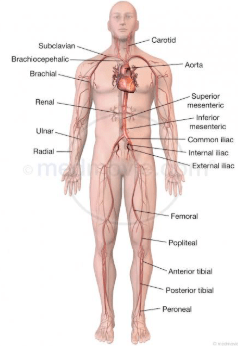
Locate at least 2+ artery locations
Radial, Carotid, Brachial, Femoral
Radial → wrist/thumb side
Carotid → side of the neck
Brachial → inside of the upper arm/elbow area
Femoral → upper thigh/groin
200
What hormone helps lower blood glucose levels?
What hormone helps RAISE blood glucose levels?
BONUS: Name how many types of diabetes are there, differentiate if there are more than one, and describe stages of the path to getting diabetes.
1. Insulin
2. Glucagon
Type 1 and 2, 1 is autoimmune disease w/ earlier diagnosis & 2 develops more as you get older (more common in todays generation too) but also it is simply insulin resistance
200
A patient has a persistent rash, unusual moles, and changes in their skin. Which medical field specializes in diagnosing and treating conditions of the skin, hair, and nails.
Dermatology
200
Meaning of ABC or DR. CAB
Airway Breathing Circulation or Danger Response Circulation Airway Breathing
300
A patient has been diagnosed with iron-deficiency anemia. They begin taking iron supplements but continue to feel tired several weeks later. A student says, “The treatment isn't working because they're still tired.” What important factor should the healthcare team consider before reaching that conclusion?
How often the medicine is being taken as told by the patient so consistency, and if enough time has passed to allow the medicine to take effect.
300
A healthcare worker needs to measure a patient's respiratory rate. The patient is aware that their breathing is being counted. Why might the healthcare worker count the patient's respirations without telling them exactly what is being measured?
Being aware that their breathing is being observed may cause the patient to consciously change their breathing, making the measurement less accurate.
300
The three smallest bones in the body
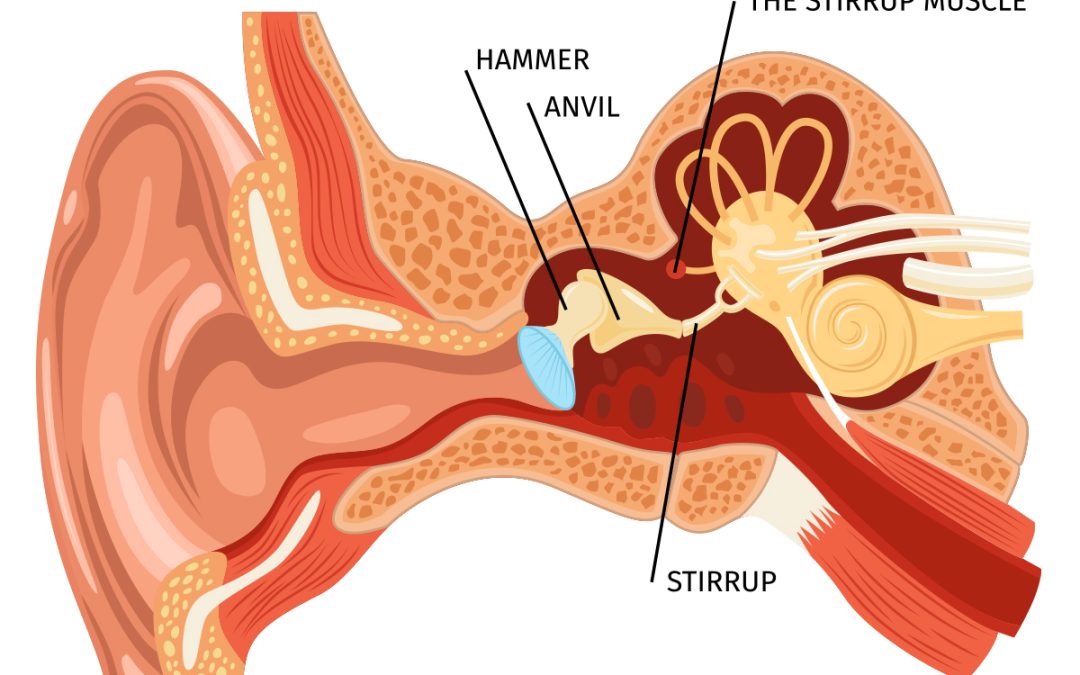 H.A.S ; Hammer, Anvil, Stirrup
300
A patient wants therapy but does not need medication. They meet with a healthcare professional who uses psychotherapy to help them manage anxiety, depression, and life stressors with healthy coping mechanisms.
The professional has an advanced social-work license to also do other work on the side other than therapy. What is their credential? (FREE HINT; LCSW)
Licensed Clinician Social Worker
300
You arrive at an emergency where a person is unconscious but breathing normally. After making sure the scene is safe and calling 911, what position should you place the person in while waiting for help?
Recovery position
400
A student notices that their friend has been unusually energetic for several days, sleeping only a few hours each night without feeling tired, talking much faster than usual, and making unusually risky decisions. The student says, “They're just in a really good mood.”
What mental health condition or event occurred could these symptoms be associated with, and what makes this different from simply being happy or energetic?
A manic episode which is within bipolar disorder
400
During a routine checkup, a teenage patient is accompanied by a parent. The parent repeatedly answers questions for the patient, interrupts them, and does not allow the patient to speak privately with the healthcare provider. For future reference what should happen to prevent this?
An important detail to consider they are 14, and different hospital/clinic systems is also going to affect outcomes of the patient.
The provider should respectfully create an opportunity to speak with the adolescent privately, while maintaining a professional and nonjudgmental approach toward the parent.
Because the patient has reached the age to be legally protected w/ privacy, let the patient be aware of it for future reference if they want to wish their parent not to enter the exam room w/ them.
400
A person begins exercising and notices that their breathing and heart rate both increase. Why do these two systems work harder during exercise?
Working muscles need more oxygen and produce more carbon dioxide, so the cardiovascular and respiratory systems increase their activity.
400
A patient is diagnosed with a tumor and is referred to a specialist who focuses on cancer treatment. What is this medical field called?
Oncology
400
While the choking person is receiving the Heimlich maneuver, the patient then becomes unconscious. You have already called 911. What should you do next?
Lower them to the ground and begin CPR, starting with chest compressions. Each time you open the airway to give breaths, look for the object.
500
A patient repeatedly experiences sudden episodes of intense fear that seem to come “out of nowhere.” During these episodes, their heart races, they have difficulty breathing, feel dizzy, and fear that they are going to die. After several episodes, they begin avoiding places where they worry another episode might occur.
What condition is most consistent with this pattern, and what feature of the scenario helps distinguish it from ordinary anxiety?
Panic disorder. The key feature is recurrent, unexpected panic attacks followed by persistent concern or behavioral changes, such as avoiding places because of fear of another attack.
500
You are a medical resident reviewing a patient's laboratory results for diabetes. The patient's hemoglobin A1C is 5.8%. Normal range is <5.7% The patient is known to have other unrelated conditions that influence their A1C and make them constantly in the prediabetic zone.
Is there anything you should tell the patient in regards of what they can put into action of their lifestyle then? And is that measurement still a thing to worry about? Why or why not?
You should still tell them to work on their lifestyle by eating a good diet & exercising. There's always still room for improvement and just because they have more conditions doesn't mean it's impossible to improve.
It's really not a big thing to worry about if it's just over by one, labs will always differ every time cause a body is constantly changing. It's also a considered normal value, don't entirely depend on it.
500
A patient is having difficulty breathing. When you listen to their lungs, you hear a high-pitched, musical sound, especially when they breathe out. Based on the lung sounds and symptoms, what condition is most likely occurring?
Asthma, bronchitis, bronchospasm
500
A patient has unexplained weight loss, extreme fatigue, and an abnormal number of white blood cells. Their doctor suspects a disease affecting the blood-forming tissues. Which medical field specializes in diagnosing and treating conditions of the blood?
Hematology
500
You arrive at a two-car collision. The scene has been made safe and EMS is on the way. You have two seriously injured patients:
Patient A is conscious but has severe bleeding from their thigh. They are pale, sweaty, confused, and breathing rapidly.
Patient B is unconscious and has a head injury. They are breathing irregularly at 8 breaths per minute and have vomited.
Several bystanders are available to help. Which patient should receive your immediate attention, and what should you have the bystanders do?
1. Prioritize person B abnormal breathing and unconsciousness indicate a potentially life-threatening airway/breathing emergency
2. Have one bystander call/confirm 911, another retrieve an AED, and another begin controlling Patient A's severe bleeding with direct pressure/tourniquet if appropriate