Encoding & Processing
Memory Systems & Models
Types of Memory
Forgetting & Memory Errors
Retrieval, Cues & Key Experiments
100
The process of transforming sensory input into a form that can be stored in memory.
Encoding
100
The three steps of the information processing model.
Encoding, Storage, Retrieval
100
Memory for facts like historical dates.
Semantic memory
100
Failure to encode information results in:
Encoding failure
100
Retrieving information without cues, like on an essay test.
Recall
200
A student remembers words better when thinking about their meaning rather than their sound. According to levels of processing theory, _______ leads to stronger memory.
Deep (semantic) processing
200
A brief visual memory lasting less than a second.
Iconic memory
200
Memory of personal experiences tied to a specific time and place.
Episodic memory
200
Calling your new friend by your old friend’s name demonstrates:
Proactive interference
200
Multiple-choice tests rely primarily on:
Recognition
300
A student studies by focusing on whether words rhyme.
Phonemic (shallow) encoding
300
In an experiment, participants forgot trigrams like “CHJ” within seconds when prevented from rehearsing.
The Brown-Peterson study
300
A person improves at a video game over time but cannot explain what they learned.
Implicit (procedural) memory
300
Learning new material that makes it harder to remember old material demonstrates:
Retroactive interference
300
Exposure to one stimulus influences response to another, often unconsciously.
Priming effect
400
A student remembers where images appeared on a page without trying, but must study vocabulary intentionally.
Automatic vs. effortful processing
400
A student repeats a phone number over and over but does not connect it to meaning.
Maintenance rehearsal
400
A vivid memory of hearing about a shocking event, such as a major tragedy.
Flashbulb memory
400
Participants remembered false details after hearing misleading information about an event.
Misinformation effect
400
People recall information better when in the same environment they learned it.
Context-dependent memory
500
A student rereads notes multiple times but performs worse than another student who self-tests.
The testing effect (retrieval practice)
500
Which model suggests memory consists of central executive, phonological loop, and visuospatial sketchpad?
The working memory model (Baddeley & Hitch)

500
Remembering to submit an assignment later tonight relies on:
Prospective memory
500
A graph shows rapid forgetting soon after learning, then leveling off.
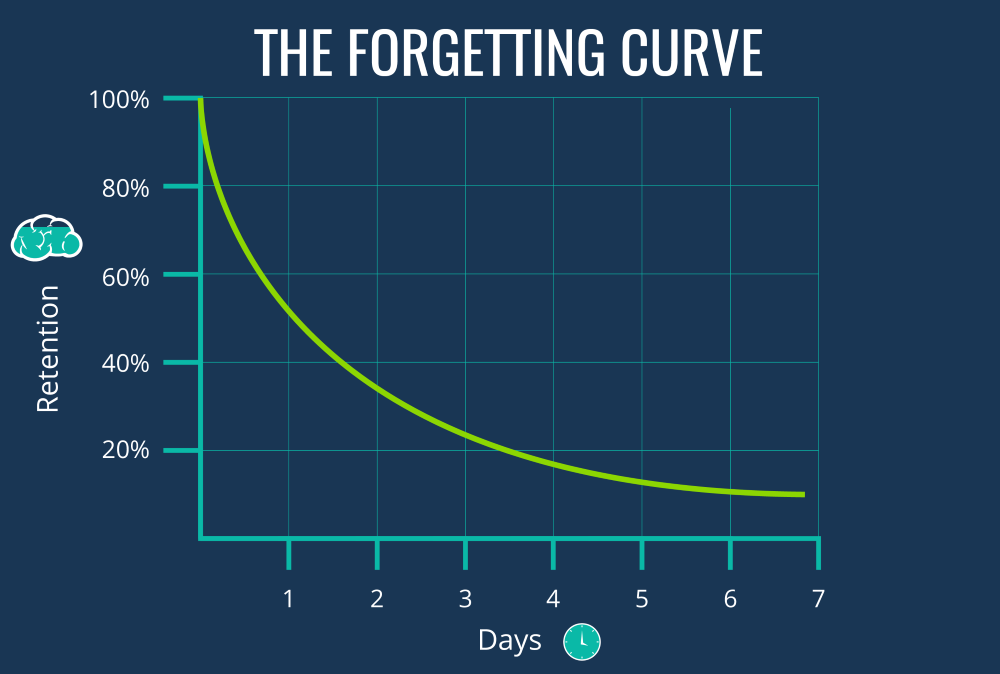
The Ebbinghaus forgetting curve
500
Participants estimated higher speeds when the word “smashed” was used instead of “hit.”
The Loftus & Palmer study (1974)