Geography
People
Aztec, Inca, and Maya
Africa
Random
100
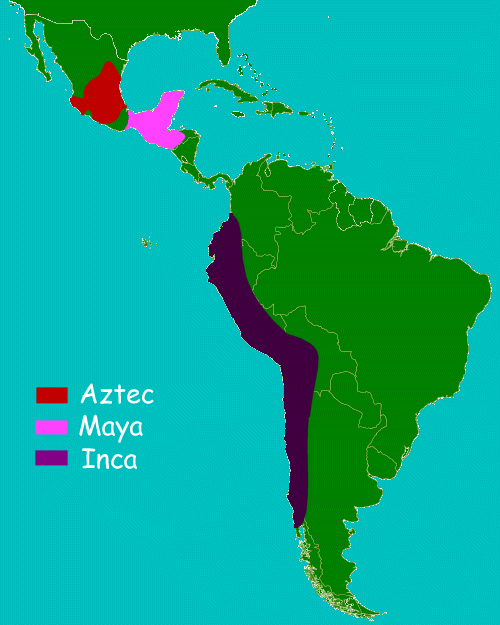
Identify on a map to show the location of the Inca, Aztec, and Maya empires. Just label the Inca, Aztec, and Maya empires. (NOT THE WORDS IN THE WORD BANK. JUST LOOK AT THE MAP ONLY AND LABEL.)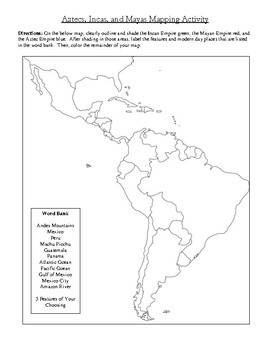
100
Describe the Aztec people, including
*Their language
*The significance of Aztec calendar
*Montezuma
*The role of Hernando Cortez
*When used to describe ethnic groups, the term "Aztec" refers to several Nahuatl-speaking peoples of central Mexico in the Postclassic period of Mesoamerican chronology, the ethnic group that had a leading role in establishing the hegemonic empire based at Tenochtitlan.
*Classical Nahuatl was the language of the Aztec empire and was used as a lingua franca in much of Mesoamerica from the 7th century AD until the Spanish conquest in the 16th century.
*The Aztec calendar was a complex calendar comprised of two separate systems that together created a 52-year cycle. Each system served an important purpose for the Aztecs in their daily and religious lives. Not only did they serve as a means to determine the passage of time, but both calendars provided guidance for the timing of religious ceremonies, festivals, and agriculture.
*Several sources describe Montezuma as a proud ruler who instead of focusing on reality, gave in to the power of omens and prophecies.
*Hernán Cortés was a Spanish conquistador, or conqueror, best remembered for conquering the Aztec empire in 1521 and claiming Mexico for Spain. He also helped colonize Cuba and became a governor of New Spain.
100
* Explain how society differed between the Aztec and Inca civilizations.
*What are the different gods, famous leaders, locations, and capitals both the Aztec and Inca had?
Both Aztec and Inca possessed a society ordered in hierarchies, the nobility being the most important sector Among the Aztecs the most recognized were military leaders, priests, and civil servants, who were part of the Pipiltin class; while the rest were part of the common people called macehualtin. The Incas differed between the nobles (the Inca and the provincial chiefs) who were the most powerful. Then he was followed by lower-ranking officials and artisans. A little lower were the peasants who owned land assigned to work by the curacas and finally, there were the yanas, servants.
Incas:
* God: Inti is the ancient Incan sun god.
* Famous Leader: Atahualpa
* Location: The Inca Empire, or Inka Empire (Quechua: Tawantinsuyu), was the largest empire in pre-Columbian America. The administrative, political and military center of the empire was located in Cusco in modern-day Peru.
* Capital: Cusco
Aztec:
* God: Polytheistic
* Famous Leader: Montezuma
* Location: The Aztec Empire was located in what is now called central Mexico and was the last of the great Mesoamerica native civilizations to be overthrown.
* Capital: Tenochtitlán
100
Why was West Africa an important trading center?
Around the fifth century, thanks to the availability of the camel, Berber-speaking people began crossing the Sahara Desert. From the eighth century onward, annual trade caravans followed routes later described by Arabic authors with minute attention to detail. Gold, sought from the western and central Sudan, was the main commodity of the trans-Saharan trade. The traffic in gold was spurred by the demand for and supply of coinage. The rise of the Soninke empire of Ghana appears to be related to the beginnings of the trans-Saharan gold trade in the fifth century.
100
What are the 5 pillars of Islam?
* Shahadah means that’s the bearing witness to two very important facts. that there really is only one God Allah. He has no partners and he alone is the Creator the sustainer of the universe. He always was and always will be. and that’s my god. that’s basically the first part of Shahadah.
* The Second pillar is to establish the Salat – Namaz. Salat means the connection that we have with the law through our worship by standing in a certain way. Facing the direction of Mecca. and then opening up our hearts and praying to him. and going through the ritualistic motions that he’s prescribed for us to do to make this connection with him.
* The third pillar is usually referred to as zakat. and this is the charity that the wealthy give every year once a year. They give a small percentage of their wealth that they hold for over a year’s time directly to the poor. We don’t actually have something where you’re you know like donating 10% of your income or anything like that to a church or temple, but rather this is something goes directly to the poor. and you can do it by way of your local Masjid or whatever.
* The fourth pillar is called Ramadan fasting. The month of Ramadan that is to abstain from any food or drink during the daylight hours of the month of Ramadan. and then at the end of that month, there is something called the EID that goes along with this.
* Then finally last & Fifth Pillar is Hajj. what about Hajj, The pilgrimage to the House of Allah once in the lifetime. If a person has a way to do it. Allah makes a way for them.
200
What are the major physical features of African geography?
The physical features of Africa include,
* The Sahara desert
* Sahel
* Ethiopian Highlands
* Savannas
* Rainforests
*Swahili Coast
*Southern Africa
* The Great Lakes
* The Nile River
200
Even though greatly outnumbered, what are at least three factors that helped Europeans conquer the Mesoamerican natives?
* Superior Weapons
* Alliances and Experience
* The Power of Horses
* Deadly Disease
200
Create a list of at least three Aztec inventions. Include a brief description of each
invention.
*Chocolate:
The Aztecs and Mayans take credit for introducing chocolate to the world. In Mayan culture, chocolate was so important it was used as currency. The Aztecs used the cacao bean to make xocoatl (bitter water), similar to a brew prepared by the Mayans. This hot chocolate beverage was popular with the upper class and was concocted out of cacao beans, corn flour, water, and chilies. Xocoatl would serve as the foundation for a number of other hot chocolate drinks. The Spanish would introduce sugar as a further improvement to this spicy drink.
*Medicine:
An herbal remedy used today to ease insomnia, epilepsy and high blood pressure date back to the Aztec empire. The passion flower was used by the Aztecs as a medication to calms spasms and relax muscles. Some believe this was used during surgery.
*The Calendar:
Time was measured by the Aztecs through a calendar wheel. The Aztecs actually used several calendars, but one of them used the current system of 365 days in a year. This calendar was known as the xiuhpohualli and it was broken up into several 18-day months, with 5 leftover days at the end of the year.
200
What is an African Storyteller called?
A griot is a West African historian, storyteller, praise singer, poet, or musician. The griot is a repository of oral tradition and is often seen as a leader due to his or her position as an advisor to royal personages
200
Who was Mansa Musa and why is he important?
Mansa Musa was the leader of Mali a West African empire which became the largest and richest empire in Africa under Mansa Musa. Mansa means emperor so Mansa Musa means Emperor Musa. He is believed to be the grandson of Sundiata, the founder of the dynasty. He is famous for his pilgrimage to Mecca, in 1325 he set out with 60,000 porters; 80 camels carrying 140 kg of gold each, and 6000 slaves clad in Persian silk. It is said that his lavish spending in the bazaars of Cairo flooded the market with so much gold that it depressed its value for 12 years. It was this flamboyant journey which awakened the world to the splendor and riches of Mali.
300
What do Mesoamerican empires have in common w/ other empires?
They all grew too big to handle and usually got overpopulated.
300
What are some of the similarities of the monotheistic religions?
Two major similarities between the monotheistic religions are that only one god is always worshiped and that it is impossible to worship without the endorsement of religious leaders.
300
Identify at least two ways that the Aztec capital, Tenochtitlan, impressed Europeans.
The Aztec conquered a large empire in Central Mexico. Their capital city was named Tenochtitlan. Mexico's capital city stands on this ancient site today. Tenochtitlan was originally built on two islands in the middle of a lake. The people believed that their god wanted them to build Tenochtitlan in this swampy area. Because of the surrounding waters, the city had canals and causeways crisscrossing through it.
300
What country was in the center of a major empire in South Africa.
Zimbabwe
300
What was the Columbian exchange?
The Columbian Exchange, or Grand Exchange, was the widespread transfer of animals, plants, culture, human populations, communicable diseases, technology and ideas between the American and Afro-Eurasian hemispheres in the 15th and 16th centuries, after Christopher Columbus' 1492 voyage. A major consequence of Columbus' voyages was the eventual exchange of goods between the Old World (Europe) and the New World (the Americas). For a list of some of the goods that were shared in this "Columbian Exchange" between the continents, look here.
400
How many countries are in Africa?
As of July 2016, Africa contains 54 fully recognized sovereign states (countries), two de facto independent states having limited or no recognition (Western Sahara or Sahrawi Arab Democratic Republic and Somaliland), and 10 non-sovereign territories.
400
How did the first people reach to the Americas from Russia?
The first people were Native Americans who had crossed by using the land-bridge from Asia to North America. (which is not here now.)
400
Describe the Inca people, including,
*Their language
*The importance of Atahualpa
*Machu Picchu
*The role of Francisco Pizarro.
*Inca government and how it worked
*At least three major Inca inventions (and include a brief description and hand-
drawn picture for each).
*Education
*Agriculture
* Quechuan languages
*Atahualpa (ca. 1502-1533) was the Inca emperor of Peru whose capture and execution by Francisco Pizarro enabled the conquistadores to secure the Inca lands for the Spanish crown.
*Machu Picchu is one of the most important archaeological sites in the world. Machu Picchu is tangible evidence of the urban Inca Empire at the peak of its power and achievement—a citadel of cut stone fit together without mortar so tightly that its cracks still can’t be penetrated by a knife blade.
*Francisco Pizarro was one of the cruelest Spanish conquistadors. He is most famous for conquering the Inca Empire in Peru. He was also part of the expedition led by Vasco Núñez de Balboa that discovered the Pacific.
*The Inca government was called the Tawantinsuyu. It was a monarchy ruled by a single leader called the Sapa Inca. Sapa Inca -The emperor or king of the Inca Empire was called the Sapa Inca, which means "sole ruler". He was the most powerful person in the land and everyone else reported to the Sapa Inca.
*Inventions:
-The invention of the quipus. A quipu was an item that had different colored strings knotted to the main string. The color differences and length differences between the knots told a story, similar to reading a book. In order to read the quipus to others, one had to be a specially trained quipus reader.
-The Inca calendar is not as famous as the Mayan calendar, but it was important to the Incas nonetheless. It was known as a Tower, and the Incas were very concerned with time due to religious reasons. Incas also used a stone calculator they had created, in order to perform math functions, and studied astronomy and the stars. Agriculturally, Incas were very successful, which was due in part to their fascination with astronomy. Some of their architecture was constructed with the sun in mind so that they would know when to plant crops.
-
Living among the steep peaks of the Andes, the Incas lacked level fields for farming. To solve this problem, they developed a system of terraces that they constructed throughout the empire like a giant green staircase. Building stepped terraces help the Incas create farmland, and the clever construction of each terrace gave crops the best chance of survival.
*Inca education during the time of the Inca Empire was divided into two principal spheres: education for the upper classes and education for the general population.
*The Incan civilization was predominantly an agricultural society. The Incas took advantage of the soil, overcoming the adversities of the Andean terrain and weather.
500
Which major empire in East Africa is in Modern Day Ethiopia?
The Kingdom used the name "Ethiopia" as early as the 4th century. The Empire of Aksum at its height at times extended across most of present-day Eritrea, Ethiopia, Somalia, Djibouti, Sudan, Egypt, Yemen and Saudi Arabia. The capital city of the empire was Aksum, now in northern Ethiopia.
500
What was the first Mesoamerican civilization?
The first complex civilization known in Mesoamerica is that of the Olmecs, who inhabited the coastal region of the Gulf of Mexico during the initial pre-classic period, from 1300 BC, with apogee between 1150 and 700 BC at the sites of La Venta and San Lorenzo Tenochtitlan.
500
*Explain a possible theory to explain the downfall of the Mayan Empire.
*Create a list of at least three Mayan achievements.
*The city-states of the ancient Mayan empire flourished in southern Mexico and northern Central America for about six centuries. Then, around A.D. 900 Mayan civilization disintegrated. Two new studies examine the reasons for the collapse of the Mayan culture, finding the Mayans themselves contributed to the downfall of the empire.
*Inventions
- They had a highly advanced numeral system with place values.
- Maya mathematics was far ahead of Europe for many centuries.
- The had a sophisticated and complex calendar.