Vocabulary
Domain & Range
Functions
Sequence
Linear vs. Exponential
100
What is x-intercept?
When your function crosses the x-axis.
(x,0)
100
What is the domain and range?
The domain represents all the x values or inputs of a function and the range represents the y values or outputs of a function.
100
Evaluate f(x)=25 + 4x if x=5
45
100
Identify the sequence 2,4,6,8,10
arithmetic
100
This is the formula for linear function.
y=mx + b
m=slope
b= y-intercept
200
What is y-intercept?
When your function crosses your y-axis.
(0,y)
200
(0, 15), (4, 6), (4, 7), (3, 3) Find the domains.
What is 0,4,4,3?
200
Is it a function?
No
200
Identify the sequence 2, 6,18, 54,162
geometric
200
This is the formula for exponential functions.
y=a(b)x
a= initial amount (x=0) y=intercept
b= rate of change (pattern)
300
True or False. Intervals of increasing, decreasing or constant ALWAYS pertain to x-values.
True
300
(3, 6), (10, -5), (5, -2), (7, 1) Find the ranges.
What is 6,-5,-2,1
300
f(x) = 2x - 10 find f(6)
f(6) = 2
300
Identify the next two terms 26,20,14,___
8 and 2
300
Fill in the blanks: A linear function ____________ or ____________ by the same amount. An exponential function ____________ or ______________ by the same amount.
add/subtracts multiplies/divides
400
A relation that assigns exactly one value in the range to each value in the domain?
Function
400
Find the domain and range. {(-3,4),(0,10),(11,8),(4,5)}
D:{-3,0,4,11} R:{4,5,8,10}
400
f(x) = -6x - 9 find f(3)
-27
400

In a arithmetic sequence, is this formula recursive or explicit?
Explicit.
Explicit: A formula for any term, depending on the term number
400
This is the model that best describes the following information. {(1,8),(2,12),(3,16),(4,20),(5,24)}
Is this linear or exponential?
Linear
500
 What is the name of this formula?
Average rate of change or slope
500
(2, –3), (4, 6), (3, –1), (6, 6), (2, 3) List the Domain/Range/If it is a function or not
What is domain: {2, 3, 4, 6} range: {–3, –1, 3, 6} Not a function
500
Given the points write a function rule (-1,-1); (0,1); (1,3);(2,5)
What is f(x)=2x+1?
500
In a geometric sequence, does this formula represent an explicit or recursive?
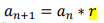
Recursive.
Recursive: A formula for the next term, depending on the previous term
500
This is the answer when f(x) = 10(5)x is evaluated for f(3).
1250