Shoulder
Shoulder/Elbow
Wrist/Hand
Elbow/Nerve Entrapment
Miscellaneous
100
A patient presents with shoulder pain and difficulty lifting the arm. During shoulder elevation, you observe excessive scapular elevation and early upward rotation, with the shoulder shrugging to compensate for limited arm elevation. What is the diagnosis-- be specific.
Type III scapular dyskinesia
100
A patient with adhesive capsulitis is in the freezing stage. Pain begins at 30 degrees of shoulder abduction. Should you force the joint to 35 degrees to improve ROM?
No, stay within the pain tolerance of the patient and consider grade 1 or 2 mobilizations
100
A patient cannot maintain thumb adduction while holding paper. The thumb IP joint flexes as compensation. What is the name of this test and what does it indicate?
Froment's sign, suggesting deep ulnar nerve dysfunction
100
A patient has sudden anterior elbow pain after trying to catch a heavy falling object. They have supination weakness, bruisning, and mishapened muscles in the arm. What injury has occured?
Distal biceps tendon rupture
100
A patient develops difficulty extending the fingers and thumb after repetitive forearm rotation. Examination reveals finger and thumb extension weakness, but wrist extension is relatively preserved and there is no cutaneous sensory loss. What is the likely diagnosis? Which nerve is affected? What key finding distinguishes this from a more proximal radial nerve injury?
Posterior Interosseoius Nerve Syndrome
PIN, the motor branch of the radial nerve
PIN sydnrome causes primarliy motor deficits without sensory loss. During wrist extension, ECRB is weakened and ECRL is spared resulting in radial deviation with wrist extension
200
A 52-year-old patient reports gradually worsening shoulder pain, difficulty reaching overhead, and difficulty sleeping on the affected side. Both active and passive ROM are globally limited, especially ER. What is the likely diagnosis and what is your treatment plan?
Adhesive Capsulitis
Freezing stage: reeduce pain and protect ROM- grade 1 and 2 joint mobes
Frozen stage: improve mobility--progressive stretching, AROM exercises epecially for ER
Thawing stage: strength and function, scapular and rotator cuff strengthening
200
A patient has shoulder weakness, a positive drop-arm test, and difficulty controlling arm lowering. What is the diagnosis? What special tests can be performied?
Rotator Cuff tear
TIC: Drop arm, Infraspinatus, Painful arc
Teresminor- Hornblowrs
Subscap- Lift off, IRLS
200
A patient has numbness and tingling in the thumb, index, and middle fingers, especially at night, with thenar weakness. What is the likely diagnosis?
Carpal Tunnel Syndrome
200
Which tendon is commonly implicated in lateral epicondylalgia?
Extensor carpi radialis brevis
200
A patient develops persistent, disproportionate hand pain after a wrist fracture. Even light touch causes severe pain. What condition should be considered?
Complex regional pain syndrome
300
A swimmer reports deep shoulder pain, clicking, and symptoms during overhead activity. The clinician suspects a superior labral injury near the biceps attachment. What is the diagnosis?
SLAP tear
300
A patient with elbow dislocation has no fracture but has ligament injury. How does this differ from a complex dislocation?
A simple dislocation has no associated fracture; a complex dislocation includes fracture
300
What are the clinical prediction rules for CTS?
>Age 45
Positive Flick Sign
Wrist Ratio Index >.67
Symptom Severity Scale score >1.9
Diminished sensation in top of thumb compared to thenar eminence
300
What is the main difference between a tendon disorder and a peripheral nerve entrapment?
Tendon disorders are more often load-related; nerve entrapments may produce sensory changes or nerve-related weakness
300
For TOS, how would symptoms differ between venous and arterial systems?
Venous: Arm swelling, heaviness, and cyanotic hands/fingers
Arterial: Coolness, pallor, diminished pulses
400
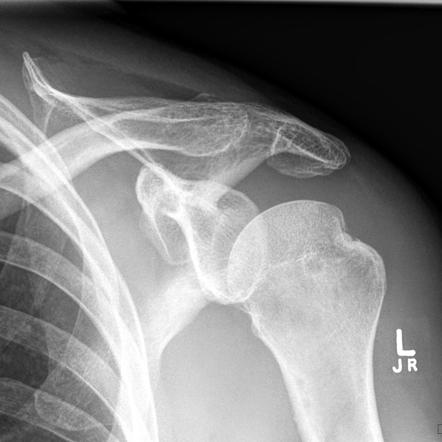
What is pathology is indicated in this x-ray?
Hill Sachs Fracture
400
What is the primary restraint to valgus stress at the elbow?
Anterior bundle of the UCL
400
A patient falls on an outstretched hand and develops ulnar-sided wrist pain with clicking during axial loading and ulnar deviation. What structure is likely injured? What tests can be performed?
Triangular fibrocartilage complex
Piano Key
TFCC Grind
400
A patient falls asleep with the upper arm compressed against a hard surface. They wake with wrist and finger extension weakness and dorsal hand paresthesia. What nerve is likely affected?
Radial Nerve
400
A patient falls asleep with the upper arm draped over the back of a chair after a long day of studying for their PT midterm. Upon waking, the patient has wrist drop and difficulty extending the fingers. Sensation is decreased over part of the dorsum of the hand. What is the likely diagnosis? Which nerve and common compression site are involved? Why does this patient have wrist drop?
Saturday night palsy
Radial nerve compression commonly at the spiral groove of the humerus
The radial nerve supplies the wrist and finger extensor muslces, compression can weaken and paralyze these msucles
500
A patient has painful shoulder elevation but also neck pain, tingling into the hand, and altered reflexes. Why should you not assume an isolated rotator cuff disorder?
The patient possibly has cervical radiculopathy or another neurological disorder becasue of their symptoms going down to the hand and altered reflexes
500
A patient has pain with resisted middle-finger extension and tenderness deeper in the proximal forearm rather than directly over the epicondyle. What is the diagnosis?
Radial Tunnel Syndrome.
It involves compression or irritation of the radial nerve in the proximal forearm. The location is why it differs from lateral epiconyltiis.
500
A patient sustains a deep laceration to the volar side of the finger. During examination, the patient can flex the PIP joint but cannot actively flex the DIP joint. Which tendon is most likely injured, and what is this injury called?
Flexor Digitorum Profundus
Jersey Finger
500
A patient has wrist drop after a humeral shaft fracture at the spiral groove. Why may this injury cause a more extensive deficit than a distal PIN injury?
The radial nerve is affected before several wrist and finger extensors receive innervation
500
A patient has UE paresthesia that worsens with repeated overhead serves in tennis. Her symtpoms improve when the arm is lowered and there is no localized wrist pain or median nerve sensory pattern. What is the likley diagnosis? Name the possible anatomical regions involved? And name the tests you would use to rule in/rule out this diagnosis?
Thoracic Outlet Syndrome
Scalene trianagle (anterior &middle scalene, first rib), costoclavicular spoace, pec minor space
Roos, Wrights, Adsons, Edens