Experimental Stuff
Electron Configuration
Schrodinger and Calculations
Periodic Trends
Random
100
What are the differences between orbits and orbitals? (name at least 2)
Orbits: 2-D, fixed path, solar sytem model
Orbitals: 3-D, probability
100
Give me the noble gas shorthand configuration for Potassium
[Ar]4s1
100
Explain Heisenberg's Uncertainty Principle
We can never be certain the location and velocity at which an electron is traveling. There's a 90% probability that they're in the places we found solutions for
100
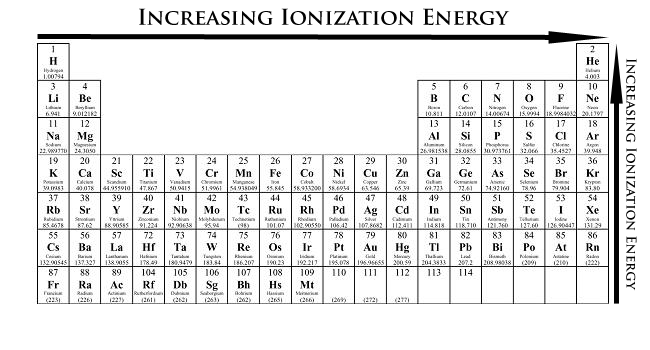
Explain the periodic trend for ionization energy
100
What element is represented by chemical symbol Mo?
Molybdenum
200
What accounts for one laser being more intense than another?
Intensity aka amplitude aka number of photons
200
What element has electron configuration [Xe]4f14 5d10 6s1?
Gold (Au)
200
Draw the shape of the first two orbital types
s and p
200
Without knowing the actual measurements and solely based off of periodic trends, what would you say is the atom with the greatest atomic radius in the bulk of the periodic table (do don't look at the last two f orbital rows)? Why?
Francium (Fr); greatest n level, less pull into the nucleus
200
Tell me the difference between ionization and electron affinity.
Ionization: energy required to remove an electron in an atom
Electron Affinity: energy released when electron is added to an atom
300
Explain the double slit experiment. What was the significance of it?
Shoot electrons through two slits. They exhibited wave like interference patterns. Electrons, like light, exemplify wave-particle duality
300
Complete an orbital diagram for element, Co
Cobalt [Ar] 4s2 3d7 (I can't attach a picture, but if you have questions, ask a TA)
300
What did De Broglie do and what is the significance?
Said that everything that moves has a wave property associated with it, so explains how electrons can travel as a wave, instead of like orbiting particles.
**HIGHLY recommend watching this
https://www.youtube.com/watch?v=oLd-6UytkIU&ab_channel=CrashChemistryAcademy
300
An electron can be removed from Na or Rb by electromagnetic radiation (the photoelectric effect). Which element, Na or Rb, would require the shortest wavelength to remove the electron?
Na.
Shorter wavelength = more energy required. Ionization energy Na > Rb
300
Which energy is greater? First or second ionization energy? Why?
Second; In the second, you are trying to remove an electron from an already negative anion.
400
Explain blackbody radiation and the problem it pointed out with the classical physics model.
Blackbody radiation = spectrum of light emitted by black body; Classical physics assumed if you increased the frequency infinitely, the blackbody would increase in the intensity of the EM radiation involved. That means it radiate an infinite amount of UV radiation, if you put in a high enough frequency, but that wasn't the case. Helped us to explain that energy must be quantized.
This is a good resource to understanding blackbody radiation and quantum mechanics! https://www.youtube.com/watch?v=FXfrncRey-4&ab_channel=PhysicsGirl
400
Draw the electron box diagram for Pb.
[Xe]6s2 4f14 5d10 6p2 (I can't attach a picture, but if you have questions, ask a TA)
400
Write out Coulomb's Law and explain the significance in comparing periodic trend
Charge and distance
F proportional (k)q1q2/r^2
(For example, comparing O and F, going across the periodic table, as the force of attraction increases, the distance between the electrons and the positively charged nucleus will decrease, as the electrons will "pull in tighter" towards the nucleus. Therefore, F would have a smaller atomic radius than O)
400
The 1st IE is higher for N than for O, even though O has 1 more
proton in its nucleus. Offer an explanation.
In nitrogen, the 2p orbitals are exactly half filled. Removing an electron from oxygen will require energy, but it will require less than in nitrogen because it will result in half filled orbitals, which are more energetically favorable.
400
Write the equation for what's happening with electron affinity
X + e- --> X-
500
Explain the photoelectric effect and the problem it pointed out with the classical physics model
Light can shine on a metal and knock an electron off of it. They found that higher frequency/energy electrons could knock electron off, but more intense light didn't do that. (ping pong ball analogy)
***For more resources, Khan academy and Sway have good explanations
500
How do you know if an atom is in an excited state?
Electron will ideally fill up electrons in order of increasing energy. If the orbital isn't filled and the next energy orbital is being occupied, it is in an excited state.
500
What are the solutions to the "ms" section in Schrodinger's equation? What does that tell us? What is the conclusion from this?
-1/2, +1/2; electron spin; there are two electrons in each orbital
500
The compound, NaCl, consists of sodium cations and chlorine anions. The sodium and chlorine ions are not the same size as they are in the elemental state. Explain how their relative sizes change (larger or smaller) in relationship to their size in the elemental state.
Na will decrease in size, Cl will increase in size.
(Na loses an electron, Cl gains an electron)
-Fewer electrons leads to less electron repulsion between neighboring electrons
-Gaining electrons makes anions larger because there are more repulsions between the electrons, which also shield each other from the attraction of the nucleus.
500
Explain why the 1s orbital is smaller for Ar than He.
More protons = stronger forces of attraction (Coulomb's Law)