Ch 6: Hybridization
Ch 7: Reactions/ Stoichiometry
Ch 7: Reaction Calculations
Ch 8: Precipitation/Acid-Base
Ch 8 Gas/Redox
100
A chemical bond results from the _________ of two half-filled orbitals and spin-pairing of the two ________ electrons
A chemical bond results from the overlap of two half-filled orbitals and spin-pairing of the two valence electrons
100
Write a general equation for the reaction of an alkali metal with a halogen.
2M(s) + X2(g) → 2MX(s)
100
Hydrogen gas and chlorine gas react to produce hydrogen chloride.
Assuming the reaction goes to completion, what is left in the container after the reaction reaches completion?
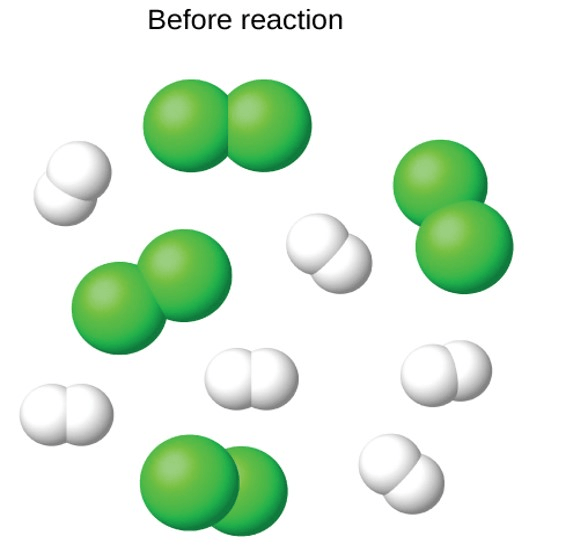
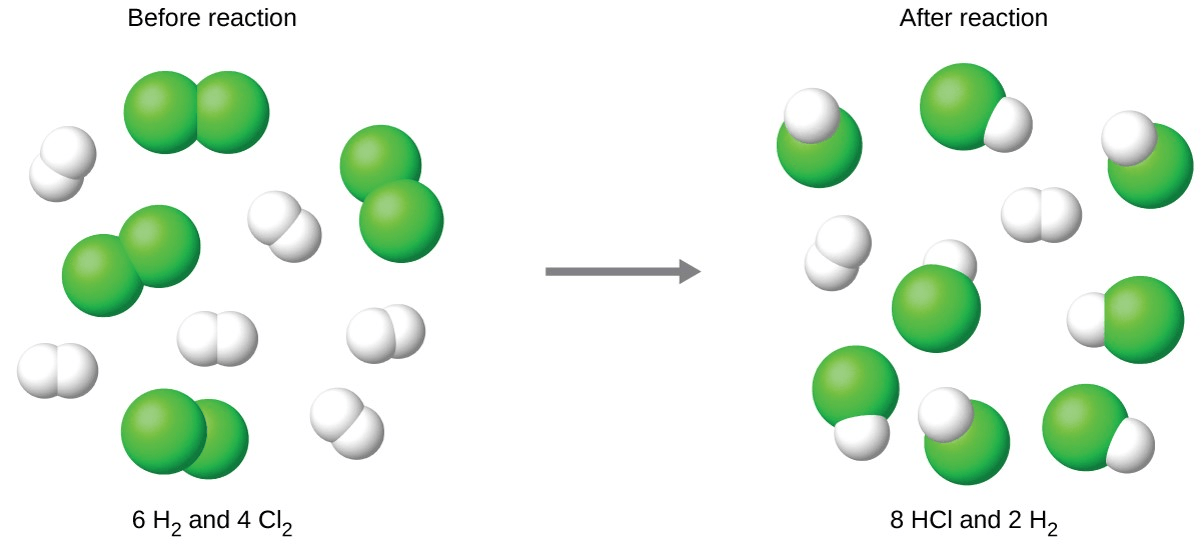
100
To what volume should you dilute 30 mL of a 11.0 M H2SO4 solution to obtain a 0.150 M H2SO4 solution?
2.2 L
100
Hydrogen fluoride gas reacts with aqueous sodium sulfide. Predict the products and balance the equation.
2 HF(g) + Na2S(aq) → 2 NaF(aq) + H2S(g)
200
Draw the type of overlap to form:
•Sigma bonds
•Pi bonds

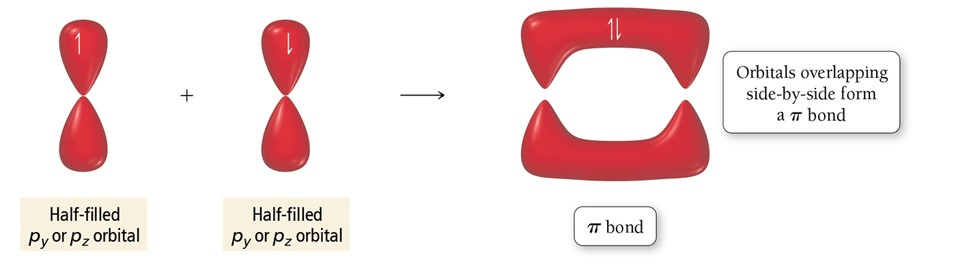
200
Write a general equation for the reaction of an alkali metal with water.
2M(s) + 2H2O(l) → 2M+(aq) + 2OH−(aq) + H2(g)
or
2M(s) + 2H2O(l) → 2MOH(aq) + H2(g)
200
Consider the balanced equation for the combustion of hexane:
2 C6H14(g) + 19 O2(g)→12 CO2(g)+ 14 H2O(g)
Determine how many moles of O2 are required to react completely with 5.1 moles C6H14.
48.5 mol O2
200
Aqueous sulfuric acid reacts with aqueous potassium hydroxide. Predict the products, including states, and balance
H2SO4(aq) + 2 KOH(aq) → 2H2O(l) + K2SO4(aq)
200
Write a balanced molecular equation for the gas-evolution reaction that occurs when you mix aqueous chloric acid and aqueous potassium carbonate.
2 HClO3(aq) + K2CO3(aq) → H2O(l) + CO2(g) + 2 KClO3(aq)
300
How do you form pi-bonds?
What effect does a pi-bond have on the molecule’s:
Strength
Rotation
UNHYBRIZED, PARALLEL P-ORBITALS
Strength: stronger (but not as strong as sigma bond)
Rotation: restricts it
300
Write a balanced equation for the reaction of bromine with chlorine in their natural states (include them).
What type of reaction is this?
Br2(l) + Cl2(g) → 2BrCl(g)
Inter-Halogen Reaction
300
Hydrobromic acid dissolves solid iron according to the following reaction:
Fe(s) + 2HBr(aq) → FeBr2(aq) + H2(g)
What mass of HBr (in g) would you need to dissolve a 3.1 −g pure iron bar on a padlock?
9.0 g HBr
300
How many of the following compounds are insoluble in water?
KC2H3O2 , CaSO4, CaS, AlPO4
2
CaSO4
AlPO4
300
What is the oxidation state of Cl in each of the following ions?
•ClO-
•ClO2-
•ClO3-
•ClO4-
•ClO-: +1
•ClO2-: +3
•ClO3-: +5
•ClO4-: +7
400
How many sigma bonds & pi bonds can each hybridized central atom form?
a.sp
b.sp2
c.sp3
d.Sp3d
e.sp3d2
How many electron groups, sigma bonds & pi bonds can each hybridized central atom form?
a.Sp – 2 e- groups, 2 σ, 2π
b.sp2 – 3 e- groups, 3 σ, 1π
c.sp3 – 4 e- groups, 4 σ, 0π
d.Sp3d – 5 e- groups, 5 σ, 0π
e.sp3d2 – 6 e- groups, 6 σ, 0π
400
Balance the following rxn.
C6H14 + O2 -> CO2 + H2O
What type of rxn is it?
2 C6H14 + 19 O2 -> 12 CO2 + 14 H2O
Combustion
400
DAILY DOUBLE
Iron(III) oxide reacts with carbon monoxide according to the equation:
Fe2O3(s) + 3CO(g) → 2Fe(s) + 3CO2(g)
A reaction mixture initially contains 22.90 g Fe2O3 and 15.76 g CO.
Which is the limiting reagent?
Fe2O3 is the limiting reagent
400
What volume (mL) of 0.184 M Na3PO4 solution is necessary to completely react with 95.2 mL of 0.118 M CuCl2?
40.7 mL
400
What element is the oxidizing agent (if any) in the following reaction?
Zn(s) + 2 AgNO3(aq) → Zn(NO3)2(aq) + 2 Ag(s)
Ag is reduced, so AgNO3 is the oxidizing agent
500
In this molecule, how many sigma and pi bonds are there?
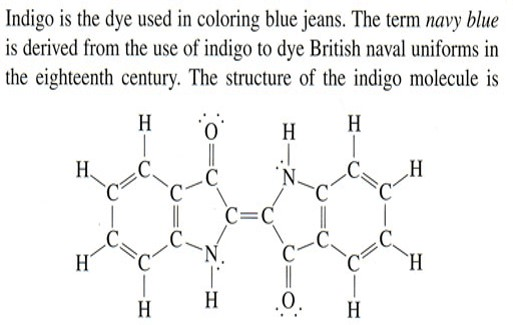
Sigma: 33
Pi: 9
500
Write a balanced chemical equation for the fermentation of sucrose (C12H22O11) by yeasts in which the aqueous sugar reacts with water to form aqueous ethyl alcohol (C2H5OH) and carbon dioxide gas. Include states.
C12H22O11(aq) + H2O(l) → 4 C2H5OH(aq) + 4 CO2(g)
500
Iron(III) oxide reacts with carbon monoxide according to the equation:
Fe2O3(s) + 3CO(g) → 2Fe(s) + 3CO2(g)
A reaction mixture initially contains 22.90 g Fe2O3 and 15.76 g CO.
How much of the excess reagent remains after the reaction is complete?
3.71 g CO remain
500
A 24.00 −mL sample of an unknown HClO4 solution requires titration with 22.12 mL of 0.2200 M NaOH to reach the equivalence point.
What is the concentration of the unknown HClO4 solution? The neutralization reaction is:
HClO4(aq)+NaOH(aq) → H2O(l)+NaClO4(aq)
0.2028 M
500
Identify which redox reactions occur spontaneously in the forward direction.
Mg2+(aq) + Zn(s) → Mg(s) + Zn2+(aq)
2Al(s) + 3Pb2+(aq) → 2Al3+(aq) + 3Pb(s)
Sn(s) + Mn2+(aq) → Sn2+(aq) + Mn(s)
2Ag+(aq) + Ni(s) → 2Ag(s) + Ni2+(aq)
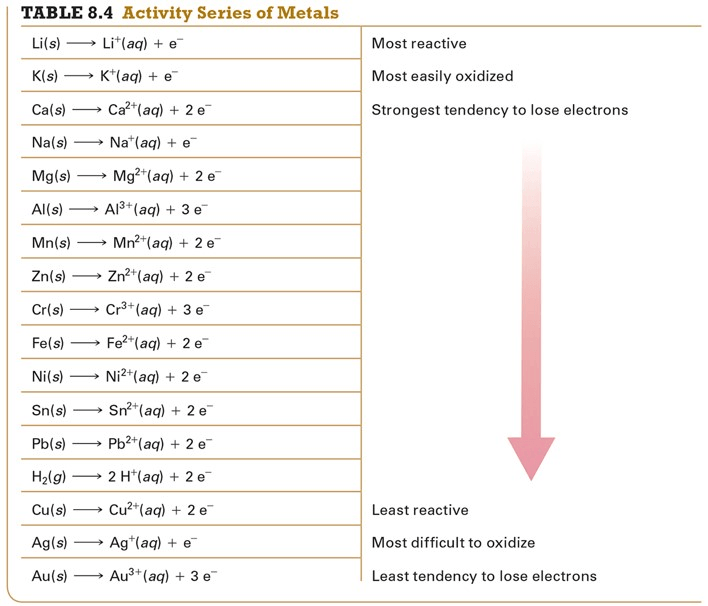
2Al(s) + 3Pb2+(aq) → 2Al3+(aq) + 3Pb(s)
2Ag+(aq) + Ni(s) → 2Ag(s) + Ni2+(aq)