Stay Classy
I'm more than my measures!
Hardwired
Control Yourself
ATTENTION!
100
Is balance a motor ability or a motor skill?
ability
100
If a group of subjects was measured at the beginning of a study, and then again at the end, what type of statistical analysis should be used?
dependent (paired) t-test
100
What specific neurons carry nerve impulses from the central nervous system (CNS) to produce voluntary muscle actions?
alpha motor neurons
100
What does a generalized motor program govern? (solving the degrees of freedom problem)
Class of actions
100
What are the 4 factors that influence our attention capacity?
Arousal
Enduring dispositions
Momentary intentions
Evaluation of demands
150
What motor ability, lends itself to the motor skill of juggling?
hand-eye-coordination, and a smaller degree finger dexterity (grasping)
150
What would an instructor’s error score be if she tended to be late to class?
High or Low AE, CE, and VE?
High AE: not "on time" will result in this increasing +/-)
High CE: always late/positive score
Low VE: always opposite of CE
150
Identify the green, yellow and pink sections; what lobe are they located in?
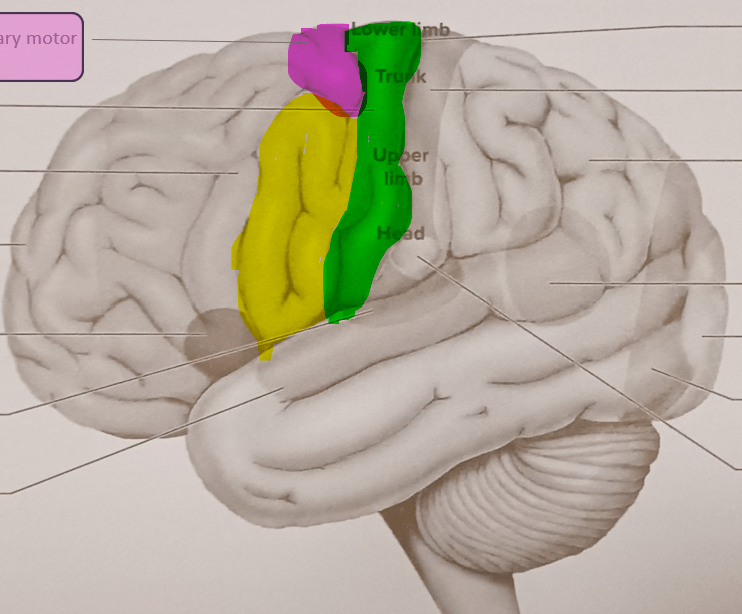
Green: Primary motor cortex
Pink: Supplementary motor area (SMA)
Yellow: Premotor area
All in frontal lobe
150
What movement characteristics are variable and must be programmed into each performance of a motor skill’s GMP
Parameters (Schema theory)
150
Describe how arousal/anxiety effects performance?
Yerkes-Dodson inverted U concept.
Too little: poor
Too much: poor
There is an optimal level of arousal for peak performance.
200
Is driving a car more of a fine, gross, or middle of the continuum motor skill?
middle of the continuum
-Arms and ankles doing majority
200
In an instructor was always on time and ready to start class at 10 after the hour, what would their error score be?
High or Low AE, CE, and VE?
Low AE, therefore,
Low CE and VE
200
Identify the blue, upper pink, green, and yellow sections and state which lobe they are located in.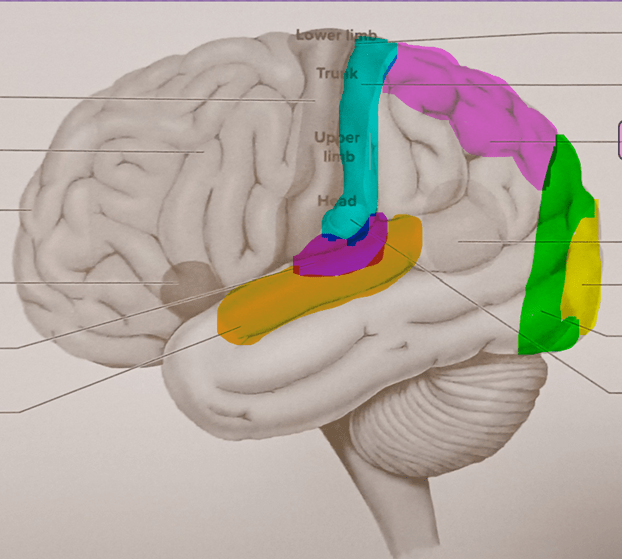
Blue: primary somatosensory cortex - parietal
Pink: Somatosensory area - parietal
Green: Visual association area - occipital
Yellow: Visual cortex - occipital
200
What are the three main aspects of Dynamic Systems Theory that explain "self-organization?"
1. Multi-limb Coordination/Limb Dynamics
2. Seeking Stability/Attractor states
3. Adapting to the Environment/Direct interaction with the environment
200
The stroop effect is an example of our ability to do what?
parallel processing
250
Is driving your car around town more of a discrete, continuous, or serial motor skill?
serial
250
Scenario: A car slams on their brakes in front of you. Using the diagram below, identify the stimulus, your reaction time, your movement time, and your total time (B-C, or A, etc.):
A B C
l__________l__________l
A: brake lights of person in front of you light up
B: lift your foot off the gas pedal
C: hit your brake pedal
A: Stimulus
A-B: Reaction Time
B-C: Movement Time
A-C: Total Time
250
Are closed-loop or open-loop systems more reliant on proprioceptive feedback?
closed-loop systems
250
When at bat in baseball, what are the following characteristics of a GMP called?
The initial shift in weight forward, pivot of the back foot, rotation of the torso, subsequent forward movement of the upper body limbs, and then the bat.
Sequence of movement components: invariant feature
Also invariant features: relative time and relative force of each movement component
250
When a coach cues you, what are trying to do, to help improve your performance?
create a momentary intention, focus your attention
300
Gentile's 4x4 taxonomy of motor skills helps determine how ________ or __________ a motor skill is.
open or closed
300
In the same scenario (the car in front of you slammed on the brakes): If we fractionated the the reaction time using EMG, where on this diagram would we find the pre-motor component and the motor component?
A B C
l__________l__________l
A: brake lights of person in front of you light up
B: lift your foot off the gas pedal
C: hit your brake pedal
BOTH between A and B (reaction time)
EMG activity begins with "motor component" before observable movement occurs.
Indicates information processing and planning of response (action preparation)
300
What causes "limb coupling" which results in what Dynamic Systems Theory calls limb dynamics?
Alpha motor neurons cross at the corpus callosum
300
In lecture, the brief activity of finger pinching in Anti-phase, then continuing to speed up, ultimately ending up finger pinching using an in-phase pattern, is a demonstration of what?
A phase transition from one attractor state to another (anti-phase to in-phase)
300
According to attention theory, what is the experience called when in a movie theatre and you can't help but notice someone near you pull out their phone due to the screen's bright light?
Enduring disposition
350
According to Gentile’s 4x4 taxonomy, classify how open or closed of a motor skill "A skilled person wake boarding, on a busy lake" is by addressing each of the following variables:
Intertrial variability or No
Body transport or No
Object manipulation or No
In-motion or Stationary regulatory conditions
Fairly Open:
Intertrial variability
No Body transport
Object manipulation
In-motion regulatory conditions
350
Identify the production measure and the outcome measure in the following scenario:
After Louie's long jump attempt his score of 12'2" was lower than his average. His coach showed him a video of his attempt and he notices he extended his legs to land too early.
Production "measure": video/motion analysis showing early leg extension
Outcome: his score
350
Why is the parietal lobe the most important lobe for voluntary motor control?
Where sensory feedback is processed (from PNS), and then, communicated to the frontal lobe for proper motor responses to be sent out
350
What is Schema Theory's error detection and modification mechanism? How does Dynamic Systems Theory explain this ability?
Recognition Schema
Open and closed-loop feedback systems within the coordinative structures
350
Someone who has been driving all over the world, for 40 years can theoretically multi-task when driving in their home town. Why?
Attention demands < attention capacity, or "freed-up attention"
400
According to Gentile’s 4x4 taxonomy, classify how open or closed of a motor skill "running on a treadmill, at a set speed" is, by addressing each of the following variables:
Intertrial variability or No
Body transport or No
Object manipulation or No
In-motion or Stationary regulatory conditions
Very Closed
No Intertrial variability
Body transport
No Object manipulation
In-motion regulatory conditions
400
Anything that requires more information processing will cause an increase in reaction time, while advanced information, cueing, repetition, and experience will result in decreased reaction time. What is the ultimate reason for this?
Influences attention positively.
*Directs/focuses attention or frees up attention (lowers demands)
400
What is the innate ability to time a catch or block of something coming at you? What triggers it?
Tau/time to contact
Rate of retinal expansion, of the "image"
400
Scenario: You're walking a trail when all the sudden you are walking up an incline. Think about how this effects your coordination pattern. What is the DST concept or term called that "forces or pushes us" from one coordination pattern to another?
Control parameters; in this case the increase in incline = requires more absolute force with each step
400
What is the theory that states, actions are best planned by their intended outcomes?
Action-effect Hypothesis