Vocabulary
Parallel Lines Cut by a Transversal
Perpendicular
Bisectors
Bisectors
Proving Lines
Parallel
Parallel
Proving Lines Perpendicular
100
Angles x and y are called ________.
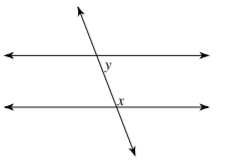
Same Side Interior Angles
or Consecutive Interior Angles
100
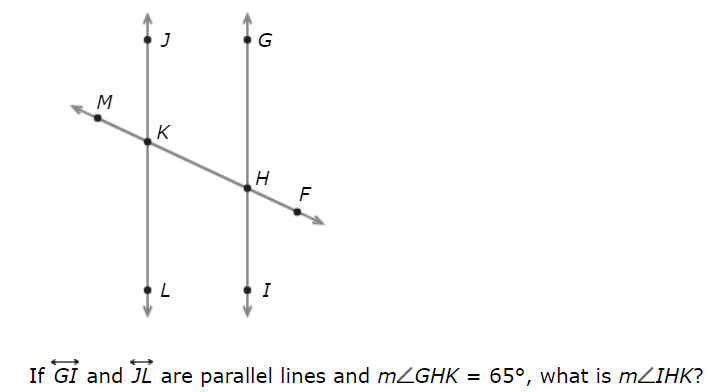
The measure of angle IHK is 115 degrees.
100
Find the value of segment MN.
MN=7
100
What value of x makes lines a and b parallel?
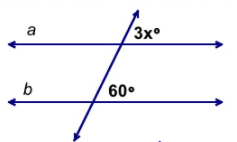
x=20
100
Define perpendicular lines.
lines that meet at 90 degrees
200
Angles 1 and 7 are called ____________ angles.
same side exterior consecutive exterior
200
Find the value of x.
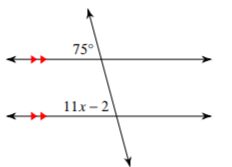
11x-2=75
11x=77
x=7
200
Line m is the perpendicular bisector of segment AB . Find the value of x.

3x-8=2x
x=8
200
If line m is parallel to line l, then
mangle3+mangle6=180
by the _____________________ theorem.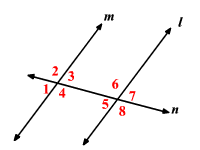
same side interior angles
200
What is the measure of angle DBC?
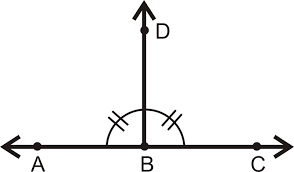
90 Degrees
300
Angles EXY and XDF are called ________________ angles.

corresponding
300
Solve for x.
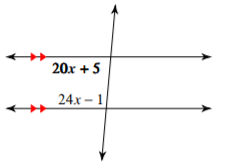
Same Side Interior Angles are Supplementary
20x+5+24x-1=180
44x+4=180
44x=176
x=4
300
Find the value of x.
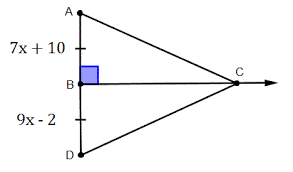
7x+10=9x-2
7x+12=9x
12=2x
x=6
300
mangleAGE+mangleEGB=180
by the linear pair theorem.
Then
mangleAGE+120.53=180
by _____________________.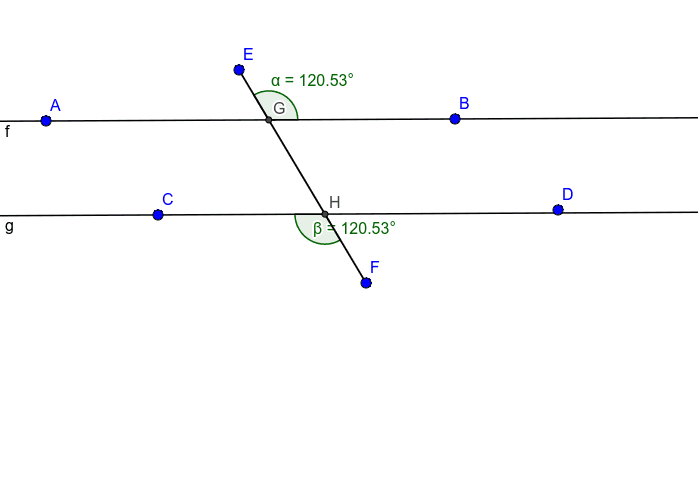
substitution
300
What is the measure of angle 1?
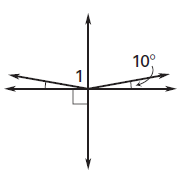
80 degrees
400
Angles b and c are called ________ angles

alternate interior angles
400
When parallel lines are cut by a transversal, any pair of angles you pick will be either ________ or _________.
congruent or supplementary (add to 180 degrees)
400
What value of x will make line AD the perpendicular bisector of BC.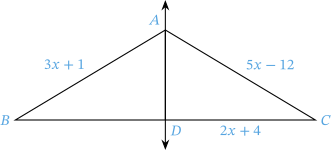
3x+1=5x-12
3x+13=5x
13=2x
x=6.5
400
mangle6=45 degrees
by the ________________ theorem.
Then, if the lines are parallel,
mangle6+(5x+35)=180
by the __________________ theorem.
vertical angles
same side interior angles
400
According to the perpendicular transversal theorem, what else is true about this picture, although it is not marked?
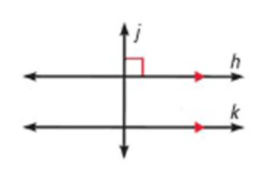
line j is perpendicular to line k
500
Angles x and y are called _________ angles.
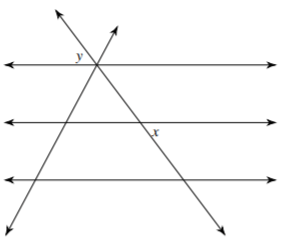
Alternate Exterior or Opposite Exterior
500
Find the value of x and y.
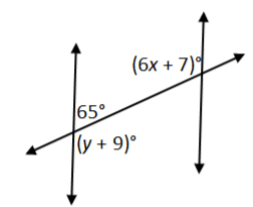
x = 18 degrees
y = 106 degrees
500
Solve for x and y.
x+5=3x-5
10=2x
x=5
2y+15=9y-13
28=7y
y=4
500
If
mangle7=mangle2
then lines l and m are parallel, by ______________.

The converse of the alternate exterior angles theorem
500
What is true about the slopes of perpendicular lines, when they are graphed on the coordinate plane.
They multiply to negative 1.
They are opposite reciprocals of eachother.