🟦 Category 1: Decimal Detectives
🟨 Category 2: Fraction to Decimal Showdown
🟩 Category 3: Equation Explorers
🟧 Category 4: Real‑World Math
🟥 Category 5: Area Model Match‑Up
100
Compare 0.4 and 0.25 using >, <, or =.
0.4 > 0.25
100
Write 4/10 as a decimal.
4/10 = 0.4
100
Complete the pattern: 2, 5, 8, __, 14.
2, 5, 8, 11, 14
100
Miss Diaz drinks 1.78 L Monday and 2.5 L Tuesday. What expression finds the total?
The expression that shows the total amount of water Miss Diaz drinks is 1.78 + 2.5.
100
Write the area model as a fraction: 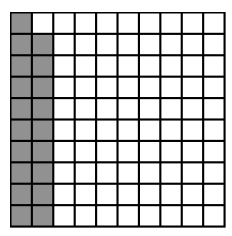
19/100
200
Plot 0.3 and 0.55 on a number line, then compare using <,>, or =.

0.3 < 0.55
200
Write 5/100 as a decimal.
5/100 = 0.05
200
Fill in the blanks: 10, 100, __, __.
10, 100, 1,000, 10,000
200
A runner completes 0.85 of a mile in the first lap and 0.65 of a mile in the second. How far did they run in total?
The runner ran 1.5 miles in total because 0.85 miles plus 0.65 miles equals 1.5 miles.
200
Write the area model as a decimal: 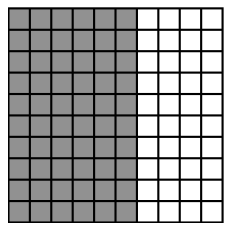
60/100
300
Which decimal is closer to 1: 0.6 or 0.65?
0.65 is closer to 1
300
Match 6/10 to its decimal form.
6/10 = 0.6
300
Add 4/10 + 32/100.
72/100 or 0.72
300
A water bottle holds 1.5 liters. If you drink 0.75 liters, how much water remains?
There are 0.75 liters of water left because 1.5 liters minus 0.75 liters equals 0.75 liters.
300
How could I write 60/100 as tenths?
60/100 = 6/10
400
Explain why 0.9 is greater than 0.41 even though 9 < 41.
0.9 > 0.41 because 9 tenths is greater than 41 hundredths.
400
Match 19/100 to its decimal form.
19/100 = 0.19
400
Add 3 and 7/10 + 2 and 15/100.
5 and 85/100
400
A store discounts a $12.50 shirt by $3.75. What is the new price?
The new price of the shirt is $8.75 because $12.50 minus $3.75 equals $8.75.
400
What is this fraction equal to: 6/1
6/1 = 6
500
Convert 24/100 into decimal form.
24/100 = 0.24
500
Explain how you know whether a fraction will have one or two decimal places.
Fractions with tenths have one decimal place; hundredths have two.
500
Explain how place value helps you add decimals correctly.
Place value aligns digits correctly when adding decimals.
500
A baker uses 0.25 kg of sugar for one batch and 0.375 kg for another. How much sugar does she use altogether?
The baker used 0.625 kilograms of sugar altogether because 0.25 kg plus 0.375 kg equals 0.625 kg.
500
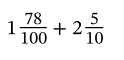
What is this equal to?