Collisions Dynamics
Energy!
Impulse
Conceptual Reasoning
100
A 2.0 kg block moving at 4.0 m/s to the right makes a perfectly inelastic collision with a 3.0 kg block at rest. What is the final velocity of the combined mass?
1.6 m/s to the right
100
In a "perfectly inelastic" collision, what physical quantity is definitely not conserved?
Kinetic Energy (it is converted to internal energy/heat)
100
A 0.2 kg baseball is hit by a bat, changing its velocity from -30 m/s to +40 m/s. What is the magnitude of the impulse delivered to the ball?
14 Ns
100
Why does a bungee jumper use a stretchy cord instead of a stiff rope to stop their fall?
It increases the time of the collision which decreases the average force for the same change in momentum.
200
A 0.5 kg firecracker at rest explodes into two pieces. One piece (0.2 kg) flies off at 10 m/s. What is the velocity of the second piece?
-6.67 m/s
200
A 2000 kg car traveling at 10 m/s hits a wall and stops. How much kinetic energy was lost, and where did it go?
100,000 J; converted into heat, sound, and deformation of the car.
200
If a constant force of 500 N acts on a 10 kg object for 0.1 seconds, what is the change in the object's velocity?
5 m/s
200
An astronaut at rest in space throws a heavy tool away from them. Describe the motion of the astronaut and the hammer.
The astronaut moves backwards while the hammer moves faster forwards.
300
A 1.0 kg ball moving North at 4.0 m/s collides with a 1.0 kg ball moving East at 3.0 m/s. If they stick together, what is their final magnitude of velocity and direction?
2.5 m/s 53 degrees NoE
300
Two objects have the same kinetic energy. Object A has twice the mass of Object B. Which object has a greater magnitude of momentum?
Object A
300
If you are given a graph of Force vs. Time. How do you determine the total change in momentum of the object from this graph?
Calculate the area under the curve
300
A ball is dropped and bounces off the floor. At the instant the ball is at its maximum compression against the floor, what is its momentum?
Zero (it is momentarily at rest before rebounding
400
A 3.0 kg object moving at 5.0 m/s collides elastically with a 2.0 kg object moving in the same direction at 2.0 m/s. What is the final velocity of the 3.0 kg object?
2.6 m/s
400
A 5 kg object is moving at 10 m/s when an internal explosion breaks it into two parts. If the total kinetic energy of the system increases by 500 J, and no external work was done, what caused the increase?
Conversion of Chemical Potential Energy into Kinetic Energy
400
Water strikes a wall at a rate of 10 kg/s with a speed of 20 m/s and splashes straight back with a speed of 10 m/s. What is the average force exerted by the water on the wall?
300 N
400
A rain cloud loses mass as rain falls vertically out of it. If the cloud is moving horizontally at a constant velocity and there is no wind resistance, what happens to the horizontal velocity of the cloud as it lightens?
The horizontal velocity remains constant (the rain carries away its own horizontal momentum).
500
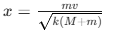
A block of mass M is at rest on a frictionless table and is attached to a relaxed spring with constant k. A bullet of mass m is fired into the block at speed v and embeds itself. What is the maximum compression x of the spring?
500
Two blocks of mass M and 2M are placed on a frictionless horizontal surface with a compressed spring of negligible mass between them. The blocks are initially held at rest. When the blocks are released, the spring pushes them apart and then falls away. If the total elastic potential energy originally stored in the spring was U, what is the final kinetic energy of the block with mass 2M?
1/3 U
500
A 2.0 kg object is moving at 10 m/s in the positive x-direction. It then experiences a net force F in the negative x-direction. The magnitude of this force is shown on a graph as a function of time: it starts at 0 N at t = 0, increases linearly to 40 N at t = 2 s, and then stays constant at 40 N until t = 3 s. What is the final velocity of the object at t = 3 s?
-30 m/s (or 30 m/s in the negative x-direction)
500
Two identical blocks, A and B, are suspended from the ceiling by light strings, forming two pendulums. You fire two projectiles of equal mass and equal initial velocity at the blocks. Projectile A is a bouncy rubber ball that hits Block A and bounces back with nearly its original speed. Projectile B is a piece of clay that hits Block B and sticks to it. Which block will swing to a higher maximum vertical height? Explain your reasoning using momentum principles
Block A (the one hit by the bouncy ball) will swing higher.