Fill in the Blank w/ Vocab
True or False
Test your knowledge
Earning Statement: Notice the Details
More Money Info
100
Individuals who work for themselves, such as freelancers or contractors, are considered to be _________________.
What is self employed.
In 2025, U.S. self-employment reached a record high of approximately 16.77 million to 17.4 million individuals, representing over 10% of the workforce
100
True or False
January 1 is the last day to submit income forms or request an extension for tax returns.
False.
- Tax Return Deadline: The deadline to submit your tax returns is April 15.
- Extension Deadline: April 15, 2026, to file Form 4868 for an automatic 6-month extension until October 15.
- Important Note: An extension allows more time to file, but tax payments are still due on April 15.
100
At what amount do you start paying income taxes?
In the U.S., you generally start paying federal income taxes when your gross income exceeds the standard deduction for your filing status, which for 2025 is $15,750 for single filers under 65. You are generally required to file a tax return if you earn more than this amount. If self-employed, you must file if net earnings exceed $400.
100
What is the pay rate and hours this employee worked this pay period? 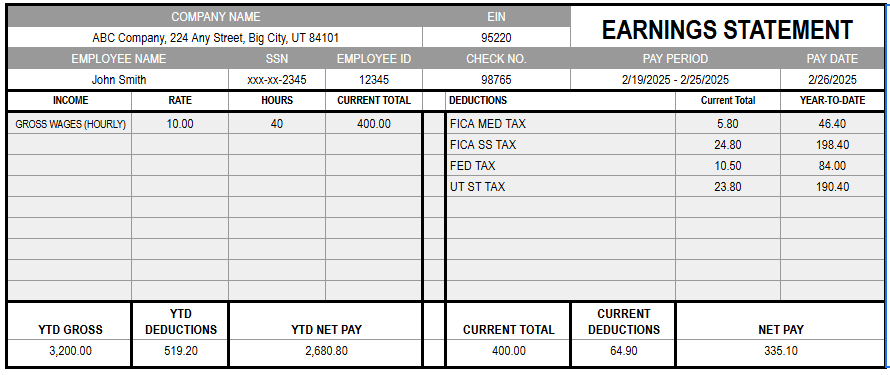
Pay rate 10$ at 40 hours a week.
100
Our tax money is spent on all except:
- Social Security
- Private School Education
- The Military
- National Parks
B. Private School Education
Tax revenue is primarily used to fund public programs and services that benefit the general population.
200
When starting a new job, employees must fill out a(n) ________________ form to indicate their tax withholding preferences.
What is a W4.
This form must be completed by an employee at the start of employment to indicate his or her tax situation (exemptions, marital status, etc.) to the employer, who then withholds the corresponding amount of taxes from each paycheck
200
True or False
In January, your employer mails you the tax forms W-2, W-4, and I-9.
False.
In January, your employer is required to send you a W-2 form (Wage and Tax Statement) by January 31, detailing your previous year's earnings and tax withholdings. The W-4 and I-9 are not mailed to you in January; you fill out a W-4 for withholding and an I-9 for eligibility upon hiring.
200
Which of the following paycheck withholdings puts money into a retirement investment fund that you will manage?
- Social Security
- Medicare
- 401(k) contribution
- Federal income taxes
401k Contribution
A 401(k) contribution is a voluntary withholding where an employee directs a portion of their pre-tax or post-tax salary into a retirement savings plan sponsored by their employer.
200
What was the net (or take home) pay for this employee for this pay period?
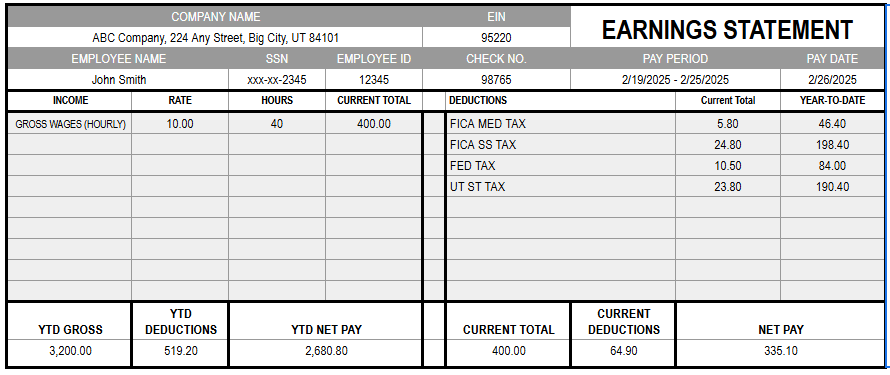
$335.10
Net Pay is the money that goes to you after taxes and deductions are taken out.
200
Which of the following is applied to wages, salaries, and interest earned?
- Corporate Income Tax
- Income Tax
- Estate Tax
- Excise Tax
A. Income Tax
These sources are considered part of an individual's taxable income, which is subject to federal, and in many cases, state taxes. Interest income is taxed similarly to ordinary income
Side Note: Excise Taxes are indirect, hidden taxes imposed on specific goods and services and often luxury items with negative effects like fuel, tobacco or alcohol.
300
___________________ is a federal program that provides monthly benefits to millions of Americans, including retirees, military families, surviving families of deceased workers, and disabled individuals
What is Social Security?
As of early 2025, over 73 million Americans—more than one-fifth of the population—receive Social Security benefits, with an average retired worker receiving approximately $2,000 monthly. The system pays out over $130 billion monthly to retirees, survivors, and disabled workers. Benefits are adjusted annually for inflation and represent a primary income source for most Americans over 65.
300
True or False
Your W-2 form tells you how much you earned as an employee.
True.
A W-2 form, officially the "Wage and Tax Statement," is an annual tax document employers must provide to employees by January 31, detailing total earnings, Social Security/Medicare wages, and federal/state taxes withheld for the previous year. Employees use this information to file their personal income tax returns with the IRS.
300
If a taxpayer fills out their W-4 in a way that does not withhold enough money to cover their tax obligation, what is the most likely outcome after they file their taxes?
- They will receive a refund
- They will owe a payment to the IRS
- They will be audited
- They will be charged with tax evasion
They will owe a payment to the IRS.
- Balance Due: A tax bill must be paid by the tax deadline, typically April 15.
- Underpayment Penalties: If the tax paid throughout the year is below certain thresholds, the IRS may apply penalties.
- Interest Charges: Late payments are subject to interest, in addition to any penalties.
300
What is the amount of the deductions taken out year to date? 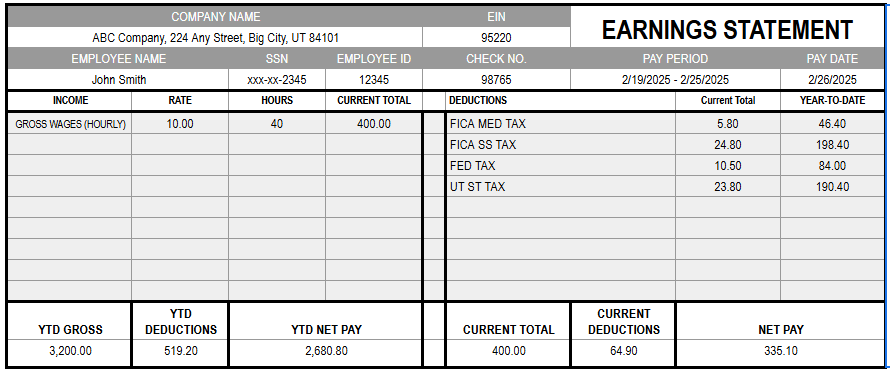
519.20
Year-to-Date (YTD) deductions are the cumulative total of all pre-tax and post-tax amounts withheld from an employee's paycheck from the beginning of the calendar or fiscal year to the current date. These figures include income taxes, Social Security, Medicare, retirement contributions, and insurance premiums.
300
Which of the following ways is NOT a way to file your taxes:
A: Mailing in a paper return to the IRS
B. Through a tax professional
C. Using software like Turbotax
D. Through your employers HR department
D. Through your employer's HR Department
400
To verify employment eligibility, new hires in the U.S must complete the _________ form.
What is an I-9 Form.
Form used by an employer to verify an employee's identity and to establish that the worker is eligible to accept employment in the United States. Employees must complete section 1 of this form on their first day.
400
True or False
The Form 1099 is the standard federal income tax form completed each year.
False.
1099 forms are IRS information returns used to report non-salary income, such as payments to freelancers/contractors ($600+), interest, dividends, and royalties
400
Which of the following statements about the W-2 form is TRUE?
- A W-2 lists all the money you earned in cash over the last year
- The total wages you earned from ALL jobs you worked in the previous year appear on ONE W-2 form
- You need a separate W-2 form from EACH of your employers in order to file your taxes
- The W-2 includes information about the interest you earned from your investments
You need a separate W-2 form from EACH of your employers in order to file your taxes.
You must use the information from every W-2 you receive to accurately report your total annual income on your tax retur
400
How much did this person pay towards Medicare in this pay period?
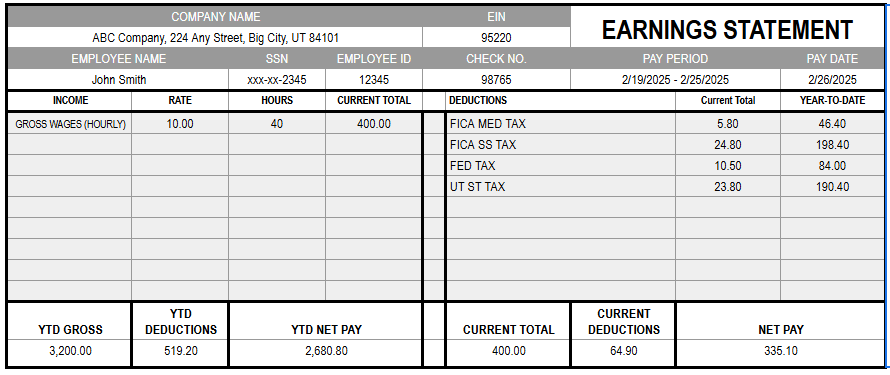
$5.80
For most employees in 2026, 1.45% of gross wages is taken out of each paycheck for Medicare. This rate is a fixed percentage, but the actual dollar amount will change if your paycheck amount changes.
400
What item would you DEFINITELY see on a paystub?
A. Retirement
B. Healthcare Deductions
C. Gross Pay
D. Your role/occupation
A Gross Pay.
Your gross pay will always be listed on your pay stub. It is the total amount of money an employee earns, including salary, wages, bonuses, and commissions, before any taxes or deductions are withheld
500
Your paycheck shows the amount of tax _____________________ that has been taken out of your earnings.
What is withholding?
The portion of an employee's wages that is not included in their paycheck because it goes directly to federal, state and local taxes
500
True or False:
If your tax situation is changing, you can fill out another W-4 and an I-9 form.
True.
You should submit a new Form W-4 to your employer whenever your tax situation changes—such as marriage, divorce, a new child, or a change in income—to adjust federal income tax withholding. While you can update your W-4 at any time to avoid a surprise tax bill or a large refund, a new Form I-9 is generally only needed if you change jobs or if your employment authorization expires and requires reverification
500
Dawn worked at a cafe while she was a college senior in Boston, Massachusetts. After graduating in June, she moved back to her home in California and started a full-time job in September. Which of the following statements is true?
- Dawn will need to file only a federal tax return
- Dawn will need to file a federal tax return and a state tax return for Massachusetts
- Dawn will need to file a federal tax return and a state tax return for both Massachusetts and California
- Dawn will need to file a federal tax return this year and file state returns the following year
Dawn need to file a federal tax return and a state tax return for both Massachusetts and California.
She must file a nonresident return in Massachusetts for income earned there and a resident return in California for her full-year income and employment.
500
How frequently is this employee paid? 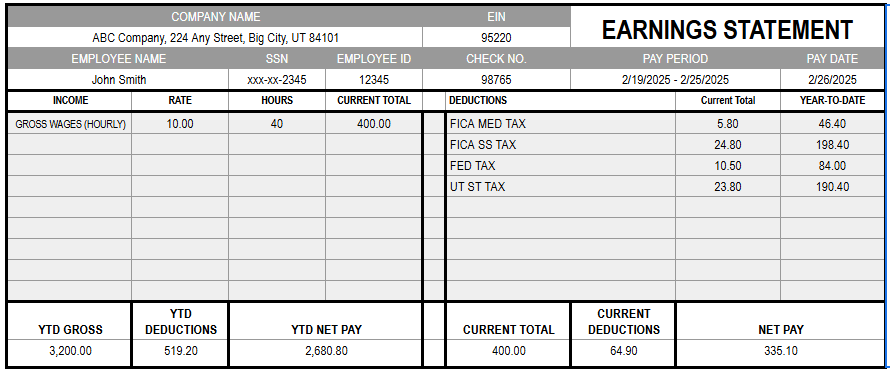
Weekly
In California, most employees must be paid at least twice during each calendar month on designated regular paydays. Wages earned between the 1st and 15th must be paid by the 26th, and wages from the 16th to the end of the month by the 10th of the following month. Employers must post a notice with the designated, regular payday, time, and location.
500
By claiming "exempt" on the W-4 form:
A. You are paying all income taxes upfront at the START of the year.
B. You are asking for one year exemption from paying taxes.
C. You are paying all income taxes at the END of the year.
D. You are saying that you do NOT meet the minimum income requirements to file.
D. You are saying you do not meet the minimum requirements to file.
600
You may have to file taxes if you receive a certain amount of _________________ through gifts, unemployment benefits, dividends, or inheritance.
What is unearned income?
It is generally taxable, though some types (like life insurance proceeds) are exempt. It is not subject to payroll taxes (FICA) but may be taxed at ordinary or capital gains rates.
600
True of False
A mandatory deduction to pay for Social Security and Medicare is called Federal Income Tax.
False.
The mandatory deduction for Social Security and Medicare is called FICA tax which stands for Federal Insurance Contributions Act. It is a payroll tax, typically totaling 7.65% for employees (6.2% for Social Security and 1.45% for Medicare), which is matched by employers.
600
Which of the following describes what a "dependent" is for tax purposes?
- A child or adult that you support financially
- Someone who is temporarily disabled
- An adult who financially supports you
- Someone who is a full-time student under the age of 30
A child or adult that you support financially
A tax dependent is a qualifying child or relative relying on you for over half their annual support. Qualifying children must be under 19 (or 24 if a full-time student) or permanently disabled. Adult dependents must earn less than (2025) and, if not related, live with you all year
600
What is the amount of the deductions for this pay period?
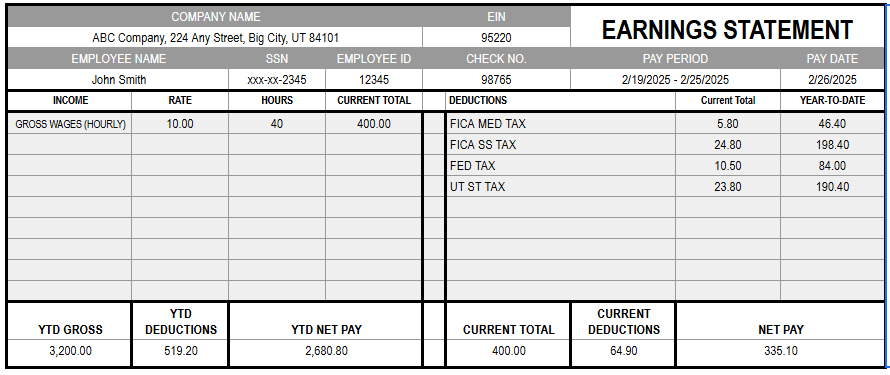
64.90
Current paycheck deductions in 2026 consist of mandatory taxes (FICA and income tax) and optional voluntary contributions. The total employee payroll tax burden typically includes 6.2% for Social Security and 1.45% for Medicare, totaling a 7.65% FICA rate. Additional deductions often include federal/state income tax, healthcare premiums, and retirement contributions
600
Jess is in college, he is 21 years old and has a job that provides 65% of his support. Is he considered a dependent of his parents?
No. A child must not provide over 50% of their own support; Jess provides 65%