Depression
Treatments
Suicide
Bipolar & Somatic
Dissociative
Medications
100
Major Depressive Disorder
Mild-Moderate-Severe Depression
Persistent Depressive Disorder (Dysthymia)
Premenstrual Dysphoric Disorder
Transient Depressive Disorder
Substance/Medication-Induced Depressive Disorder
What are the types of Depressive Disorders?
100
*Side effects of medications
*Thyroid deregulation
*Hormonal issues
*Viral illnesses
*Underlying causes (tumors, stroke, other medical conditions)
What is ruling out other causes of depression?
100
Part of the nursing process that identifies and distinguishes ideas (thoughts), plans (intentions), and attempts (behavior) of suicide. If self-injury behavior is observed, must determine suicidal self-injury or nonsuicidal self-injury.
What is the nursing assessment?
100
Affects the voluntary motor or sensory functioning - suggesting a neurological problem, but it cannot be explained by any known medical disorder or pathophysiological mechanism.
Examples: Paralysis, inability to speak (aphonia), seizures, coordination issues, deafness, blindness
What is Conversion Disorder?
100
The inability to recall important personal information that is too extensive to be explained by forgetfulness and is not due to substance abuse or other other medical conditions.
Is usually related to something traumatic or stressful in nature.
What is Dissociative Amnesia?
100
A client under lithium medication suffered from diarrhea and vomiting. Which of the following nursing intervention should the nurse in charge do first?
A. Recognize this as a drug interaction
B. Give the client Cogentin
C. Reassure the client that these are common side effects of lithium therapy
D. Hold the next dose and obtain an order for a stat serum lithium level
What is D. Hold the next dose and obtain an order for a stat serum lithium level?
200
Five or more must be present in same 2 week period that cause decreased ability to function & is NOT attributable to other substance or medical condition:
1) Depressed mood most of the day
2) Marked diminished interest/pleasure in most/all activities
3) Significant weight loss without dieting (5% or more)
4) Insomnia or hypersomnia
5) Psychomotor agitation or retardation
6) Fatigue or loss of energy
7) Feelings of worthlessness/excessive or inappropriate guilt
8) Decreased ability think/concentrate
9) Recurrent thoughts of death, suicidal ideation
What are the Diagnostic Criteria for Major Depressive Disorder (DSM-V)?
200
This therapy focuses on having the client control the negative thought distortions related to expectations of the environment (seen as unsatisfying), self (unrealistically devalued), and future (seen as hopeless).
What is Cognitive Therapy?
200
Theresa, age 27, was admitted to the psychiatric unit from the medial intensive care unit where she was treated for taking a deliberate overdose of her antidepressant medication, trazodone (Desyrel). She says to the nurse, "My boyfriend broke up with me. We had been together for 6 years. I love him so much. I know I'll never get over him." Which is the best response by the nurse?
A. You'll get over him in time, Theresa.
B. Forget him. There are other fish in the sea.
C. You must be feeling very sad about your loss.
D Why do you think he broke up with you, Theresa?
What is C. You must be feeling very sad about your loss?
Nonjudgemental attitude and openly discuss the current crisis situation.
200
A client diagnosed with bipolar disorder is distraught over insomnia experienced over the last 3 nights & a 12-pound weight loss over the past 2 weeks. Which should be this client's priority nursing diagnosis?
1. Knowledge deficit R/T bipolar disorder AEB (as evidenced by) concern about symptoms
2. Altered nutrition: less than body requirements R/T hyperactivity AEB weight loss
3. Risk for suicide R/T powerlessness AEB insomnia & anorexia
4. Altered sleep patterns R/T mania AEB insomnia for the past 3 nights
What is 2. Altered nutrition: less than body requirements R/T hyperactivity AEB weight loss ?
200

What is Dissociative Identity Disorder (DID)?
200
A client is prescribed phenelzine (Nardil), an MAOI. What statement made by the clients indicates an understanding of the teaching?
A) I should wear long-sleeves and sunscreen while taking this medication.
B) I should have my blood drawn to make sure my levels are therapeutic.
C) I should not eat sausage, aged cheese, and red wine while taking this medication.
D) I should limit my water intake while taking this medication.
What is C) I should not eat sausage, aged cheese, and red wine while taking this medication?
300
Jessica, a 23 year old, just lost her job and had to move back home with her parents. Her father brought her to the clinic, reporting his concerns that Jessica doesn't eat, get dressed or shower routinely. He reports she does not talk to friends and has become withdrawn. What is the priority nursing diagnosis?
A) Imbalanced nutrition: less than body requirements
B) Complicated grieving
C) Risk for suicide
D) Social isolation
What is C) Risk for suicide?
300
Part of multimodal treatment, started after the acute phase has passed. Provides peer support to discuss issues associated with affective disorder. Gives a feeling of security to talk about possibly embarrassing issues.
What is Group Therapy?
300
Which of the following individuals is at the highest risk for suicide?
A. Nancy, age 22, Asian American, Catholic, middle socioeconomic group, alcoholic
B. John, age 72, white, Methodist, low socioeconomic group, diagnosis of metastatic cancer of the pancreas
C. Carol, age 15, African American, Baptist, high socioeconomic group, no physical or mental health problems
D. Mike, age 55, Jewish, middle socioeconomic group, suffered myocardial infarction a year ago
What is B. John, age 72, white, Methodist, low socioeconomic group, diagnosis of metastatic cancer of the pancreas?
300
Disorder that is self induced to make one sick in order to gain attention
What is Munchausen Syndrome?
DSM-5 describes as factitious disorders one imposes on self. If the disease or illness is imposed on someone else it is: Munchausen by Proxy
300
Dissociative identity disorder is characterized by
A. the inability to recall important information.
B. sudden unexpected travel away from home and inability to remember the past.
C. the existence of two or more subpersonalities, each with its own patterns of thinking.
D. recurring feelings of detachment from one's body or mental processes.
What is C. the existence of two or more subpersonalities, each with its own patterns of thinking?
300
The nurse notes in the patient's chart that the patient is taking Paroxetine (Paxil), an SSRI. The nurse knows that common anticholinergic side effects the patient may be experience include: (select all that apply)
A. Dry Mouth
B. Constipation
C. Difficulty Breathing
D. Dry Eyes
E. Difficulty Urinating
What is A. Dry Mouth, B. Constipation, D. Dry Eyes, and E. Difficulty Urinating?
400
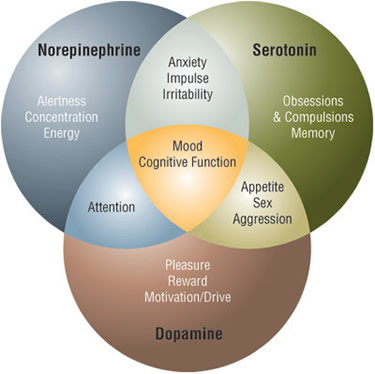
What are the neurotransmitters relationship to depressive disorders?
400
A client scheduled for electroconvulsive therapy (ECT) at 9:00 a.m. is discovered eating breakfast at 8:00 a.m. Based on this observation, which is the most appropriate nursing action?
A. The nurse notifies the client's physician of the situation and cancels the ECT.
B. The nurse removes the breakfast tray and assists the client to the ECT treatment room.
C. The nurse allows the client to finish breakfast and reschedules ECT for 10:00 a.m.
D. The nurse increases the client's fluid intake to facilitate the digestive process.
What is A. The nurse notifies the client's physician of the situation and cancels the ECT?
400
Jason was brought into the ED after attempting to hang himself. Which of the following interventions is the most appropriate in this instance?
A. Obtain an order from the physician to place Jason in restraints to prevent any attempts to harm herself.
B. Place Jason in a safe room with 1:1 observation by a mental health technician.
C. Obtain an order from the physician to give Jason a sedative to calm him and reduce suicide ideas.
D. Provide Jason warm blankets and a pillow to support his head and neck for increased comfort.
What is B. Place Jason in a safe room with 1:1 observation by a mental health technician?
400
A highly agitated client paces the unit & states, "I could buy & sell this place!" The client's mood fluctuates from fits of laughter to outbursts of anger. Which is the most accurate documentation of this client's behavior?
1. Rates mood 8/10. Exhibiting looseness of association. Euphoric.
2. Mood euthymic. Exhibiting magical thinking. Restless.
3. The mood is labile. Exhibiting delusions of reference. Hyperactive.
4. Agitated & pacing. Exhibiting grandiosity. The mood is labile.
What is 4. Agitated & pacing. Exhibiting grandiosity. The mood is labile. ?
400
Care Integration
Advocate & Tone Setter for therapeutic milieu
Expert on psychopharmacology
Care plan based on assessment and evaluation
What is the nurse's role?
400
Anticonvulsant medication used to treat mood disorders, partial seizures, and neuropathic pain. Usually started at a dose of 300 mg tablet or capsule taken three times per day.
What is gabapentin (Neurontin)?