Picture it
Seasons
Vocabulary
Explain It
True or False
100
The bar graph represents the average amount of daylight hours for Summer and Winter. Which bar represents which season?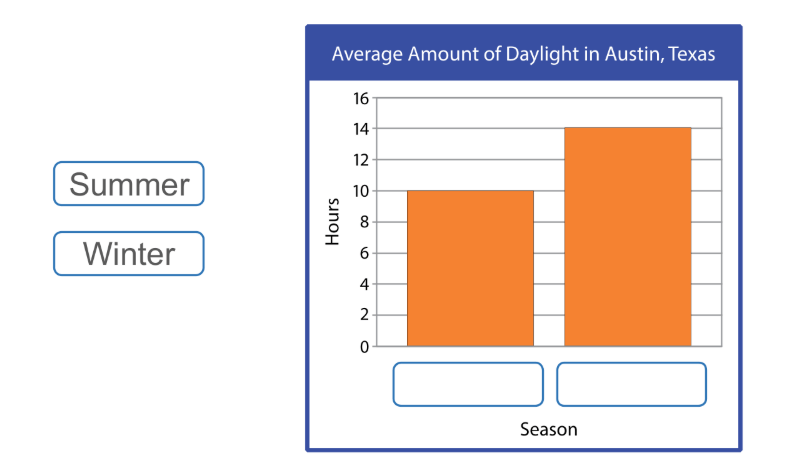
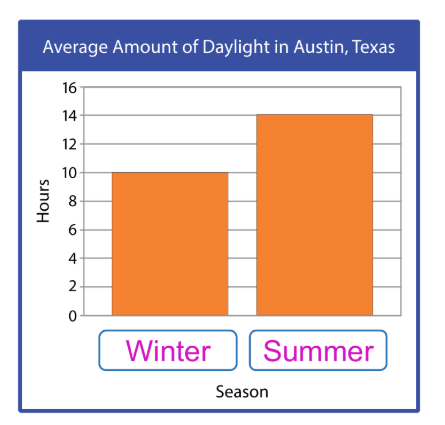
100
Each season typically last about (3 or 6) Months.
Each season typically last about 3 Months.
100
an imaginary line from the North Pole to the South Pole through the center of the Earth
Axis
100
What season is pictured? How do you know.

POSSIBLE RESPONSE
The season is Autumn/Fall. I know this because the tree is losing its leaves, and the leaves are falling to the ground. Trees often lose their leaves in the fall as the weather starts to get cooler.
100
The Earth's ROTATION causes DAY AND NIGHT.
TRUE
200
Use the chart to explain the temperature change between the seasons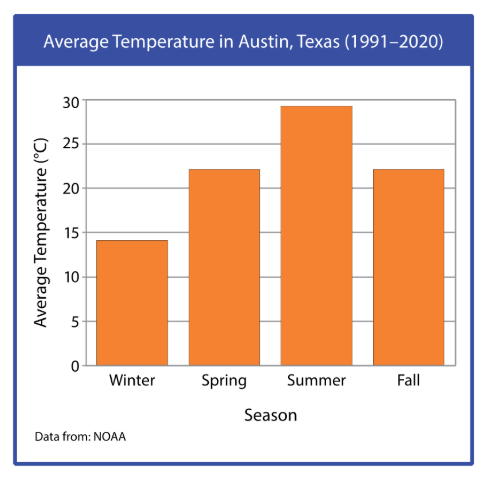
POSSIBLE RESPONSE
The average temperature increases from winter to summer. It then decreases from summer to fall.
200
Look at image B.
The NORTHERN/SOUTHERN hemisphere will have longer daylight hours.
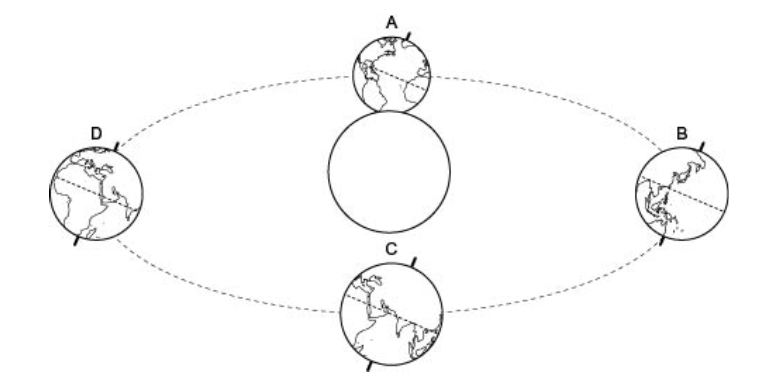
The SOUTHERN hemisphere will have longer daylight hours.
200
a curved path around an object
Orbit
200
In the Northern Hemisphere during the summer, the days are longer and the sun sets later. Why?
SAMPLE ANSWER
The Northern Hemisphere is tilted towards the sun.
NOTE: The tilt exposes the Earth is to the sun's rays for a longer period of time.
200
Four times a year, the Northern and Southern Hemisphere have equal numbers of hours of darkness and light.
FALSE
Twice a year, the Northern and Southern Hemisphere have equal numbers of hours of darkness and light.
In the Northern hemisphere it is the Spring Equinox (March 20 or 21) and Autumn Equinox (September 22 or 23).
300
Based on the image, which hemisphere is tilted towards the sun, and what is the possible season it is experiencing?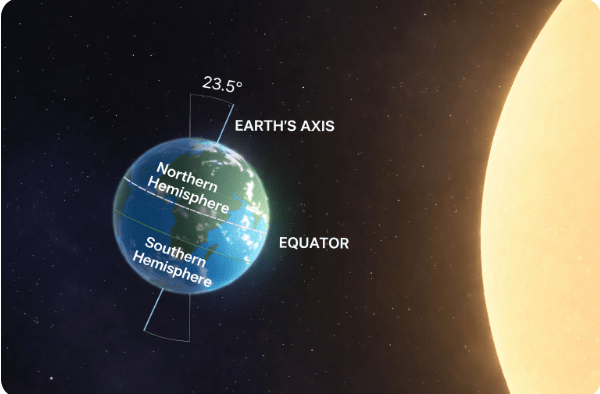
POSSIBLE RESPONSE
The Northern hemisphere is tilted towards the sun. This means the Northern Hemisphere is getting more direct sunlight and is experiencing summer.
300
Look at Image B
The NORTHERN/SOUTHERN hemisphere receive more direct rays from the sun. The pole with the longest days will be the NORTH/SOUTH pole.
The SOUTHERN hemisphere receive more direct rays from the sun. The pole with the longest days will be the SOUTH pole
300
something that repeats in a regular way
Pattern
300
Why are scientist able to determine the average temperatures for different areas?
Scientists are able to determine the average temperatures by collecting and analyzing data over long periods of time.
300
Areas around the equator receive the same amount of sunlight throughout the year.
TRUE
400
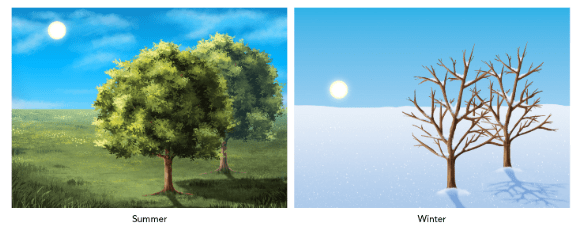
The pictures show summer and winter at the same time of day. Why does the sun look lower and closer to setting in the winter picture?
NOTE: Apply what you know about the Earth's Tilt.
POSSIBLE RESPONSE
In winter, the Sun appears lower in the sky because Earth is tilted. This tilt causes winter days to have less sunlight, so the Sun sets earlier than it does in summer.
400
Look at image B. The temperature of the Northern Hemisphere is COLDER/WARMER, and the Southern Hemisphere is COLDER/WARMER.

The temperature of the Northern Hemisphere is COLDER, and the Southern Hemisphere is WARMER.
400
a time of year with a distinct pattern of temperature and sunlight
Season
400
What causes the changes shown below? Be sure to include what changes occurred to the TEMPERATURE and DAYLIGHT.

SAMPLE ANSWER
The temperature gets colder and the amount of daylight decreases. This is cause by the the Earth changing its position as it orbits the sun.
400
The Earth's REVOLUTION causes SEASONS.
TRUE
500
What causes the seasons?
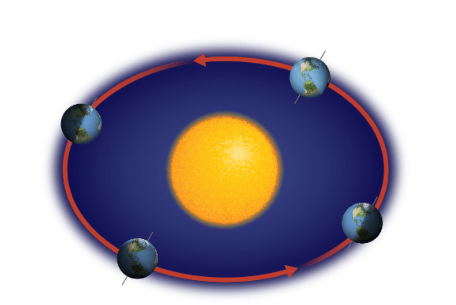
Seasons are caused by the Earth's tilt on its axis, and revolution around the sun.
500
Look at image B. The NORTHERN/SOUTHERN hemisphere is tilted TOWARDS the sun and the NORTHERN/SOUTHERN hemisphere is tilted AWAY from the sun
SOUTHERN hemisphere is tilted TOWARDS the sun and the NORTHERN hemisphere is tilted AWAY from the sun
500
A collection of things that work together
System
500
Why do temperatures on Earth change throughout the year?
SAMPLE ANSWER
Temperatures on Earth change because of the different amount of sunlight each hemisphere receives.
MORE SUNLIGHT = HIGHER TEMPERATURES
500
Places near the poles (North and South) have very little changes in the amount of sunlight they receive.
FALSE
Places near the poles (North and South) have EXTREME changes in the amount of sunlight they receive.
This is due to the Earth's tilt. When tilted towards the Sun, the days are very long and very short when tilted away from the sun.