Motion
Acceleration
Friction
Newtons laws
momentum
100
What is the deffinition of motion
Motion that changes the orientation of a body is called rotation. In both cases all points in the body have the same velocity (directed speed) and the same acceleration (time rate of change of velocity).
100
definition of Acceleration
Acceleration is the rate of change of velocity. Usually, acceleration means the speed is changing, but not always. When an object moves in a circular path at a constant speed, it is still accelerating, because the direction of its velocity is changing.
100
What is the definition of friction
Friction is the resistance to motion of one object moving relative to another. It is not a fundamental force, like gravity or electromagnetism. Instead, scientists believe it is the result of the electromagnetic attraction between charged particles in two touching surfaces.
100
Who maade the three laws of motian
Isaac Newton
100
definition of momentum
Momentum, product of the mass of a particle and its velocity. Momentum is a vector quantity; i.e., it has both magnitude and direction. Isaac Newton's second law of motion states that the time rate of change of momentum is equal to the force acting on the particle.
200
Formula For motion
F = ma
200
who invented acceluration
Galileo Galilei
200
Who invented Friction
John Walker
200
What law its this
Your leg muscles pushing pushing on the pedals of your bicycle is the force. When you push on the pedals, your bicycle accelerates.
Newtons 2 law
200
Formula for momentum
p=mv
300
who invented motion
Louis Le Prince
300
Formula for acceleration
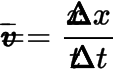
300
formula for friction
f=μN
300
what law is this
The motion of a kite when the wind changes can also be described by the __ law.
newton 1 law
300
who invented momentum
The first of these, momentum, was actually introduced by the French scientist and philosopher Descartes before Newton.