Themes in Literature
Literary Terms YOU need (but maybe don't like)
Isn't it ironic...(more tricky terms :-)
All About the A's
The Commonly Confused
Jeopardy Recap
Recap 2.0
100
How power can corrupt individuals or societies.
YOU MUST GIVE AN EXAMPLE:
Power vs Curruption
Claudius in Hamlet
Serena Joy/ Aunts in Handmaid's Tale
100
Two answers needed: Repetition of vowel sounds & Repetition of consonant sounds.
Assonance & Consonance
100
Intended to teach or instruct, often with a moral or political lesson.
Didactic
100
Language that has multiple meanings or is open to interpretation.
Ambiguity
100
Mood vs Tone (You explain the difference)
Tone = author’s attitude; Mood = reader’s feeling.
100
Mostly found in poetry, harsh, unpleasant, or discordant sounds.
Pop culture references appear in songs by the rock group Nine Inch Nails.
Cacophony
100
series of petitions for use in church services or processions, usually recited by the clergy and responded to in a recurring formula by the people.
litany
200
You must give an example:
Characters separated from society or loved ones, physically or emotionally.
Alienation & Isolation
The Invisible Man
Jaquie is There There
Baba in Kite Runner
Gatsby
OfFred
Holden
200
A narrative in which characters, events, and settings represent abstract ideas or morals.
allegory
200
Overly concerned with formal rules, minute details, or displaying academic learning ostentatiously.
Pedantic
200
Repetition of the same word or phrase at the beginning of successive clauses or sentences.
Anaphora
200
Ironic vs. Sarcastic → Explain the difference
Irony involves contrast between expectation and reality; sarcasm is often bitter mockery.
200
In poetry, the continuation of a sentence without a pause beyond the line break.
Enjambment
200
DAILY DOUBLE:
There are two answers needed for this question
One type of this poem consists of:
- Three quatrains (four lines) and a couplet, which typically concludes the poem
- ABAB, CDCD, EFEF, GG rhyme scheme
The other type contains:
- Two stanzas: one octave (eight lines) and one sestet (six lines)
- The first eight lines present an argument or question
- A volta, or “turn,” begins the sestet, which responds to the argument posed in the octave
- ABBAABBA, CDCDCD/CDECDE rhyme scheme
- Both are named for poets who not only made the form their own but also made it famous. These poems have roots in thirteenth century Italy. Both types adhere to specific rules.
What are the two main types of sonnet: Shakespearean and Petrarchan?
300
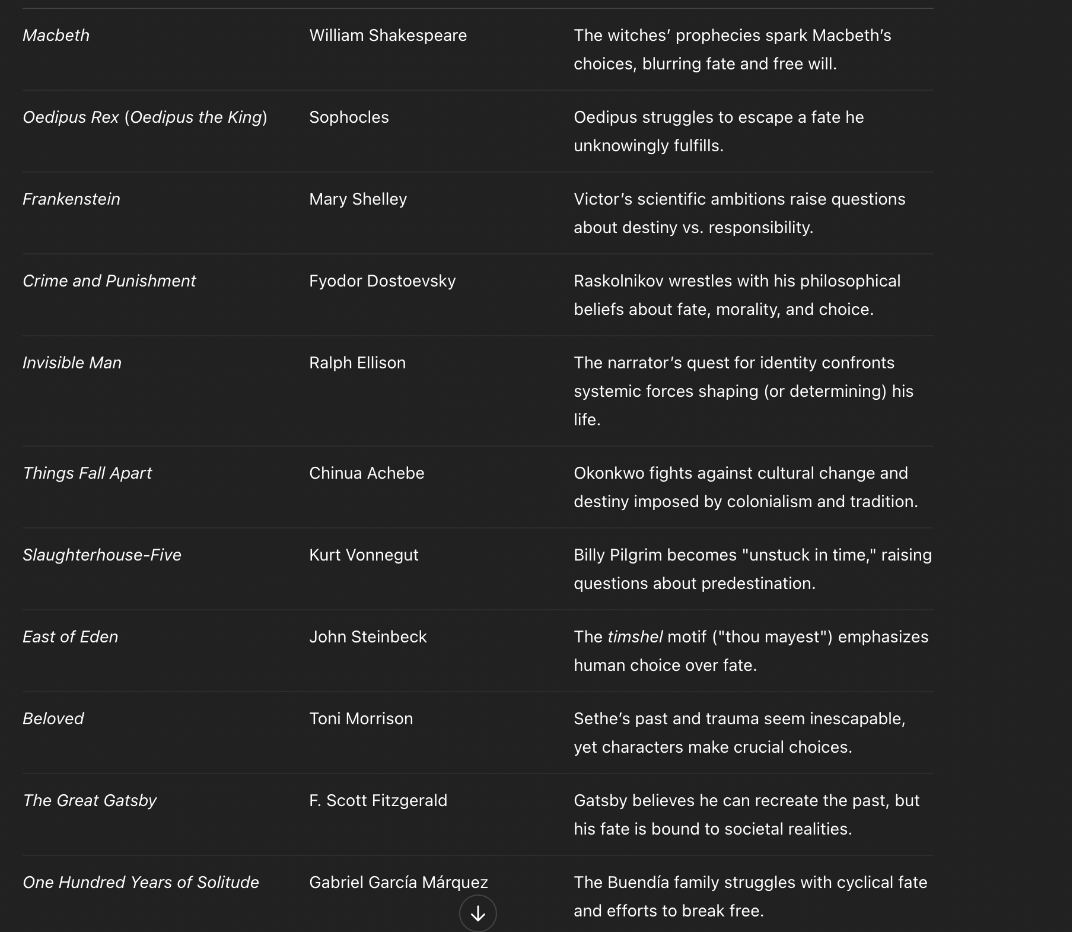
Give a literary example of: Fate vs. Free Will
300
Narrative style that presents a character’s thoughts as they occur.
stream of consciousness
300
Grimly mocking or cynical in tone.
Sardonic
300
The omission of conjunctions between parts of a sentence (e.g., "I came, I saw, I conquered").
- Julius Caesar: "I came, I saw, I conquered" (emphasizes speed/decisiveness).
- Charles Dickens: "It was the best of times, it was the worst of times..." (creates dramatic, relentless pace)
- Abraham Lincoln: "...government of the people, by the people, for the people..."
Asyndeton
300
Elegy vs Eulogy- Explain the difference
Elegy
A poem (or serious, reflective piece) mourning the death of someone or something lost. Example: "O Captain! My Captain!" by Walt Whitman (mourning Lincoln).
Eulogy
A speech given at a funeral or memorial service, praising and remembering someone who has died.
300
Addressing an absent person, abstract idea, or object directly.
_____________in literature is a figure of speech where a speaker directly addresses an absent person, an inanimate object, an abstract concept, or a divine being. Derived from Greek for "turning away," it allows characters to express intense emotions, philosophize, or personify non-human entities, often starting with "O"
Apostrophe
300
A coming-of-age story focusing on a character’s growth and development.
Bildungsroman
400
Give the theme & an example of: Discrepancy between how things seem and how they truly are.
Appearance vs. Reality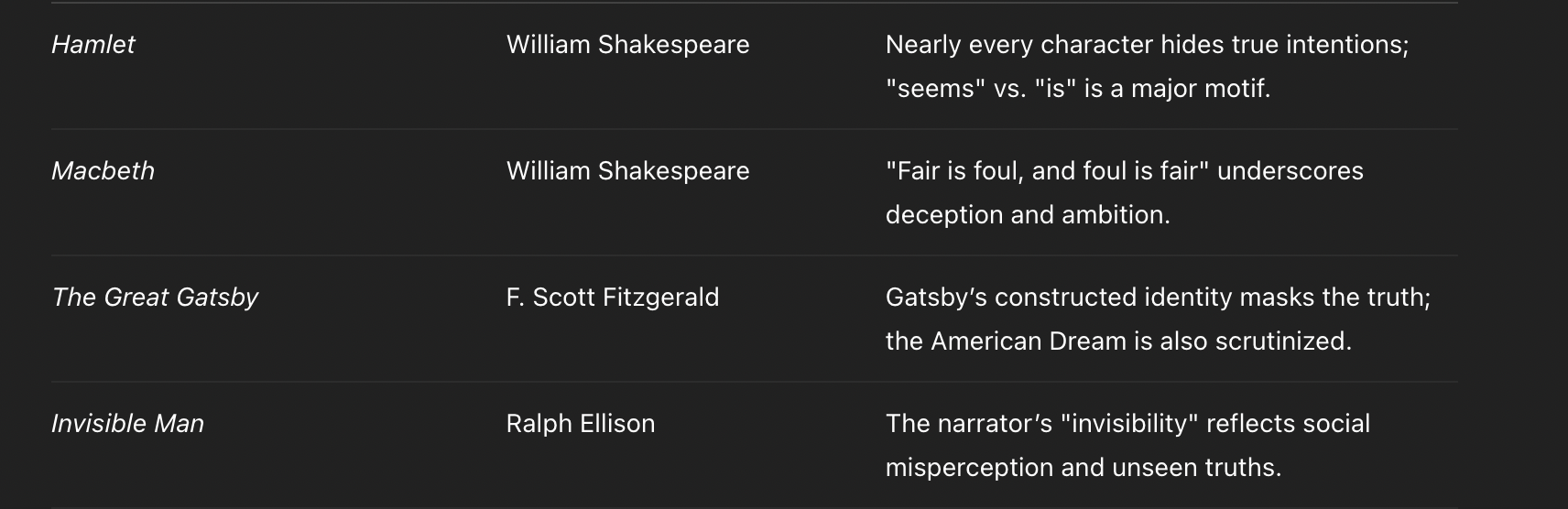
400
Daily Double!!!!!
Replacing the name of a thing with something closely related (e.g., "the crown" for royalty).
- ---------(Related Association): Uses an linked term, concept, or attribute to represent something.
- The White House said... (The building represents the President/Staff).
- The pen is mightier than the sword (Pen=writing/diplomacy, Sword=violence).
- Hollywood is releasing a new film (Hollywood represents the US film industry).
Metonymy
400
A logical argument composed of a major premise, minor premise, and a conclusion.
Syllogism
400
A rhetorical contrast of ideas by means of parallel construction (e.g., "It was the best of times, it was the worst of times").
Antithesis
400
Symbol vs Motif
Explain the difference
Symbol
An object, character, color, or event that represents a larger, often abstract idea.
Example: The green light in The Great Gatsby symbolizes Gatsby’s hopes and the American Dream.
Motif
A recurring element (idea, image, word, or symbol) that reinforces or develops a theme throughout a work.
Example: The repeated references to eyes and vision in Invisible Man emphasize perception and identity.
400
Figure of speech where a part represents a whole or vica versa.
IE: Cleveland won the finals.
Cleveland represents the Baseball team's full name
Example: "All hands on deck" refers to the entire sailor
synechdoche
400
This is a poetic form that originated in France, initially as a variation of pastoral poetry. They are specifically about obsessions and follow a strict form:
- 19 lines
- Five tercets (five lines)
- One quatrain
- ABA, ABA, ABA, ABA, ABA, ABAA rhyme scheme
- Line 1 repeats in lines 6, 12, and 18
- Line 3 repeats in lines 9, 15, and 19
- Sylvia Plaths " Mad Girl's Love Song" is an example
villanelle
500
Give a literary example of the following themes (you must be able to explain your choices)
The Individual vs. Society
Conflicts between personal desires and societal expectations or rules.
Mortality & Immortality
Reflections on death, aging, and the desire to overcome mortality.
Resistance & Rebellion
Characters pushing back against control, oppression, or expectations.
Answers will vary, MS Jen will agree or disagree
500
A concise statement that expresses a general truth or principle.
Aphorism
500
Informal language or slang used in everyday speech.
Colloquialism
500
A concise statement that expresses a general truth or principle.
- "All happy families are alike; each unhappy family is unhappy in its own way." — Leo Tolstoy, Anna Karenina
- "If you judge a fish by its ability to climb trees, it will spend its whole life thinking it's stupid." — Often attributed to Albert Einstein
- "Be yourself; everyone else is already taken." — Oscar Wilde
- "Power tends to corrupt, and absolute power corrupts absolutely." — Lord Acton
Aphorism
500
Daily Double: Paradox vs Juxtaposition
Paradox = a contradictory idea or statement that invites deeper thought.
Juxtaposition = a contrast in placement (no inherent contradiction, just a comparison).
500
DAILY DOUBLE
REQUIRES AT LEAST 3 types: A contrast between expectation and reality
(verbal, situational, or dramatic irony)
500
A deliberate pause or break in a line of poetry.
Example: Shakespeare (Hamlet):
"To be, or not to be — || that is the question."
Caesura