Exponential Graphs
Transformations of Exponential Functions
Logarithms
Talk the Talk
Mix
100
Is this function represent exponential GROWTH or DECAY?
f(x) = 1.2(0.99)x
EXPONENTIAL DECAY
100
Consider the function:
f(x)=2(x-1) +5.
What is the parent function?
f(x) = 2x
100
What is the OUTPUT of a LOGARITHMIC function? Use one word!
an EXPONENT
Logarithms are the inverse of exponential functions and used when solving exponential equations where the exponent is unknown. The output of a logarithm is an exponent.
100
What do you call of 2 value in the exponential equation?
f(x)=2∙5^x
INITIAL VALUE
When the base of this function is raised to an input of 0, the result is 1. So your are left with the coefficient being multiplied by 1. This means the coefficient is the INITIAL VALUE or what you started with before the function began to grow or decay.
100
Evaluate:
log7 721
21
200
Write the END BEHAVIOR of this graph.
x → -∞, y →
x → +∞, y →
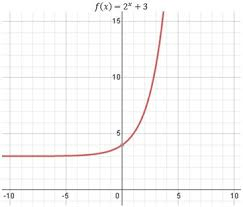
x -> -oo, y -> 3
x -> +oo, y -> +oo
200
Consider the function: f(x) = 3(x+2) - 8.
What is the parent function? Describe all transformations the function has undergone from the parent function.
Parent function: f(x) = 3x
Transformations:
Horizontal translation: 2 units left
Vertical translation: 8 units down
200
Evaluate the logarithms below:
a) log2(64)
b) log5(125)
a) 6
b) 3
200
What do you call of 5 value in the logarithmic equation?
y = log5 x
Base
200
How many times b more than a if
log a = 2 and log b = 4?
100
If log a = 2, then a=100
If log b = 4, then b=10000
b/a=10000/100=100
300
Does this exponential function model GROWTH or DECAY?
y=0.75(7/6)^x+3
GROWTH
The common ratio (r) in this equation is greater than 1 which indicated decay (the outputs are getting bigger by a factor of 7/6 for every increase of 1 in the input.
300
Identify the TRANSFORMATIONS applied to f(x) in order to create g(x). Be specific.
f(x) = 4x
g(x) = -2(4)x-3 - 5
HORIZONTAL SHIFT (TRANSLATION): 3 units right
VERTICAL SHIFT (TRANSLATION): down 5 units
REFLECTED over the x-axis
VERTICAL STRETCH by a factor of 2
300
Write the logarithm in EXPONENTIAL form.
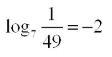
7^-2=1/49
300
What can you say about the graphs of exponential and logarithmic functions? Be specific.
Since exponential and logarithmic functions are inverse functions, their graphs are symmetrical along the line y=x.
300
Solve for x:
log3 x = -4
x = 1/81
Solution:
3-4 = (1/3)4 = 1/81
400
Write the exponential equation for the table below.
f(x) = 5(3)x
400
The blue graph is of f(x)=2x. Find the equation of the green graph g(x) which has been transformed.
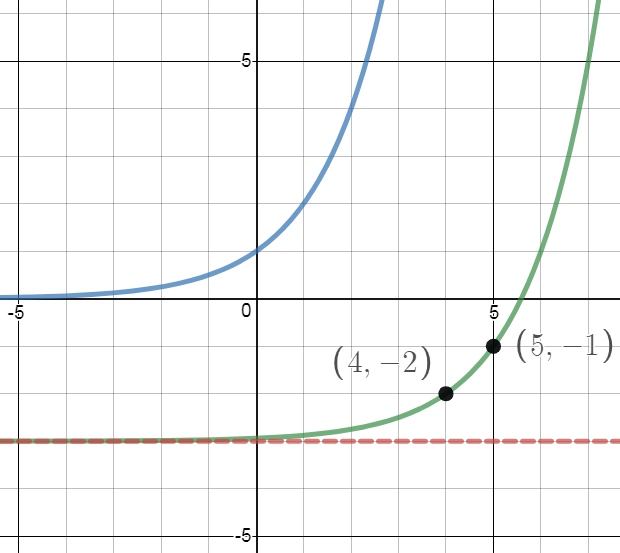
g(x)=2^((x-4))-3
400
Estimate the value of log3 (90) WITHOUT a calculator.
xapprox4.1
Since 34=81 and 35=243, we can see x must be between 4 and 5. Since 90 is much closer to 81 than 243, we can estimate the value to be slightly over 4.
400
Convert to exponential form: log3 81 = 4
34 = 81
400
Solve for x:
log4 (-16) = x
undefined
The domain of the logarithmic function is any positive number.
500
Write the equation of the exponential graph.
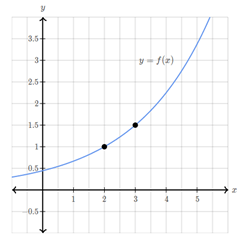
y=0.5(1.5)^x
500
Graph the function:
f(x)=2(x-3) + 2.

500
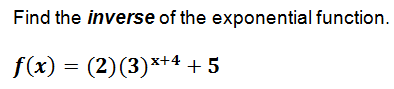
y=log_3((x-5)/2)-4
The inverse of an exponential function is a logarithm. So rewrite the original function in logarithmic form by switching x and y and then isolating y.
500
Convert this to logarithmic form: 45=1024
log4 1024 = 5
500
Convert 5 to a log statement if the base is 6.
5 = log6 7776