FUN ctions
Much Ado about Graphs
Zip, Zero, Zelch
Logging for matrices and inverses
This and That
200
If f(x) = x3+1 and g(x)=4-x, find (g+f)(3)
29
200
Determine the transformations of
y=sqrt(x-2) +1
Right 2, up one
200
List all possible rational zeros of
10x^3+17x^2-3
+-(1,3,frac(1)(2),frac(1)(5),frac(1)(10),frac(3)(2),frac(3)(5),frac(3)(10))
200
Expand the logarithm
ln frac(x^3sqrty)(z^4)
3lnx+frac(1)(2)lny-4lnz
200
Solve
(x-5)(x+2)^2>0
(5,oo)
400
Find g(f(x)) and its domain for
f(x)=5x-1, g(x)=x^2-9
25x^2-10x-8, D:(-oo,oo)
400
A graph shows y=x2 shifted right 4 units and reflected across the x-axis. Write the equation.
y=-(x-4)^2
400
List all potential rational zeros for
6x^4-11x+15
+-(1,3,5,15,frac(1)(2),frac(3)(2),frac(5)(2),frac(15)(2),frac(1)(3),frac(5)(3),frac(1)(6),frac(5)(6))
400
Solve
3^(2x-4)=9^(3x+1)
x=frac(-3)(2)
400
Compute and simplify the difference quotient for
f(x)=2x^2-5x+1
4x+2h-5
600
f(x)=(x+1)/(x-5)
evaluate f(-3) and give the domain of f(x) in interval notation.
f(-3)= frac(1)(4)
D:(-oo, 5)U(5,oo)
600
Graph f(x) and its parent function using transformations.
f(x)=-(x+3)^2+4
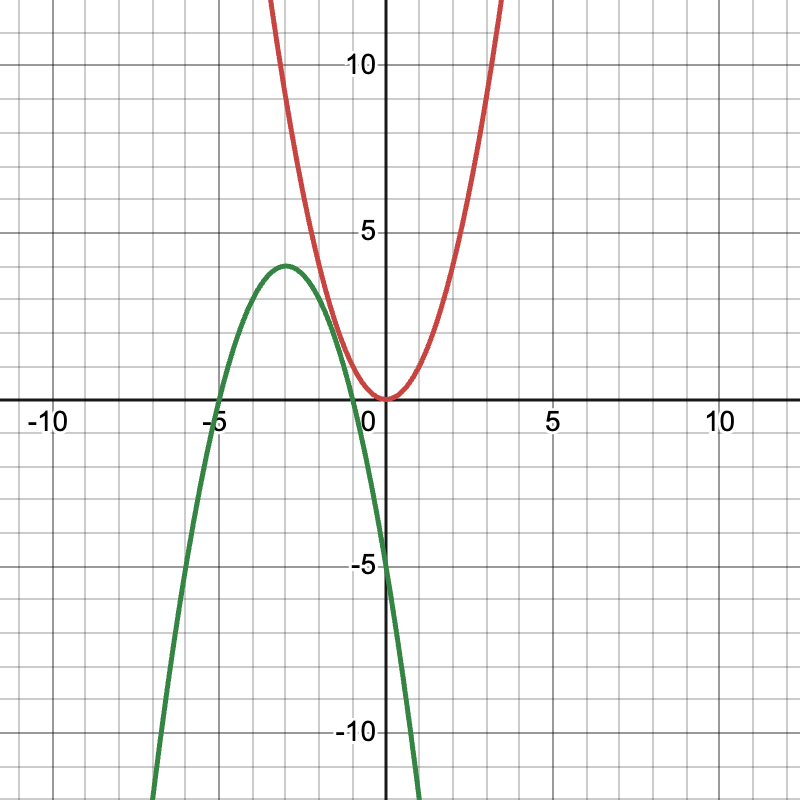
600
Find all zeros for
x^3-7x+6
x=-3,1,2
600
Solve the system and answer in reduced fractions:
3x-2y=7
4x+y=5
x=frac(17)(11), y=frac(-13)(11)
600
Find the vertex and the axis of symmetry for
f(x)=3x^2-12x+9
(2, -3), x=2
800
Let
f(x)=1/(x+6), g(x)= sqrt(2x-1)
Find f o g (x) and the domain.
frac(1)(sqrt(2x-1)+6)
D: (frac(1)(2), frac(37)(2))U (frac(37)(2), oo)
800
A graph shows that a function y is stretched vertically by a factor of 3 and shifted up 5. Write the equation when
y=sqrtx
y=3sqrtx+5
800
List all possible zeros of f(x) and then factor completely.
f(x)=2x^3-3x^2-11x+6
+-(1,2,3,6,frac(1)(2),frac(3)(2))
(x-3)(2x-1)(x+2)
800
Find the inverse of
f(x)=frac(3x-1)(x+4)
f^-1=frac(-4x-1)(x-3)
800
Analyze R(x). Where is it positive? Give solution(s) in interval notation.
R(x)=frac(x^2-16)(x^2+5x+4)
(-oo,-1)U(4,oo)
1000
Find f o g (x) and the domain for:
f(x)=sqrt(x+4), g(x) = frac(3x)(x-2)
fog(x)=sqrt(frac(7x-8)(x-2)
D:[frac(8)(7),2)U(2,oo)
1000
A parabola has a vertex (2, -3) and passes through (4,5). Write the quadratic in vertex form.
y=2(x-2)^2-3
1000
List the zeros, multiplicity and the graph effect/behavior for
f(x)=(x+3)^4(x^2+1)^2(x-6)
Zero: -3, Multiplicity: 4, Effect: Bounce
Zero: 6, Multiplicity: 1, Effect: Cross
1000
Solve
3^(2x)+3^x-30=0
x=frac(ln5)(ln3)approx1.4649
1000
Find the hole(s), vertical asymptote, horizontal asymptote, x and y intercepts of
R(x)=frac((x-1)(x+4))((x-1)(x-3))
Hole @ x=1, VA: x=3, HA: y=1,
x-int: (-4,0), y-int:
(0,frac(-4)(3))